





 Portuguese
  English
  Spanish
  3 min of reading
  1 comment


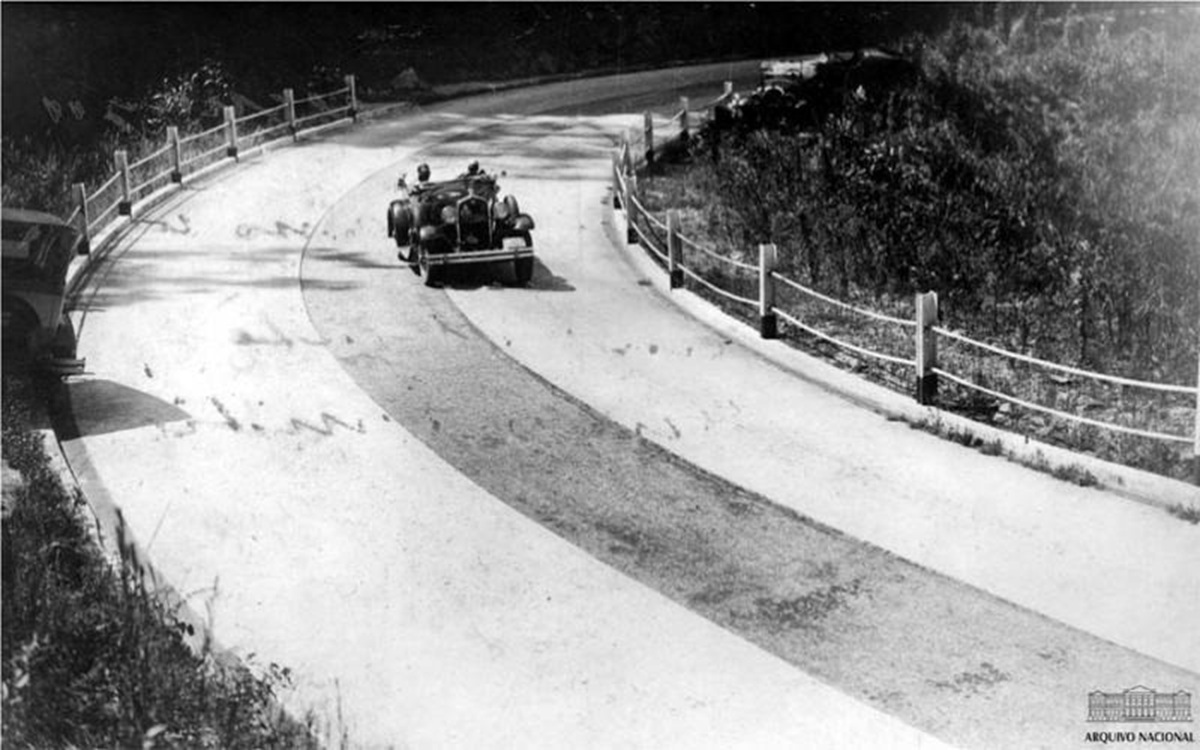


In 1928, Brazil took a bold step toward modernization. The connection between Rio de Janeiro and Petrópolis went from a precarious path to becoming the first paved highway in the country. The Rio–Petrópolis road was a landmark not just of engineering, but of political vision.
Inaugurated with great fanfare on August 25, 1928, the Rio–Petrópolis road marked a turning point in Brazil’s infrastructure. It was the first paved highway in the country and a showcase of the ambition of then-president Washington Luís, whose famous phrase — “To Govern is to Open Roads” — took on a literal form in the new connection between the then federal capital and the imperial city.
Until then, the route between Rio de Janeiro and Petrópolis was made along dirt paths, subject to erosion, landslides, and constant flooding, especially after rains.
The new highway, planned and built to overcome the challenges of the Serra do Mar, radically transformed this scenario.
-
A scientist proved with a thermal camera that the fan does not cool the environment but reduces the temperature of your skin by up to 6 degrees thanks to a natural mechanism of the human body that almost no one understands how it really works.

-
Scientists find a new explanation for the origin of Earth, which may have formed solely from material close to the Sun, changing an old theory and indicating that Jupiter may have been the cause of it all.

-
Brazilian beaches are among the most contaminated in the world by cigarette butts, with levels up to 40 times above the global average and areas where this waste already represents the majority of all the trash found.

-
2,000-Year-Old Machine Gun: Roman weapon found in Pompeii fires arrows at 109 m/s with an automatic gear mechanism, leaving perfect geometric patterns on the walls and proving its real use in the siege of 89 B.C.
With lanes 8 meters wide in the Baixada Fluminense and 6.5 meters in the mountains, the road had a speed limit of 60 km/h — an achievement for the time.
An Impressive Work
The construction of the road was a technical audacity by early 20th-century standards. The mountain section included tunnels carved into rock over a hundred meters high and winding curves on steep slopes.
Even with few vehicles circulating in Brazil — the Federal District had about 20,000 at the time — the demand for a safe and functional route justified the project.
The day after the inauguration, 1,783 vehicles passed through the new road. A number that impressed both the government and the public, becoming a symbol of progress.
The then-president Washington Luís, who had taken power in 1926, made the road one of the hallmarks of his administration, the last of the so-called Old Republic.
Modernization and Changes
In 1931, the government began replacing asphalt with concrete over the mountain section, which is about 22 km long. This project included the construction of three challenging viaducts, spanning deep ravines — landmarks of national engineering.
The entire construction became a reference for infrastructure in the country and a symbol of modernization.
In the following decades, the Rio–Petrópolis underwent structural changes. In the 1950s, the Petrópolis Bypass was built, connecting Itaipava to Xerém.
The original road then began to operate as an uphill lane, while the new route served as a downhill lane. This division remains today.
Concession and New Phase
In 1996, the highway was granted to the private sector. The Concer (Concession Company of the Juiz de Fora–Rio Highway) began to manage the stretch between Rio and Juiz de Fora, including the historical segment between Rio and Petrópolis. The privatization aimed at improving the roadway, increasing safety, and ensuring ongoing maintenance.
However, the mountain section remained a challenge. Tight curves, dense fog, and narrow lanes generated risks and accidents.
In 2013, construction began on a new uphill route, featuring modern tunnels and viaducts.
The goal was to make the trip faster and safer, but the works were marked by delays and questions about the management of the concession.
Today, about 7,000 vehicles circulate daily through the stretch managed by Concer. The official name of the segment between Rio and Petrópolis is Washington Luís Highway, in honor of the president who envisioned the project.
Part of BR-040, the road connects Rio de Janeiro to Belo Horizonte and continues to Brasília, establishing itself as a strategic national route.
A Legacy That Resists
More than 90 years after its inauguration, the Rio–Petrópolis remains alive in the country’s memory.
The road that symbolized the beginning of the Brazilian highway era also became a witness to Brazil’s political, economic, and social transformations.
From a symbol of progress awaiting modernization, it continues to connect not just cities, but also distinct chapters of national history.
The road remains a concrete reminder that, for many governors, progress begins on asphalt. And that sometimes, a highway can carry much more than cars — it transports ideas, hopes, and the very notion of development.








Essa rodovia conta a história da minha família. Deus abençoe as gerações das famílias que viveram, vivem e viverão ao longo dessa rodovia.