





 Portuguese
  English
  Spanish
  5 min of reading
  6 comments


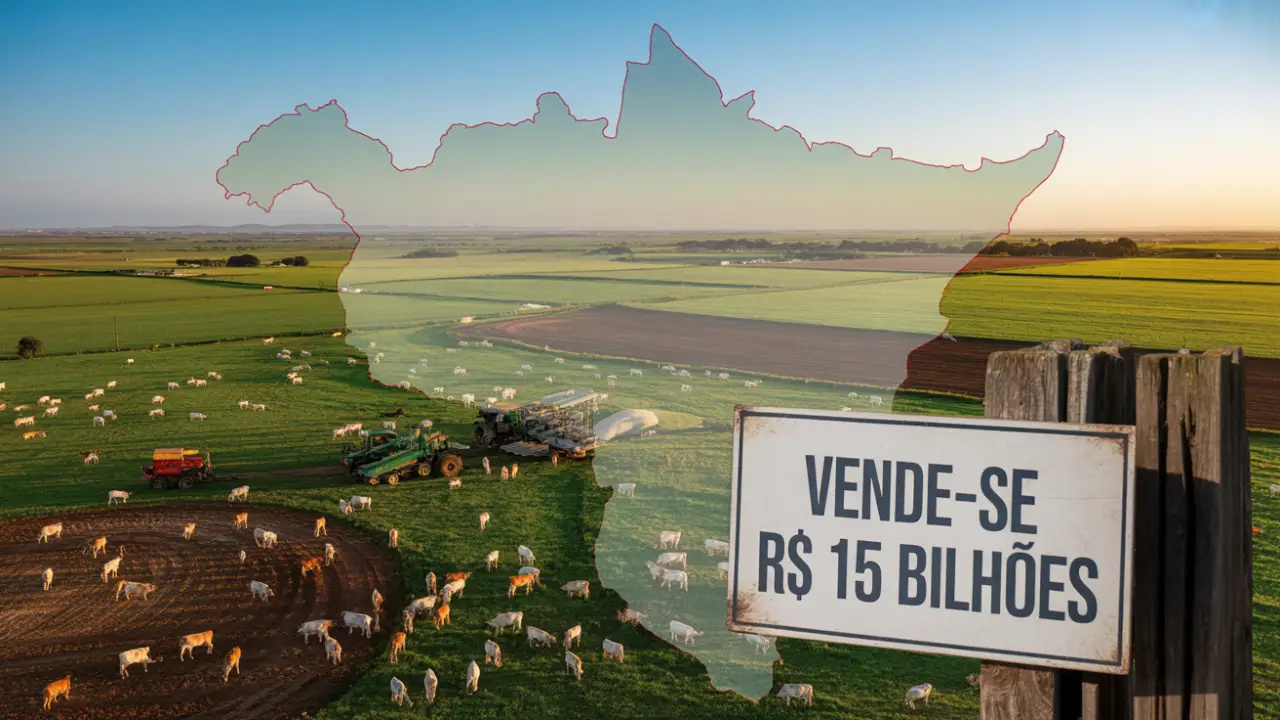


Brazilian Farm Worth R$ 15 Billion: The 90 Thousand Hectare Giant Surpasses Stock Market Companies and Makes History as the Most Expensive in Brazil
Can you imagine a Brazilian farm almost the size of urban Rio de Janeiro, worth more than entire companies on the stock market? Well, this is exactly what is happening in the heart of the national agribusiness. Located in Sinop (MT), a rural property of 90 thousand hectares has been put up for sale for an incredible R$ 15 billion, establishing itself as the most expensive farm in Brazil. But what lies behind this astronomical figure? And why are so many people keeping an eye on Brazilian lands?
Lands in Brazil: Impressive Appreciation and Investor Interest
The land market in Brazil has shown breathtaking appreciation. In the last five years, the average price of agricultural land has skyrocketed by more than 110%, according to a survey by Globo Rural. And this growth is not happening by chance. The global rise in commodities, the relentless search for productive areas, and the appetite of large funds for real assets have placed Brazil at the top of the list for those looking to profit from agribusiness.
Just in 2024, land transactions have generated billion-dollar figures. But, curiously, experts point out that there was more speculation than actual sales. “There was a lot of land supply, a lot of speculation, however, a lower volume of deals compared to 2023,” stated Geórgia Oliveira, CEO of Chaozão, a platform that monitors the sector and organized the survey in partnership with several real estate agencies. According to her, most closed transactions involved smaller properties, with average values of up to R$ 30 million.
-
Mothers and daughters come together, create an ‘express’ beauty salon and turn the idea into a network with 21 units, revenue of R$ 16.7 million and 12,000 subscribers.

-
End of the 6×1 schedule: how the reduction of hours can affect service companies, industry, and agribusiness.

-
Brazil Ignores Trump’s threats to BRICS, Buys 42 tons of gold and reduces the Dollar’s share by 6.45% in international reserves.

-
Havan buys historic football land in Blumenau for a million-dollar amount protected by a confidentiality clause and is already planning to change even the layout of streets to build a megastore in half-timbered style costing 80 million reais.

The Giant of Sinop: 90 Thousand Hectares of Productive Potential
The property that tops the national ranking has a total area of 90 thousand hectares, equivalent to the size of urban Rio de Janeiro and of dual aptitude, meaning it can be used for both crops and cattle ranching. This partly explains the price of R$ 167 thousand per hectare. But what really matters is the location: Sinop is one of the fastest-growing cities in Mato Grosso, the state that leads national grain and beef production.
The region stands out not only for its productivity, but also for its established infrastructure and ease of production flow, factors that make all the difference when evaluating a rural property. According to Conab, Mato Grosso is expected to harvest more than 100 million tons of grain in the 2024/25 crop, maintaining its lead in the national ranking.
São Paulo Leads in Value Per Hectare
Although Sinop holds the title of the most expensive farm in Brazil in absolute value, the leader in terms of highest price per hectare is a farm located in Franca (SP). Valued at R$ 2.75 billion, the property has “only” 5,040 hectares, but with a value of R$ 545 thousand per hectare. This shows how factors such as proximity to urban centers, availability of water, and logistics can weigh more than land area.
This type of evaluation highlights a curious behavior in the land market: while large producers seek extensive areas in regions such as the Midwest, institutional investors or those with high purchasing power often prefer smaller properties that are extremely well-located and have high profitability per square meter.
Ranking of the Most Expensive Farms in the Country
The survey by Chaozão revealed that Mato Grosso holds half of the ten most expensive farms in the country in 2024. The list is completed with properties in Mato Grosso do Sul (2), Tocantins (1), Pará (1), and São Paulo (1). This distribution highlights the importance of the Midwest as a strategic hub of the Brazilian agricultural market – especially in soybean, corn cultivation, and cattle ranching.
Another highlight of the year was the appreciation of lands owned by SLC Agrícola, one of the largest companies in the sector. According to financial data from the company itself, its lands surpassed R$ 11.6 billion in asset value in 2024, a direct reflection of the confidence the market has in the growth potential of Brazilian agribusiness.
Challenges of the Market and Future Prospects
Even with such impressive numbers, the sector is going through a phase of transition. The accelerated appreciation in recent years has begun to show signs of cooling off, at least in terms of pace. The market itself has become more cautious, with investors paying closer attention to the economic scenario and political instabilities.
The statement from the CEO of Chaozão helps to understand this moment: “Transactions above R$ 30 million have been fewer. Many people put land up for sale, but the investor is more selective, waiting for the right moment to enter.”
Despite the adjustments and the decrease in the volume of large transactions, the land market in Brazil remains solid as one of the most dynamic in the world. And the data does not lie: the country continues to be one of the best bets for those seeking secure returns in the long term.
Agriculture Does Not Stop and Land Remains Gold
If there is one certainty amidst the uncertainties of the global market, it is that Brazilian agribusiness still has much growth potential. Properties like the billion-dollar farm in Sinop are just the tip of the iceberg of a sector that moves billions, feeds the world, and continues attracting investors from all over the globe.
And what do you think about this ever-growing market? Do you believe it is worth investing in lands in Brazil? Have you thought about buying a farm or do you think this is a game only for giants? Leave your comment below and share this article with those interested in the agribusiness world!





Desde ja obrigado pela matéria…
Tenho 5 hectares de terra em Guapimirim-RJ com uma grande vegetação nativa e duas nascentes. Interessados podem entrar em contato pelo tel./Zap 05521999642752
Quem compra terra nao era , mesmo que demore anos , mas a valorização vai chegar , sempre a perca é de quem vende , quem investe em terras so tem a ganhar, investimento garantido , mesmo sendo a longo prazo.
O que dizem os grileiros paulistas e gaúchos qu se apossaram de muitas terras públicas nesses estados do oeste brasileiro, sem nunca terem sido incomodados pelo poder público. Né seu Hilário?