





 Portuguese
  English
  Spanish
  8 min of reading
  3 comments


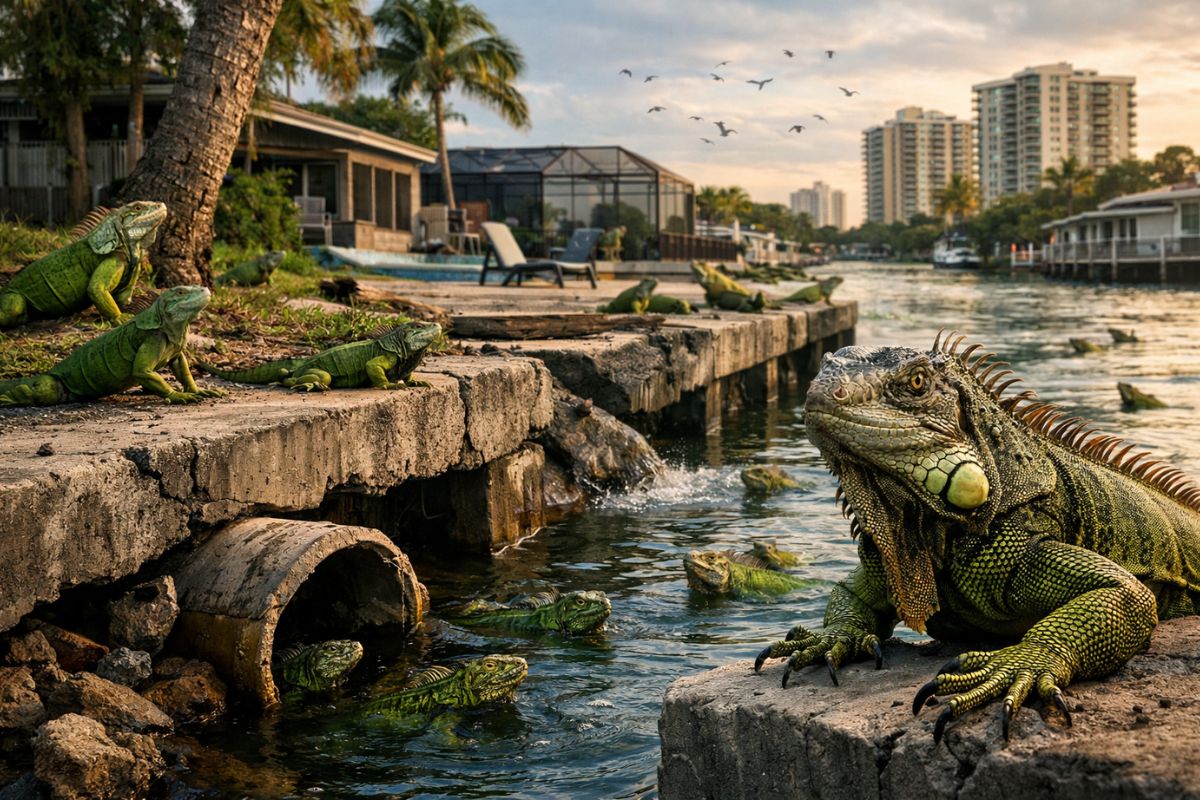


In Florida, the Green Iguana Became a Pest After Decades of Released Exotic Pets and Escapes During Hurricanes. It Swims, Climbs, and Digs Burrows That Erode Slopes, Sidewalks, and Canal Banks. The State Allows Hunting All Year Round, Creates Ownership Rules, and Tries to Contain Populations Already Spread Throughout Entire Cities.
In Florida, the green iguana has transformed from being just a striking, brightly colored reptile with generally non-aggressive behavior to a gigantic urban and environmental problem, with millions scattered across neighborhoods, canals, and public areas, requiring more than US$ 1 million in control, capture, and eradication efforts.
What makes the crisis even tougher is that the war began late. Florida coexists with an animal that adapts to urban environments, uses the network of artificial canals as a dispersal corridor, finds shelter in storm drains and debris, and when the population explodes, transforms gardens, walls, sidewalks, and canal banks into vulnerable spots due to burrows and erosion.
The Reptile That Got Out of Control and Why Florida Became the Stage for This War

The green iguana is a large lizard, usually green, but can also appear in brown or almost black shades. During certain times of the year, some adults may turn orange or pink.
-
Something is happening around the Earth: Inside the huge explosion of fireballs in 2026

-
A hot air bubble coming from Argentina expands over Brazil, causing thermometers to exceed 38 degrees with a thermal sensation of 40 degrees in late March, affecting 6 states at once.
-
The radish leaf that almost everyone throws away has more polyphenols, flavonoids, and fiber than the consumed root, and a 2025 study showed that the leaf contains compounds that protect the intestine, combat inflammation, and may inhibit the growth of cancer cells.

-
A planet that seemed to defy the laws of physics has intrigued scientists for decades, until the James Webb revealed what is really affecting Saturn’s rotation.

It has spines along its neck, back, and upper tail, as well as black rings on its tail, traits that make the animal recognizable even from a distance.
Despite its appearance as an “exotic display animal,” the green iguana is not native to Florida. Its natural distribution area extends from Central America to tropical regions of South America, as well as some eastern Caribbean islands.
When removed from this context and placed in a state with a favorable climate and urban structure, the result can be explosive.
In Florida, the green iguana is not restricted to one type of environment. It can live on the ground, in bushes, and in trees, occupying suburban, urban, small town, and agricultural areas, always exploring whatever is available.
In deforested habitats, such as canal banks and vacant lots, it settles in burrows, storm drains, drainage pipes, and piles of rocks or debris, creating a map of hiding spots that makes removal a constant challenge.
How the Invasion Began and Why Florida Took So Long to React

In Florida, the first records of green iguanas date back to the 1960s, in Hialeah, Coral Gables, and Key Biscayne, along the southeast coast of Miami-Dade County.
This localized beginning created the false impression that these were isolated and controllable appearances.
Over time, the problem expanded along the Atlantic coast and the Gulf of Mexico. Today, populations stretch along the Atlantic coast in Broward, Martin, Miami-Dade, Monroe, and Palm Beach counties, and along the Gulf of Mexico in Collier and Lee counties.
There are reports further north, but these cases are generally attributed to animals that escaped or were released and are unlikely to establish lasting populations because cold weather limits the species.
Nonetheless, the area where the iguana has truly established itself is already large enough to create a permanent pressure on cities and public areas in Florida, especially where human density and the network of artificial canals increase the animal’s circulation.
Inside the Animal: Size, Strength, Behavior, and Advantage in the City

The green iguana grows much larger than many people imagine when they see it young. Males can exceed 1.5 meters in length and weigh up to 7.7 kg.
Females can also reach 1.5 meters but usually do not exceed 3.2 kg. In the wild, they can live up to 10 years, while in captivity, this time can extend to 19 years.
Adult males develop jowls and a much larger dewlap than females. This dewlap can make them appear larger, repel rivals, and even send signals to predators.
It also helps regulate body temperature, an important detail for a reptile that alternates between shade, sun, water, and open areas.
The green iguana also has an advantage that weighs heavily in Florida. It is an excellent swimmer, tolerates both fresh and salt water, and can remain submerged for up to four hours at a time.
In a state with so many canals, banks, and drainage systems, this becomes a perfect tool for movement.
Diet: Why Florida Feels the Impact on Gardens and Natural Areas
Green iguanas feed on a wide variety of vegetation, including buds, leaves, flowers, and fruits.
They attack plants in urban and residential environments, eating ornamental vegetation and damaging landscaping and gardens.
There is a broad list of plants cited as part of their diet, such as cowpeas, firebush, jasmine, orchids, roses, Washington palmettos, hibiscus, vegetables, pumpkins, and melons.
The tendency to eat ornamental plants makes the iguana a backyard pest, with accumulating and recurring damages.
Although they are primarily herbivores, adults may also feed on bird eggs and deceased animals, while younger ones may eat vegetation, insects, and snails.
This behavior increases the risk of indirect environmental impacts, especially when the population is already widespread.
The Canal Network in Florida as a Dispersal Corridor
One of the most decisive points for the expansion in Florida is the infrastructure. The extensive artificial canals in the southern part of the state serve as ideal dispersal corridors, allowing iguanas to colonize new areas.
This changes the logic of control, as the problem does not remain isolated in one spot: it “walks” and “swims” easily into neighboring neighborhoods.
In areas where vegetation has been removed or the soil is exposed, the iguana finds perfect places to dig and create shelter, reinforcing the cycle of permanence.
The more canals, slopes, and banks there are, the more opportunities arise for the animal to establish itself.
Urban Impacts: Erosion, Damaged Sidewalks, and Threatened Walls
The impacts in Florida are not just aesthetic. Green iguanas cause damage to vegetation in residential and commercial areas and are often treated as pests by property owners.
But there is a second problem that is even more costly: infrastructure.
By digging burrows, iguanas can cause erosion and destroy sidewalks, foundations, retaining walls, slopes, and canal banks.
In a state with many neighborhoods built beside water and drainage, any repeated erosion becomes a cumulative risk.
Furthermore, iguanas leave droppings on docks, moored boats, walls, porches, decks, pool platforms, and inside pools, adding wear and cleaning costs in residential and public spaces.
Environmental Impacts: Threat to Native Species and Effects in Protected Areas
In Florida, the impact also reaches native fauna and flora. Researchers have found remnants of tree snails in the stomachs of green iguanas in Bill Baggs Cape Florida State Park, suggesting they could pose a threat to native and even endangered tree snail species.
In Bahia Honda State Park, green iguanas have consumed cowpeas, which are host plants for the Miami Blue Butterfly, an endangered species.
In other words, the iguana is not just an urban nuisance: it can directly interfere in sensitive ecological cycles in protected areas.
Health Risk: Why Florida Treats This as a Health Issue Too
As with other reptiles, the green iguana can transmit the infectious bacteria Salmonella to humans, especially through contact with water or surfaces contaminated by feces.
In a scenario with pools, decks, porches, and recreational areas affected, this risk becomes part of everyday life, not a distant alert.
This point emphasizes why control in Florida revolves not only around “landscaping” or “nuisance,” but an array of risks involving the environment, infrastructure, and health.
What Florida Allows: Rules for Hunting, Public Areas, and Prohibition on Relocation

In Florida, green iguanas are not a protected species, except under laws against animal cruelty. This means they can be humanely killed on private property with the owner’s permission.
In public areas, capturing or killing iguanas is allowed year-round without a license in 32 public areas in southern Florida.
There is also mention that this has been in effect since April 29, 2021, reinforcing that the state formalized its response when the problem was already widespread.
A crucial detail is that captured iguanas cannot be relocated and released in other areas of Florida.
This prohibition exists because releasing in another region does not solve the problem; it merely displaces the invasion.
Practical Recommended Measures in Florida to Reduce Visits and Prevent Burrows
Florida advises homeowners to take direct action on making the environment less attractive.
Among the cited measures are removing plants that act as attractants, filling holes to discourage digging, and installing deterrents.
Examples include wind chimes and intermittent noise objects, CDs with reflective surfaces, and spraying water on the animals as a form of deterrence.
The goal is to reduce the comfort and routine of the animal in the area, breaking the pattern of return.
However, these measures depend on consistency.
When iguanas are already spread throughout entire neighborhoods, Florida faces a scenario of continuous maintenance because external pressures never stop.
When the Pet Becomes a Problem: License, Delivery, and the Attempt to Contain New Releases
The release and escape of pets continue to be one of the main sources of introduced species in Florida, and introducing non-native species into the state is illegal. Therefore, Florida has also adjusted rules to prevent the cycle from repeating.
There is a requirement for a license to keep green iguanas as pets acquired before the new rule, as personal pets. And, to reduce releases due to abandonment, there is the Exotic Animal Amnesty Program, which allows for the surrender of animals without penalties, regardless of whether they have been kept legally or not.
The surrendered animals are adopted by new qualified owners who possess the necessary licenses.
In practice, this measure attempts to cut the root of the problem, reducing the chance of new iguanas being released into urban areas and reinforcing responsible ownership in Florida.
Why Florida’s War is Considered Late and Difficult to Win
Florida is waging a war against a popular and highly adaptable animal that lives in trees, canals, storm drains, and debris, consumes urban vegetation, and can grow large.
When actions become necessary, the population is already spread across several counties, making control a routine and not a quick solution.
The state has already spent more than US$ 1 million to hunt and reduce the presence of the invasive reptile, but the damages continue to emerge in the form of erosion, destruction of sidewalks, problems with retaining walls, feces in domestic areas, and impacts on parks and native species.
In Florida, the problem has become a package of environmental, urban, and health losses that feeds off the very delay in response.
In your opinion, should Florida further tighten the rules and expand control in public and residential areas, or has the state already passed the point where this invasive reptile can truly be contained?







We need them gone!! They are destroying our ponds retaining wall that is in our neighborhood drainage system in jupiter Fl.
Two of the animals are 5’-6’ w many smaller iguanas.
Also our neighbor insists on feeding the ducks, which bring the rats!!!!!!!! The rats are eating the coconuts, the iguanas are eating everything including the Washingtonian palms, hibiscus…..
We also have the Jesus Christ lizard, and night anole. Soon there won’t be any natural animals in the area.
My parents were born here, their parent came here 1907, 1912,and it’s not getting better.
Florida is a Trumpian hellscape
They sit and watch as invasive species destroy their ecosystem and still DO NOTHING to restrict the exotic pet trade
Vai resolver. É só o ESTADO pagar por individuos abatidos.