Portuguese
  Spanish


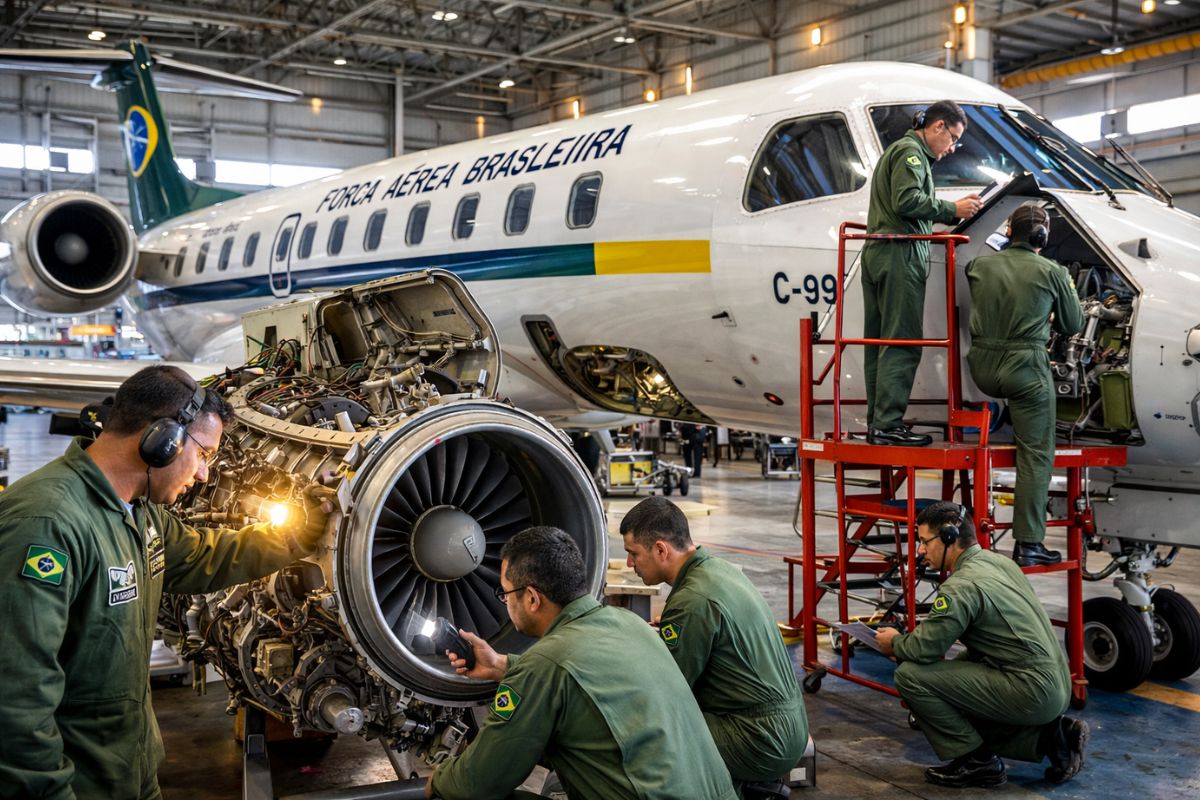

The Brazilian Air Force has just set a mark that has never been reached: for the first time in history, its own military conducted a high-complexity calendar inspection on the C-99 without any external technical support, and the result redefines what the country can do on its own.
The Brazilian Air Force has just proven that it no longer needs to ask for permission to take care of its own planes. At the Galeão Air Base in Rio de Janeiro, military maintainers completed for the first time a calendar inspection of 354 months on the C-99 jet, the military version of the renowned Embraer 145, without the presence of foreign technicians or contracts with international companies.
The procedure was carried out on the aircraft FAB 2523, under the coordination of the Galeão Aeronautical Material Park (PAMA-GL). For those who follow defense and aviation, the news carries weight that goes far beyond a completed work order. It means that the largest air force in Latin America has taken a concrete step to not depend on anyone when it comes to keeping its jets in the air.
What exactly is a 354-month inspection and why was it done by foreigners

image: FAB
The C-99 is a transport and aeromedical evacuation aircraft derived from the Embraer 145, a regional jet that flies worldwide. Like any aircraft, it follows a strict schedule of preventive maintenance.
-
She spent 73 years breathing inside an iron lung, survived the aftereffects of polio, and became the last woman in the United States dependent on the equipment before dying at 78 years old.

-
Brazilian students created a $1 filter using pine bark, cotton, and 3D-printed parts to clean cassava wastewater, reduce the toxicity of a hazardous waste, and transform contaminated water into biofertilizer.

-
Astronaut from Artemis II steps down after mission to the Moon and decision surprises after a record of 406,771 km, a historic 10-day journey, and an unprecedented achievement for Canada.

-
A fossil kept for years in a small museum in Montreal concealed 450-million-year-old soft tissue, a discovery that has only happened once before in history.


The 354-month inspection, known as 354MO, is one of the most complex in this schedule. It requires partial disassembly of systems, thorough structural checks, and tests that demand specific equipment and highly specialized technical knowledge.
Until now, inspections of this magnitude required external support. This meant hiring foreign companies, waiting for the availability of international technicians, and in many cases, sending the aircraft abroad.
Every day an aircraft is grounded is one less day of operational capacity. When dependence is external, the maintenance schedule ceases to be a sovereign decision and begins to depend on others’ agendas.
How the Brazilian Air Force built this capacity internally
The achievement did not happen overnight. The maintainers of the Logistics Group of the Galeão Air Base (GLOG-GL) underwent a continuous training process that involved absorbing technical knowledge, acquiring tools, and above all, persistent investment in specialized training.
Major Aviator Renan Pacheco Pereira, Commander of GLOG-GL, confirmed that the success of the mission is a direct result of this investment.
According to him, the milestone “reinforces the logistical autonomy of the Air Force, reduces external dependence, optimizes costs, and increases the availability of aircraft.” In practical terms, the Brazilian Air Force can now decide when and how to maintain its C-99s without consulting anyone outside the country.
The preparation also involved alignment with the “IMPROVE” guideline established by the Commander of the Aeronautics, Lieutenant-Brigadier of the Air Marcelo Kanitz Damasceno. This guideline directs the institution to seek modernization, efficiency, and strengthening of Brazilian aerospace power at all levels from tactical to operational.
What changes in practice for Brazilian defense
The immediate impact is threefold. First, cost reduction. Contracts with foreign companies for high-complexity inspections involve significant amounts, quoted in strong currency, subject to exchange rate fluctuations and profit margins of the external supplier.
Second, time and availability gains. With maintenance done in-house, the aircraft returns to operation faster. This is especially relevant for logistical transport and aeromedical evacuation missions, where operational readiness can mean the difference between lives saved or not.
Third, and perhaps most importantly, real operational sovereignty. In a crisis or conflict scenario, depending on a foreign company to keep aircraft flight-ready is a strategic vulnerability. From now on, the Brazilian Air Force has eliminated this fragility concerning the C-99.
The C-99 in the FAB fleet: an aircraft more important than it seems
The Embraer 145, in its military version C-99, is not the most glamorous aircraft in the Brazilian Air Force fleet. It does not carry bombs, does not perform interceptions, and does not appear in air demonstrations. But it is one of the most used aircraft in the daily operations of the FAB.
It transports personnel, performs aeromedical evacuations, and ensures logistical connections between bases spread across the continental territory of Brazil.
Keeping the C-99 operational is not a luxury; it is a basic necessity for the entire machinery of the Force to function.
An unavailable fleet due to backlog maintenance means canceled missions, logistical delays, and loss of response capacity. Internalizing the most complex inspection of this aircraft is, in practice, shielding the daily operation of the FAB against external bottlenecks.
A standard that can be repeated in other aircraft
The precedent set with the C-99 has the potential to be replicated. If the Brazilian Air Force has demonstrated the ability to absorb high-complexity inspections on an Embraer platform, the path is paved for the same to be done with other aircraft in the fleet.
Each internalization represents less dependence, more savings, and greater control over its own operational capacity.
It is a virtuous cycle: the more technical knowledge the institution absorbs, the better prepared it becomes for the next challenges. The trend is for this type of achievement to become institutional policy, not an exception.
Why you should pay attention to this news
In a country that frequently debates investment in defense, news like this often goes unnoticed. There are no explosions, no fighters in formation, nothing visually spectacular.
But the internalization of a 354-month inspection on the C-99, carried out entirely by Brazilian military personnel at the Galeão Air Base, is the kind of silent achievement that changes a country’s status.
The Brazilian Air Force has proven that it can take care of its own aircraft at the most demanding maintenance level. This is operational sovereignty in practice, not just in words.
With information from the FAB portal.
And you, do you think Brazil should accelerate the internalization of complex maintenance on other military aircraft? Leave your opinion in the comments; we want to know what you think about the future of the logistical autonomy of the FAB.