





 Portuguese
  English
  Spanish
  5 min of reading
  0 comments


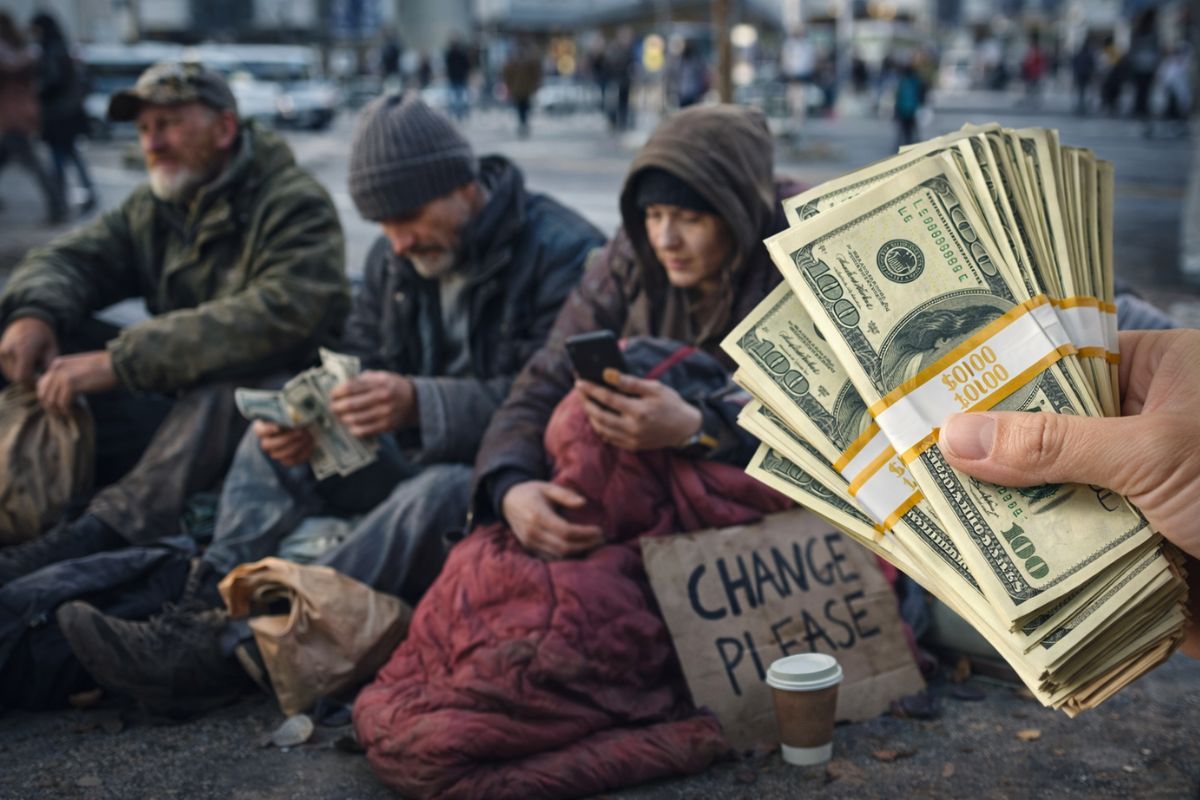
Researchers followed 103 homeless people in California for a whole year giving unconditional basic income and found that almost half gained housing but the same proportion of those who received nothing also managed and what really changed was something that goes beyond having or not a roof
What happens when you give money to homeless people and let them decide what to do with it? According to the portal the conversation, a team from the University of Southern California, in partnership with the NGO Miracle Messages, did exactly that: delivered $750 per month for a year to 103 homeless people in California, with no conditions on its use. The study, one of the first of its kind in the United States specifically involving homeless individuals, will be published in the scientific journal Social Work Research.
The researchers expected the answer to be simple: that the money would help homeless people secure permanent housing. But the result was more complicated and more revealing than anyone anticipated. Almost half of the participants who received the payments left homelessness over the year. That sounds good, until you find out that practically the same proportion of people who received nothing also found housing. The money made no difference at that point. But it made a difference in another way, and that’s where the story takes a turn.
What the study expected to find and why the researchers were optimistic
When the project started in 2022, there were reasons to believe that direct cash would solve the problem. A similar experiment in Canada demonstrated that a one-time payment of 7,500 Canadian dollars is impossible in 99 days, the time participants spent homeless.
-
Meteorologists warn of a storm with heavy rain and winds of up to 110 km per hour in the North of the continent, leaving thousands without power, causing flooding, and serving as a warning for Brazil after an increase in extreme weather events.

-
Kakebo, a Japanese technique created in 1904, teaches how to save money through simple notes and monthly tracking.
-
More than 500 Bronze Age objects, including pieces never seen in Western Europe, have emerged from a treasure buried 3,000 years ago in Scotland, intriguing archaeologists.

-
Luxurious mansion in Rio valued at up to R$ 40 million has already impressed international celebrities and belongs to a well-known Globo presenter.


Miracle Messages itself had already conducted a smaller pilot with nine homeless individuals, of whom six secured permanent housing after receiving $500 monthly for six months.
But the team knew that results from small samples can be misleading; people might have found housing anyway.
There was another crucial difference: the United States has a more fragile social safety net than Canada, which means that American homeless people face a structurally more difficult scenario. Still, expectations were optimistic.
The study was designed with a control group of homeless individuals who did not receive the payments to accurately measure the real impact of the money.
The result that no one expected about homeless people
After a year of monthly payments, the numbers told a story different from what the researchers imagined.
Almost half of the homeless individuals who received the $750 monthly left homelessness, but practically the same proportion of those who received nothing also secured housing. In statistical terms, the money did not change the rate of participants who exited the streets.
This reveals something that many people do not know: for most Americans, homelessness — while devastating — is often temporary. Most people living on the streets are trying to find a place to live. They move around, seek opportunities, and over time, many find some form of housing.
The extra money did not accelerate this process. In light of this result, the researchers asked another question: if the $750 per month did not change the housing situation of homeless people, what exactly did it change?
Not what homeless people really spent the money on
Critics of basic income programs often argue that homeless people spend free money on alcohol, drugs, and other “temptation” goods.
The study showed the opposite: the vast majority of participants used the money for basic needs — food, transportation, health, and housing expenses. Spending on alcohol, cigarettes, and illegal drugs accounted for only 5% of the total amount.
But the cold numbers do not tell the whole story. The money allowed homeless people to make decisions that, for those with homes, seem trivial but for those living on the street are impossible. One participant used the money to keep his car running, which served both as transportation to work and as temporary housing.
Another bought birthday and Christmas gifts for his parents. Another made a donation to a charity because it gave him a sense of contribution. Another paid off a credit card debt that was a constant source of stress.
None of these expenses show up in a statistic about housing, but each of them changed the experience of being homeless.
Why $750 is not enough to get homeless people off the streets
The explanation for the result is more structural than individual. As of February 2026, the average rent for a one-bedroom apartment in the United States was about $1,500 — double the amount that homeless people received in the study.
In other words, the $750 monthly simply did not cover the cost of rent in virtually any housing market in the country.
Housing does not just depend on having money in your pocket. It requires that there is a unit available and affordable, and in the U.S., especially in California, the shortage of affordable housing is chronic.
Programs directly linked to housing, such as rental vouchers or specific subsidies, tend to have a more immediate effect on the situation of homeless people because they tackle the problem at the right point: access to housing. Basic income, as dignified as it may be, hits a limit when the amount does not cover the real cost of living.
What researchers recommend based on results with homeless people
The researcher who led the study, director of the Institute for Policy Research on Homelessness at the University of Southern California, came to a straightforward conclusion. For basic income to work as a tool against homelessness, payments need to be larger, last longer, or both. The monthly amount should be closer to covering the real cost of rent in the area where homeless people live.
The study also dismantled a persistent prejudice. Homeless people who received money unconditionally did not “waste” the resources; they used them to survive with more dignity, reduce financial stress, and meet needs that no traditional welfare program covers.
The researchers found no evidence that the money caused any harm. What the study shows is that the issue of homelessness in the United States is less about individual behavior and more about a housing market that does not offer affordable options, and solving this requires interventions on the scale of the problem.
What do you think: is giving direct money to homeless people good public policy, or should the focus be on housing programs? Leave your opinion in the comments.










Seja o primeiro a reagir!