





 Portuguese
  English
  Spanish
  4 min of reading
  0 comments


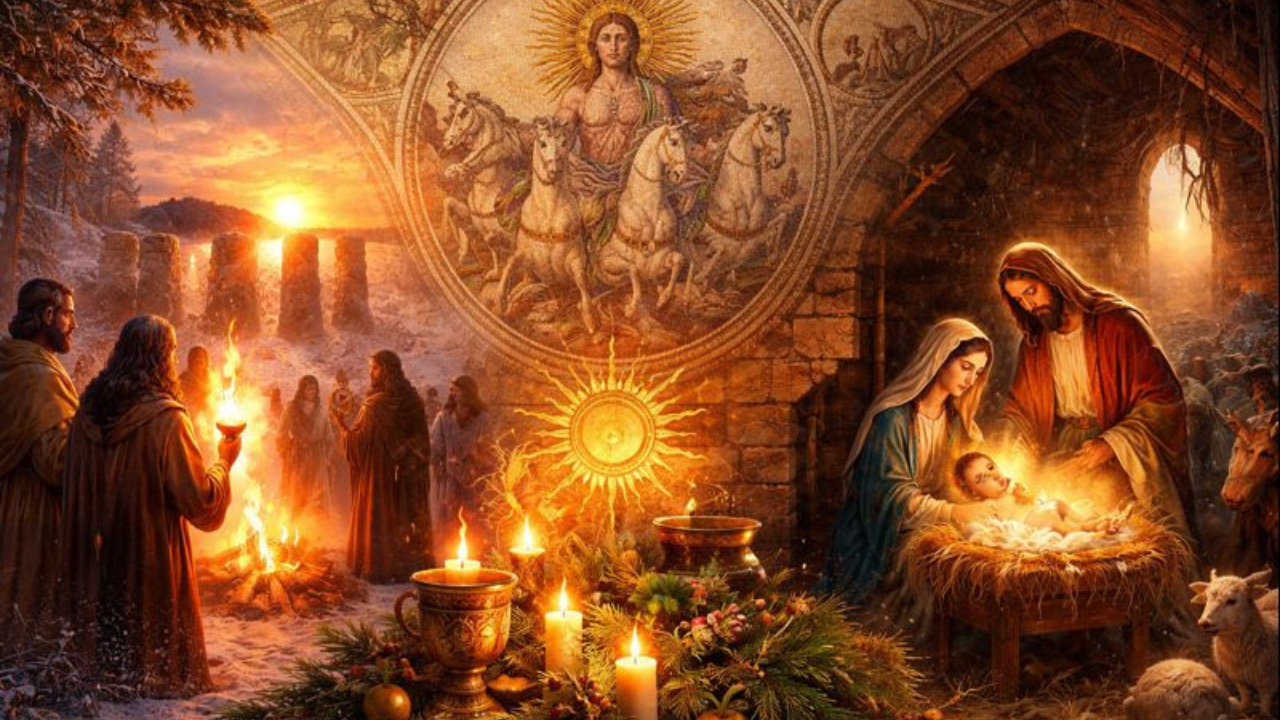
Discover The Origin Of Christmas And The Relationship Between The Birth Of Jesus, The Winter Solstice, And The Cult Of Sol Invictus.
The origin of Christmas goes far beyond the birth of Jesus, traditionally celebrated on December 25th.
The date encompasses religious, natural, and cultural elements that span millennia.
What is today one of the most popular festivals in the world was born from the combination of ancient celebrations of the winter solstice, pagan rituals of the Roman Empire, and the consolidation of Christianity as the official religion.
-
While restoring a historic mansion from 1910, a brick structure with an old turbine that generated energy from the Rio do Testo emerged, along with a hidden door and a rare floor concealed under layers of wax.

-
Italian researchers have detected what appears to be a second Sphinx buried under the sands of Egypt, and satellite scans reveal a gigantic underground megastructure hidden beneath the Giza Plateau for over 3,000 years.

-
There are 4,223 drums and 1,343 metal boxes concreted with 50-centimeter walls that store the radioactive waste from Cesium-137 in the worst radiological accident in Brazil, just 23 kilometers from Goiânia, with environmental monitoring every three months.

-
Giant Roman treasure found at the bottom of Lake Neuchâtel in Switzerland reveals an advanced trade system, circulation of goods, and armed escort in the Roman Empire about two thousand years ago.


Thus, understanding this trajectory helps explain why Christmas carries so many distinct meanings to this day.
The Origin Of Christmas Before Christianity
Long before any reference to the birth of Jesus, ancient societies already celebrated the period of the winter solstice.
In the northern hemisphere, this phenomenon marks the shortest day of the year and the beginning of the gradual increase of sunlight.
For agricultural people, this moment symbolized renewal, hope, and survival.
The story of Christmas starts, therefore, linked to the observation of nature.
With limited scientific knowledge, these civilizations interpreted the progressive return of light as a rebirth of the sun itself, crucial for the upcoming harvests and for sustaining life.
Winter Solstice And Renewal Rituals
The winter solstice held a central place in the religious calendars of antiquity.
Thus, according to historians Mary Beard and John North, in the book Religions of Rome, the period was dedicated to festivities lasting about a week, with family gatherings, gift exchanges, and large banquets.
These celebrations were associated with Mithras, a deity of Persian origin related to light, wisdom, and the victory of good over evil.
Mithras also merged with the sun itself, represented as the one who daily crossed the sky to banish darkness.
Sol Invictus And The Roman Empire
Over time, Mithras shared space with other Roman deities, like Saturn, associated with agriculture.
This syncretism culminated in the official institution of the festival of Sol Invictus, the “Unconquered Sun,” by Emperor Aurelian in the 3rd century.
The celebration of Sol Invictus, fixed on December 25th, had a strong appeal among Roman soldiers.
The date reinforced ideas of strength, invincibility, and rebirth, central values for an empire in constant expansion.
The Birth Of Jesus And The Choice Of December 25th
Although the birth of Jesus is the main symbol of the Christian Christmas, there are no historical records indicating its exact date.
Experts assert that not even the year is known with precision.
“What we know is that the gospels were written decades later and did not aim to record historical dates,” explains historian André Leonardo Chevitarese.
According to him, by the time Christian communities sought this information, it had already been lost.
Still, with the expansion of Christianity and its officialization in the Roman Empire, there arose a need to establish liturgical dates.
The association between Jesus and light facilitated the symbolic overlap between the birth of Jesus and the ancient festival of Sol Invictus.
Christianity, Adaptation, And Reinterpretation
The history of Christmas shows how Christianity engaged with earlier traditions.
Thus, for philosopher and theologian Fernando Altemeyer Junior, celebrating the birth of Jesus during this period made sense within an agricultural and symbolic logic already familiar to the population.
“Sowing and harvesting was the rhythm of life,” he states. In this context, the very word “Christmas,” linked to the idea of birth, reinforced the connection between natural cycles and spirituality.
The Officialization Of The Christian Christmas
In the 4th century, during major church councils, Christmas was officially fixed on December 25th. This decision came from Pope Julius I, in an effort to replace pagan festivals with Christian celebrations.
According to sociologist Francisco Borba Ribeiro Neto, this strategy was essential for the consolidation of Christianity. Reinterpreting already ingrained customs was more effective than trying to eliminate them entirely.
When, After All, Was Jesus Born?
The real date of Jesus’ birth remains a mystery. Historians suspect that he may have been born between 6 and 4 BCE, during the latter part of Herod the Great’s rule.
“The account of the birth in the gospels has a theological, not chronological character,” explains Chevitarese.
Thus, the goal was to present Jesus as a divine figure, endowed with extraordinary characteristics from birth.
The History Of Christmas Up To The Present Day
Over the centuries, the history of Christmas continued to evolve.
Moreover, Christianity reinterpreted the celebration in the past, and today consumer culture and different traditions around the world strongly influence Christmas.
According to historian Gerson Leite de Moraes, Christmas remains alive precisely because of its capacity to adapt.
It continues to be reinterpreted without completely losing its symbolic roots connected to light, renewal, and hope.
Thus, the origin of Christmas reveals a celebration constructed over thousands of years, uniting the winter solstice, the symbolism of Sol Invictus, and the birth of Jesus in a tradition that transcends religions, cultures, and eras.









-

-

-

-

5 pessoas reagiram a isso.