





 Portuguese
  English
  Spanish
  4 min of reading
  2 comments


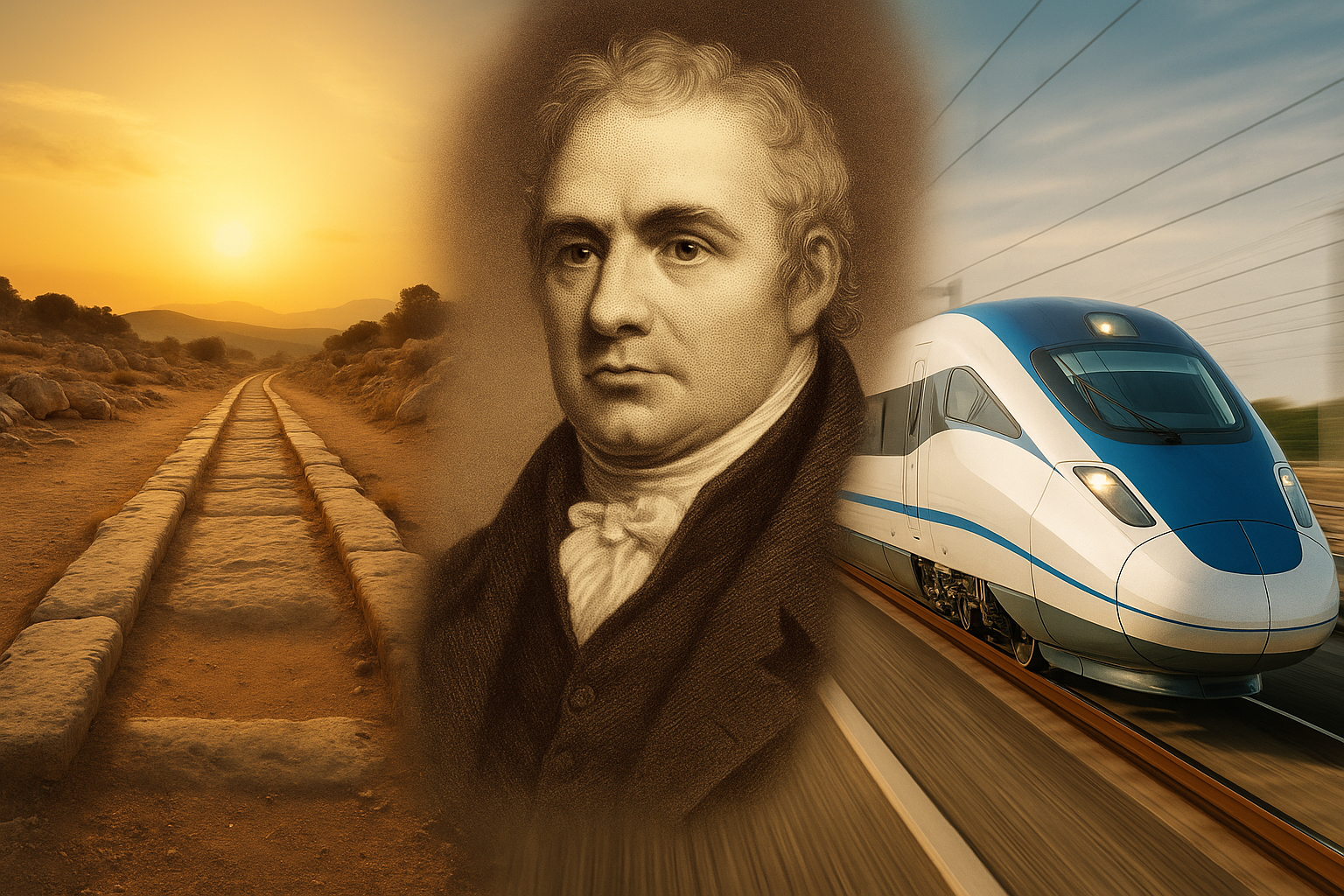


From Stone Tracks in Greece to Japanese Magnetic Train, The History of Railways Reveals Centuries of Innovation That Transformed Land Mobility Worldwide
The history of railways spans centuries, continents, and technological revolutions. From rudimentary tracks used in Antiquity to the high-speed trains of the 21st century, rail transport has solidified itself as one of the most remarkable forms of evolution in land mobility.
From Manual Tracks to Steam Engine
The first structure resembling a railway appeared around 600 BC in Ancient Greece. Known as the Diolkos road in the region of Corinth, this construction, approximately 8 km long, allowed for the transport of vessels with the help of animals and slaves.
Centuries later, in the early 16th century, Germany developed the wagon ways, systems made of wooden tracks pulled by animal traction. Widely used in mines, these systems facilitated the transport of minerals and continue to have variations in use in mining operations to this day.
-
Historic bankruptcy of Centauro shocks the market, and the century-old company puts more than 500,000 products, machines, and complete infrastructure up for online auction.
-
New shoe factory in Ceará is expected to create 400 jobs and strengthen the local economy.

-
No one imagined it, but a mixture of sawdust with a mineral that fights fires surprises scientists with a result that changes the course of fire-resistant construction.

-
From empty land to a high-end house, wooden construction uses a lightweight system, metal structure for the foundation, ventilated ceramic cladding, and special windows to create an efficient and comfortable living space throughout the year.

Around 1776, wooden tracks were replaced by iron tracks. This change marked the beginning of what became known as the rail way or railway.
The most significant advancement, however, would come in 1804. In the city of South Wales, England, British engineer Richard Trevithick presented the first steam locomotive.
The test transported 18 tons of iron and 70 men over 14 km. But upon reaching 8 km/h, the tracks did not hold and broke.
The Rise of Locomotives and Passenger Transport
Over time, the machines gained more power and replaced horses. This increased the load capacity and enabled the transport of more carriages.
Mobility also expanded to urban areas. England once again took the lead: in 1812, it inaugurated the first train designated solely for passenger transport in the city of Leeds.
But the decisive milestone came in 1830. That year, the line between Liverpool and Manchester was inaugurated, the first to operate with fixed schedules and a focus on commercial passenger transport. The success was immediate: 460,000 people used the line in the first year.
Another important step was taken in 1863. England created the first underground line, forming what would later be called the metroway. This model would serve as the basis for modern subway systems worldwide.
Electricity, Innovation, and Expansion
By the end of the 19th century, German engineers led the development of the first electrified railway lines. In 1883, Austria inaugurated the Mödling-Hinterbrühl Tram line, the first in the world to operate with electricity from overhead cables.
At the same time, the world was experiencing the advancement of neocolonialism. European nations expanded their areas of exploration and built railways in colonized countries.
But, unlike what happened in the metropolises, these structures had the sole purpose of transporting raw materials to ports.
Railways in Brazil and the United States
In Brazil, the colonial model was repeated. The first railway was inaugurated in 1854, between the Port of Mauá and the city of Fragoso in Rio de Janeiro.
It was envisioned by entrepreneur Irineu Evangelista de Souza, the Baron of Mauá. The railway lines in the country emerged due to the coffee cycle, to facilitate the drainage of production.
In the United States, the use of railways played a central role in the occupation of the territory. The lines expanded westward and to the Pacific coast.
By the early 20th century, the country already had 200,000 kilometers of railways. Brazil, despite having a similar area, constructed less than 40,000 kilometers.
High-Speed Trains Revolutionize the Sector
A new chapter began in 1964 in Japan. The country launched the world’s first high-speed train, the Shinkansen, which reached speeds of 200 km/h. Starting in the 1970s, England and France also began high-speed train projects.
The technology evolved even further in 1997 with the launch of the Maglev in Japan. This system uses superconductors and eliminates friction between the train and the tracks. At the launch, it achieved 550 km/h. Japan, Germany, and China are already operating commercial trains with this technology.
Speed Records and New Horizons
The French train TGV holds the speed record on conventional tracks: 574.8 km/h. The Japanese train JR-Maglev holds the absolute record, with 582 km/h, using superconductivity technology.
Railways continue to evolve. From Ancient Greece to the Japanese magnetic train, this journey shows how the pursuit of more speed, efficiency, and reach has shaped the way the world connects via tracks.
With information from Brasil Escola.







E aqui, destruiram o transporte ferroviário de passageiros e o de carga, quase. Um país enorme como o nosso e praticamente tudo e’ transportado por caminhões e um pouco por via aérea.. Que absurdo.
Isso chama burrice dos nossos políticos e empresários da época… Falta de visão estratégia e planejamento ao longo prazo… República das bananas…