





 Portuguese
  English
  Spanish
  6 min of reading
  0 comments



A heat wave fed by a hot air bubble over Northeast Argentina and Paraguay advances over Brazil this weekend and already makes thermometers go above 38°C in Rio Grande do Sul, with a feels-like temperature near 40°C, also reaching Santa Catarina, Paraná, São Paulo, Mato Grosso do Sul, and Mato Grosso.
The heat wave that has taken over the South, Southeast, and Midwest of Brazil is anything but ordinary for the end of March. A hot air bubble positioned over Northeast Argentina and Paraguay expanded this weekend and pushed temperatures to levels typically seen in mid-January. In Rio Grande do Sul, weather stations have already recorded highs of 38.1°C, and the feels-like temperature approached 40°C in several cities in the interior.
The phenomenon affects six states at once: Rio Grande do Sul, Santa Catarina, Paraná, interior of São Paulo, Mato Grosso do Sul, and Mato Grosso. MetSul Meteorologia issued a warning about the intensification of the heat wave, predicting that temperatures will remain high throughout the weekend. Rio Grande do Sul is the most affected state, but the extreme heat spreads across a band from the far south of Brazil to the Midwest.
How the hot air bubble from Argentina reached Brazil
The mechanism behind this heat wave is a mass of hot air stationary over Northeast Argentina and Paraguay. This heat pocket acts like a kind of atmospheric lid: it compresses the air below it, prevents cloud formation, and causes the temperature to rise continuously throughout the day.
-
The radish leaf that almost everyone throws away has more polyphenols, flavonoids, and fiber than the consumed root, and a 2025 study showed that the leaf contains compounds that protect the intestine, combat inflammation, and may inhibit the growth of cancer cells.

-
A planet that seemed to defy the laws of physics has intrigued scientists for decades, until the James Webb revealed what is really affecting Saturn’s rotation.

-
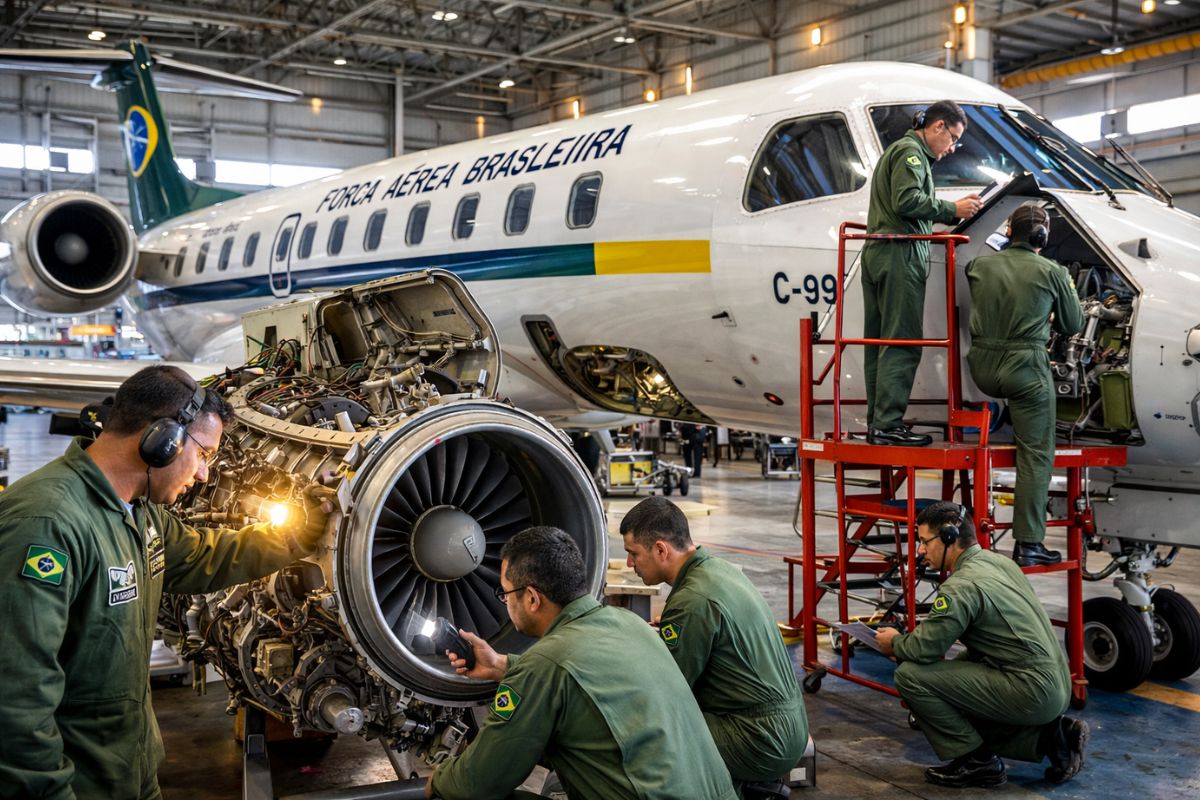
For the first time in history, the Brazilian Air Force conducted a highly complex inspection on the C-99 jet independently, without relying on foreign companies, marking a new level of logistical autonomy and operational sovereignty.
-
Beet greens that end up in the trash in many kitchens contain a high concentration of antioxidants, and a 2025 study shows that extracts may have even more potent activity when transformed into microparticles.


When this hot air bubble expands, as it is happening now, its effect spreads to neighboring countries.
In the case of Brazil, the expansion pushed extremely heated air into Rio Grande do Sul, Santa Catarina, Paraná, and the states of the Midwest.
The absence of frontal systems to break the heat pattern allows temperatures to rise without resistance, creating a scenario where even the end of March, already in meteorological autumn, registers marks typical of summer.
The hot air bubble is not a rare phenomenon during seasonal transitions, but the intensity recorded in this episode is noteworthy. Weather stations in Rio Grande do Sul marked highs above 36°C in over two dozen cities on Friday, reinforcing how much this event is above normal for the time.
The numbers of the heat wave in Rio Grande do Sul
The records from Friday (27) in Rio Grande do Sul show the reach of the heat wave in Brazil unequivocally. The highest temperature of the day was 38.1°C in São Paulo das Missões, in Northwest Rio Grande do Sul. Right behind were Bom Princípio, Marques de Souza, and Teutônia, all with 37.2°C, and Colinas with 37.1°C.
The list of cities above 35°C is extensive: Poço das Antas (36.8°C), Doutor Maurício Cardoso (36.7°C), Estrela (36.7°C), Maçambará (36.6°C), Santa Cruz do Sul (36.5°C), Uruguaiana (36.1°C), Espumoso and Camaquã (36.0°C). Other dozens of municipalities remained in the range between 35°C and 36°C, including Venâncio Aires, Lajeado, São Borja, Sapucaia do Sul, and Alegrete.
In Greater Porto Alegre, most cities recorded highs between 34°C and 37°C. Points in the capital recorded between 35°C and 36°C, with a feels-like temperature around 40°C.
For Saturday (28), the forecast is that the highs will remain at the same levels or be slightly higher, especially in the Northwest, Center, West, and Valleys of Rio Grande do Sul.
Santa Catarina, Paraná, and São Paulo also in the sights of heat
The heat wave in Brazil is not limited to Rio Grande do Sul. In Santa Catarina, the heat reached almost the entire state on Friday. Itapiranga, in the Extreme West of Santa Catarina, recorded 35.9°C. In the South of the state, Criciúma marked 35.8°C.
In Greater Florianópolis, Santo Amaro da Imperatriz hit 35°C. The forecast for Saturday indicates highs between 34°C and 36°C in the West and South of Santa Catarina.
In Paraná, the heat is more intense in the West and North of the state. Goioerê recorded 34.1°C on Friday, and similar or higher marks are expected for the weekend.
The hot air bubble expanding from Argentina ensures that the three southern states of Brazil face conditions well above average for the end of March.
The state of São Paulo also feels the effects. The capital may register between 31°C and 32°C this Saturday, while in the West, Center, and North of the interior, the highs will be in the range of 32°C to 34°C. In the Midwest, Mato Grosso do Sul records between 33°C and 35°C in several municipalities, and in Mato Grosso, the effects are more felt in the southern portion of the state.
The feels-like temperature of 40°C and what it means in practice
Thermometers show one thing, but the body feels another. The feels-like temperature that combines air temperature with relative humidity can reach 40°C or more in several cities affected by the heat wave in Brazil. This means that even with the thermometer marking 36°C, the body reacts as if it were exposed to 40°C.
In practice, a feels-like temperature in this range significantly increases the risk of dehydration, heatstroke, and exacerbation of cardiovascular problems, especially in the elderly and children.
The alert from MetSul Meteorologia reinforces the importance of constant hydration, avoiding sun exposure during the hottest hours, and keeping environments ventilated. In cities like Porto Alegre, where humidity tends to be higher, the feels-like temperature is even more oppressive than in cities in the interior of Rio Grande do Sul.
The heat index of 40°C is not an abstract number. It is the difference between a bearable hot day and a potentially dangerous day for those who work outdoors, play sports, or simply need to walk to the bus stop.
The heat wave affecting Brazil this weekend requires real caution, not just discomfort.
Is extreme heat at the end of March normal? What do historical data say
The short answer is: heat at the end of March is not unprecedented, but the frequency and intensity in recent years are notable. A survey by MetSul with data from the National Institute of Meteorology station in the Jardim Botânico neighborhood in Porto Alegre shows an increasingly evident pattern.
Last year, the last days of March had five consecutive days with highs above 30°C, peaking at 34.7°C on the 31st.
In 2024, the end of March was equally hot: 33.9°C on the 29th and 33.0°C on the 31st. In 2023, March 29 reached 35.5°C. In 2022, it was 33.6°C on the same day.
Between 2015 and 2018, no end of March recorded significant heat in Porto Alegre, which makes the contrast with recent years even more evident. In 2020, there was a sequence of hot days peaking at 34.5°C on the 30th.
The survey indicates a prolongation of summer in Porto Alegre and Rio Grande do Sul. If between 2010 and 2018 the ends of March were predominantly mild, from 2019 onwards, late heat waves have become increasingly frequent.
The data suggest that extreme heat at the end of March is ceasing to be an exception to become a standard in Southern Brazil, an indication that aligns with projections of rising temperatures associated with climate change.
What to expect in the coming days
The forecast indicates that the heat wave in Brazil should gradually lose strength starting early next week, when frontal systems begin to approach the Southern region.
But until then, the weekend will still be of very high temperatures in the six affected states, with highs above 34°C in much of the interior of Rio Grande do Sul and Santa Catarina.
For those in Rio Grande do Sul, the recommendation is straightforward: avoid sun exposure between 10 a.m. and 4 p.m., maintain frequent hydration, and stay alert to signs of discomfort caused by the heat.
The hot air bubble that arrived from Argentina still maintains its influence over the South and Midwest of Brazil, and the feels-like temperature will remain uncomfortable as long as the atmospheric pattern does not change.
With information from the portal Metsul.
Are you feeling this heat wave in your city? What was the highest temperature the thermometer marked there today? Tell us in the comments; we want to know how the heat is affecting each region of Brazil this weekend.









Seja o primeiro a reagir!