





 Portuguese
  English
  Spanish
  3 min of reading
  0 comments


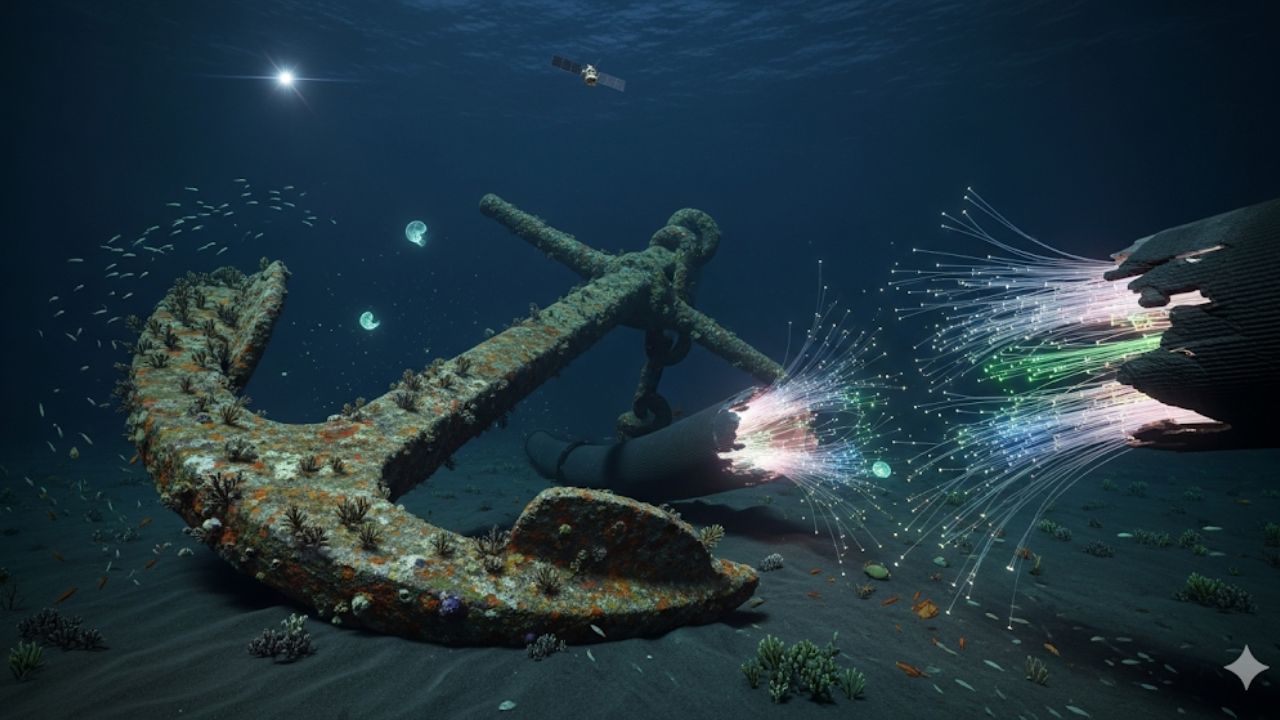
Episode Shows Risks of the Infrastructure That Carries 99% of World Traffic and Pressures for Solutions Beyond Fiber Optics.
Uninterrupted internet connections have become as essential as running water and electricity. However, a major network outage that affected Africa, Asia, and the Middle East in recent days exposed the fragility of the infrastructure that keeps us online.
The Immediate Impact of the Break in the Red Sea
About 15 submarine cables pass through the Bab el-Mandeb Strait in the Red Sea. Four of them are reported to have been broken. This break caused a significant impact on data traffic in those regions.
The Dependence on 99% of Submarine Infrastructure
Hundreds of cables rest on the ocean floor. They are responsible for carrying almost all of the global internet traffic, estimated at 99%.
-
Astronomers identify the planets with the best real conditions to host extraterrestrial life in the universe and reveal the priority targets for the James Webb Telescope!

-
Student finds dragonfly wing from the dinosaur era that was hidden for 75 million years in a park in Canada!

-
The smallest bird of prey in the world is at risk of extinction and could disappear by 2050.
-
Researchers extracted DNA from a bone fragment of a Neanderthal found in the Denisova Cave in Russia.


“We had cuts in the Red Sea last year, and now we are in the same situation, so to speak,” says Doug Madory, director of internet analysis at Kentik.
When part of the capacity is lost, providers need to reroute traffic. This change is made to the other cables. The rerouting, however, causes latency and reliability failures for users.
An Announced Accident and a Complex Repair
Although previous failures have been caused intentionally, experts believe that this case was an accident.
“The Red Sea is a problematic area… Ships anchor in shallow waters, and when many drop anchor in a small space, the disaster is almost inevitable,” explains Madory.
Normally, cable cuts are repaired quickly. However, the current location makes the situation more complex. The area is near the coast of Yemen, where conflicts hinder technical work for repairs.
Satellite Internet Emerges as an Alternative
The interruptions, which are expected to persist, have reignited the debate about the reliability of submarine cables. There is discussion about whether alternatives, such as satellite connections, can reduce this dependence. Companies like Starlink offer this service.
It is estimated that up to 200 incidents of this type occur each year. This number reinforces the interest in alternatives to cables.
Starlink, for example, has become crucial in Ukraine to avoid Russian sabotage on cables. The service already has over six million subscribers in various countries. In regions like sub-Saharan Africa, the service acts as a safety net when terrestrial connectivity fails.
Fiber Optics vs. Satellite: The Capacity Battle
Experts believe that incidents like the one in the Red Sea may accelerate the adoption of satellites. This would happen in markets willing to pay more for resilience.
The challenge is still the cost. The kits cost hundreds of dollars. Moreover, the monthly fees are higher than local plans, which limits reach in low-income areas.
Still, satellites cannot compete in scale with fiber optics.
“Starlink or any other satellite service will never replicate the capacity obtained in a fiber optic cable,” says Madory.
While submarine cables carry up to three petabits of data per second, satellites reach only 150 terabits. Planned launches may raise this capacity to 800 terabits. For now, submarine cables remain the backbone of the global internet.





-

-

-

4 pessoas reagiram a isso.