





 Portuguese
  English
  Spanish
  7 min of reading
  2 comments


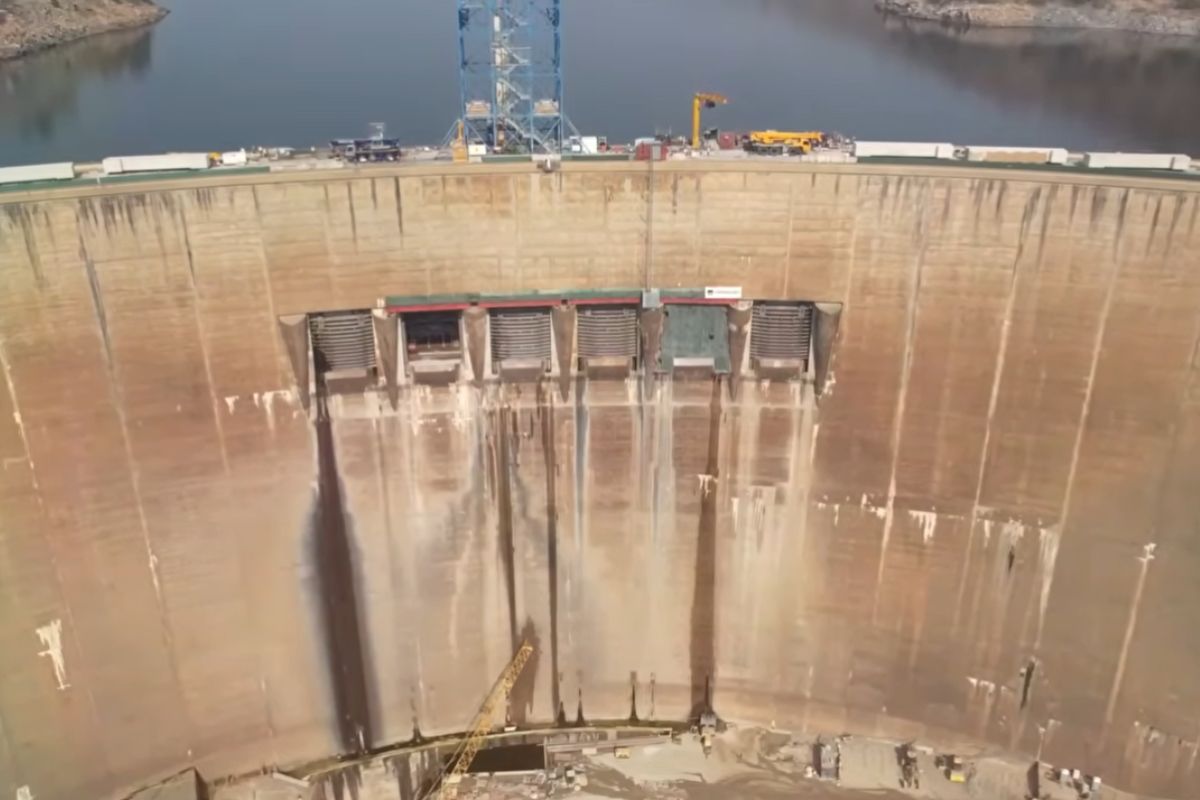


The Largest Dam in Africa, Built by the British in the Kariba Gorge to Sustain Mining and Electricity in Southern Africa, Now Faces Deformed Concrete, Foundations Threatened by Erosion, and an International Race of Almost $300 Million to Avoid Collapse, Blackouts, and Regional Human Disaster of Large Proportions in the Future.
The largest dam in Africa is back in the spotlight not for its grandeur but for the risk it has come to represent. The Kariba dam on the Zambezi River has been supporting electricity generation for an entire region for decades, but now faces a dangerous combination of aging concrete, progressive erosion, and low financial capacity to maintain a structure that holds a colossal mass of water.
The problem has ceased to be just technical. Millions of people today live under the shadow of vital infrastructure that has aged faster than the regional capacity to recover it. If the dam fails, the impact will be not just hydraulic. It will be energetic, economic, social, and cross-border, directly affecting Zambia, Zimbabwe, and the entire southern Africa dynamic.
How Kariba Was Born to Control the Zambezi and Feed Mining
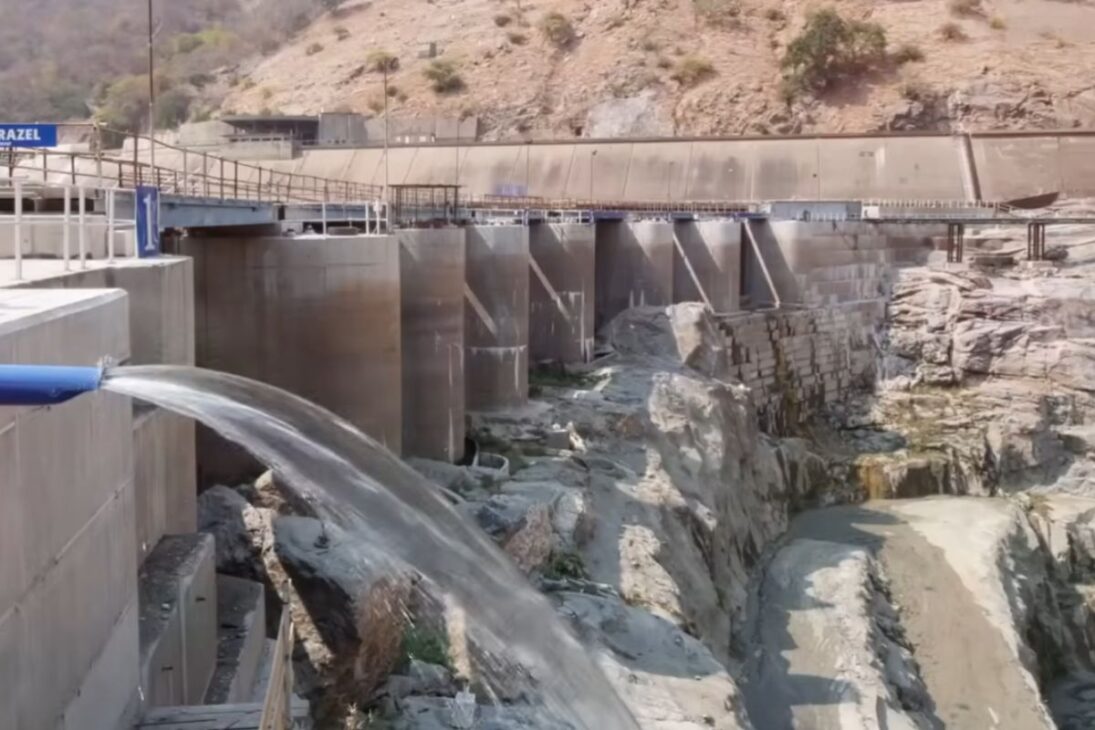
The story of the largest dam in Africa begins in the 1950s when the region was experiencing a strong cycle of mineral expansion.
-
NASA published a photo taken from space of a mountain range in the interior of Goiás, and the whole world wanted to know what it was: beneath it lies the largest hot water spring on the planet, with temperatures reaching 70 degrees in the middle of the Cerrado.
-
A thermal block costing only R$ 0.40 catches attention by reducing heat by up to 80% using recycled styrofoam, a common kitchen ingredient, and a manual technique capable of producing 50 blocks from a single bag of cement.
-
The item in the house that consumes the most water is not in the kitchen; it is in the smallest room of the house and can account for up to 30% of the expenditure on its own.

-
While Argentina relies on the USA to provide communications, data transmission, and electronic warfare for the F-16, Brazil is accelerating with the Gripen and integrating the Link-BR2, a national technology that strengthens air defense.

Copper, coal, and precious metals were driving the economy and required a continuous source of electricity to maintain industrial-scale operations.
The decision was made to dam the Zambezi River, the fourth largest in Africa, at a geologically favorable location: the Kariba gorge, where the water flows between nearly vertical basalt cliffs.
The engineers chose an arch concrete dam design, a sophisticated solution because it distributes the water pressure to the rocky sides rather than relying solely on the structure’s sheer weight.
It was an ambitious project, efficient on paper and monumental in scale. When completed, it formed Lake Kariba, over 280 kilometers long, with a capacity to store about 185 billion cubic meters of water, functioning as a gigantic hydro battery for southern Africa.
This scale, which for decades was seen as a symbol of progress, also became the root of the current problem.
What seemed an absolute advantage has come to mean constant pressure, year after year, on concrete designed in another historical context, with different calculation standards, another expected lifespan, and without the extreme climatic reality that now affects the region.
There is also a colonial dimension to this origin. The largest dam in Africa was built by the British to reorganize the production and energy flow of a territory then shaped by external interests.
The goal was to control the river, ensure electricity, and sustain an expanding extractive economy. The price of that decision, decades later, appears in the accumulated fragility of a work that remains central to the daily lives of millions of people.
What Is Corroding the Structure from Within and Below
Today, the largest dam in Africa faces a dual technical threat that reinforces each other. The first is within the concrete mass itself.
Experts have identified a slow, irreversible chemical reaction between components of the cement and minerals present in the aggregates used in the construction.
This reaction produces a gel that absorbs water, expands, and creates internal pressure, causing microcracks and deformations over time.
The most delicate effect appears in the spillway region. The dam has six large gates that function as safety valves to release water when the reservoir rises.
With the expansion of the surrounding concrete, the metal structures of these gates have begun to suffer compression, creating a risk of jamming.
If they remain closed during an intense rainy season, the water could exceed the safe limit and force an overflow over the top of the dam.
If they remain open, the reservoir could drain uncontrollably, disrupting electricity generation and altering the entire environmental balance downstream.
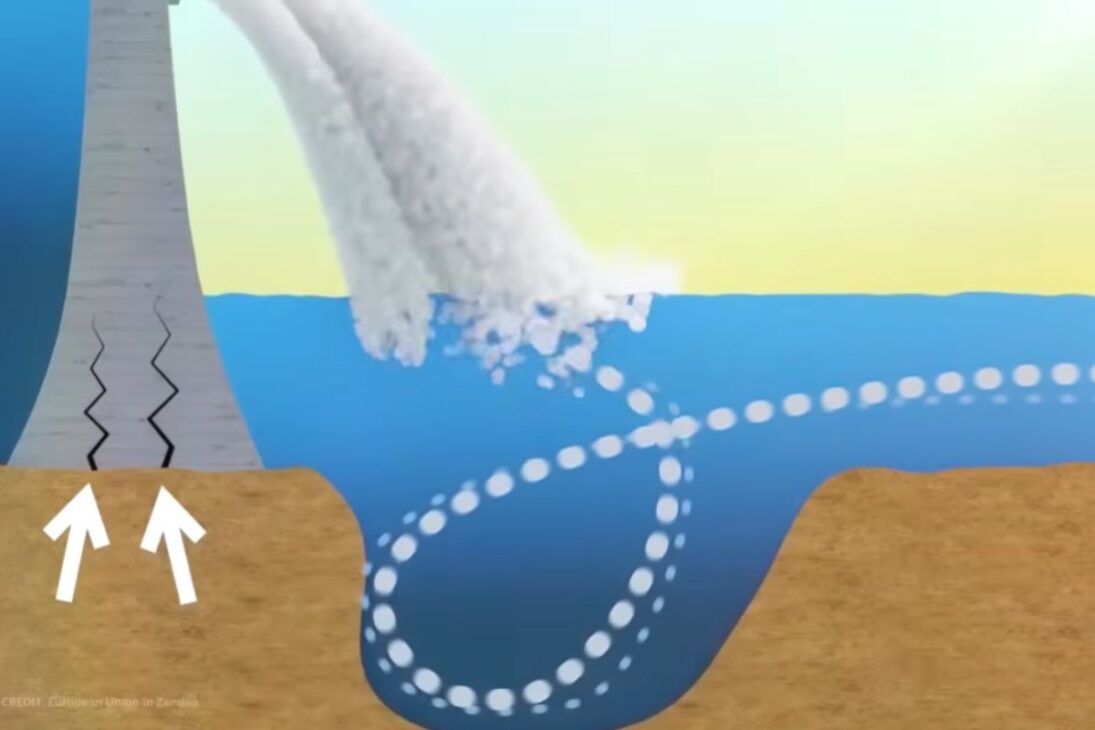
The second threat is in the least visible part of the structure, but perhaps the most dangerous. When the spillways are opened, water falls from about 128 meters high with tremendous kinetic energy.
This impact has eroded the rock at the bottom of the river over decades and created a large erosion pit. Recent studies indicate that this cavity has already reached about 80 meters in depth and continues to advance towards the foundations.
It is here that the situation becomes critical. The largest dam in Africa is not at risk only due to superficial wear but due to potential loss of geological support.
If the erosion pit continues to expand and reaches the structural base, the dam’s stability stops being a question of maintenance and becomes a question of the immediate survival of the structure.
The Dam in Crisis, the Drought, and the Weight on Regional Life

The technical crisis of the largest dam in Africa has worsened because it coincided with a period of severe droughts in southern Africa.
In 2025, the level of Lake Kariba reached, at times, a historic low of just 10% of its useful capacity for electricity generation.
This created a cruel paradox: to save the dam, money is needed; to generate money, electricity must be produced; to produce electricity, water is required; and water is no longer available in sufficient quantity.
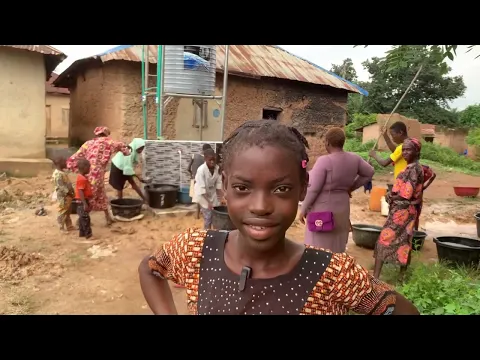
The consequences of this cycle are already directly affecting everyday life. Zambia and Zimbabwe have faced long periods of rationing, reaching up to 19 hours a day without power at certain times.
Factories have reduced operations, hospitals have had to rely on generators, and local economies have suffered significant disruptions.
The dam that was designed to ensure stability has now also become a vector of instability.
There is also a symbolic and cultural layer that weighs on Kariba. For the Tonga people, the Zambezi River is the domain of Nyami Nyami, the ancestral spirit of the waters.
In local tradition, the construction of the dam separated this spirit from its wife, located downstream. The belief has gained strength because the work was marked by extreme events that are hard to ignore.
In 1957, an unprecedented flood destroyed parts of the foundations. In 1958, another even larger flood devastated temporary structures, knocked down the access bridge, and increased human losses.
In total, 86 workers died during the construction of the largest dam in Africa, and 17 bodies were never recovered, remaining incorporated into the concrete mass.
For neighboring communities, the current drama is not just engineering failure. It also echoes a history of violence against the river, the territory, and local memory itself.
The $294 Million Surgery and the Warning for the Planet
The rehabilitation project for Kariba, estimated at around $294 million, functions like a precision surgery performed with the dam still alive, loaded, and operational.
The engineers cannot empty the lake nor completely halt the operation of the structure.
Therefore, all work is done while the system continues to bear the pressure of a gigantic reservoir.
The first work front tries to contain the advance of the erosion pit. For this, it was necessary to build a temporary dyke in the riverbed, isolate the area, pump out the water, and remodel the base with large volumes of high-quality rock and concrete.
The goal is not just to fill the cavity, but to create steps capable of dissipating the water’s energy when the spillways are opened again. The second front, even more delicate, involves replacing the six deformed gates.
Divers and engineers work in low visibility, underwater cutting, and lifting pieces under enormous hydraulic pressure.
This effort has only progressed because the World Bank, European Union, and African Development Bank provided emergency support. The calculation is simple: the cost of the work is huge, but the cost of a collapse would be incomparably greater.
The largest dam in Africa has become a global test of the ability to save aging infrastructures before they turn into catastrophes.
Kariba, however, is not an isolated exception. Dams built between the 1950s and 1970s in various parts of the world are reaching the end of their projected lifespan as extreme climatic events become more frequent.
The disaster in Derna in 2023 brutally demonstrated what happens when old structures, insufficient maintenance, and off-pattern storms encounter at the worst possible moment.
The question posed by Kariba is straightforward: Will the world have the money, technology, and coordination to restore its giants before they fail in chain?
The race for the survival of the largest dam in Africa is not over yet. Every gate replaced, every meter of rock thrown into the erosion pit, and every day of safe operation delayed is a temporary victory against infrastructure aging and against lost time in insufficient maintenance.
In the end, Kariba ceased to be just a historic dam. It has become a warning about the future of monumental works raised to control nature and forgotten until the moment nature demands back.
In your view, is the greatest risk today in Kariba itself or in the fact that the entire planet is surrounded by other large dams that are also aging at the same time?








A maior barragem de Africa foi Assuã construída pelos Russos no Rio Nilo . A segunda foi Cabora- Bassa no Rio Zambeze construída por Portugueses Meu pai , geologo, fez o levantamento geologico para sua construcao
A maior barragem de Africa foi construída pelos Russos no Rio Nilo . A segunda foi Cabora- Bassa no Rio Zambeze construída por Portugueses Meu pai , geologo, fez o levantamento geologico para sua construcao