






 Portuguese
  Spanish
  4 min of reading
  0 comments


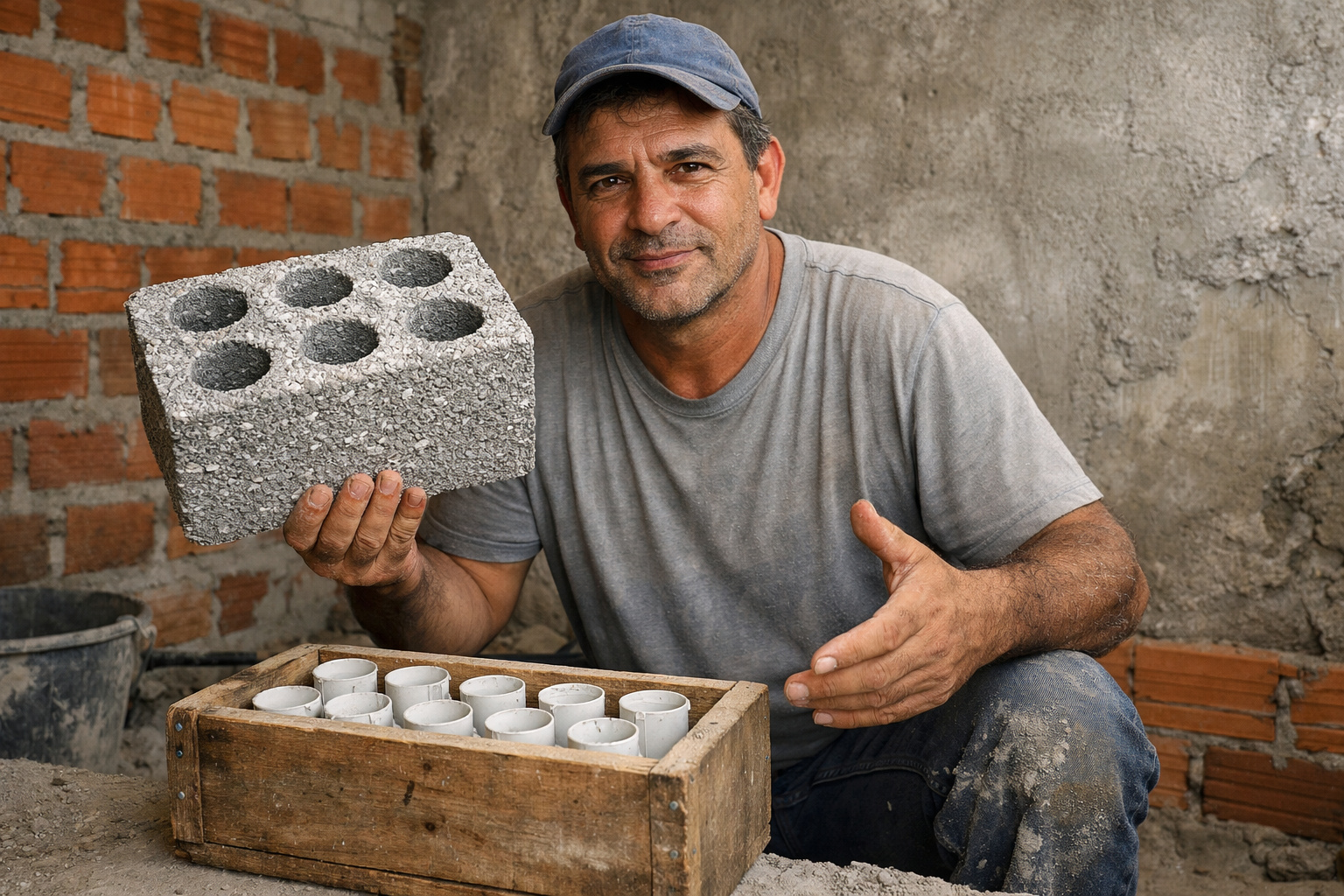
The artisanal technique that combines cement, sand, recycled foam, and a simple household additive has gained attention for delivering efficient thermal insulation, almost zero cost, and practical application in regions of intense heat
What seems like just another makeshift home improvement has, in practice, caught the attention of those seeking cheap construction, thermal comfort, and waste reuse. An artisanal thermal block, which costs about R$ 0.40 per unit, promises to reduce heat by up to 80%, using recycled foam, common construction materials, and an unexpected kitchen ingredient.
The solution has circulated in videos and practical tutorials, especially among residents of hot regions in Brazil. Besides being cheap, the method stands out for allowing the manual production of up to 50 blocks with just one bag of cement, something unthinkable in conventional masonry. As a result, the system is being seen as a real alternative for partition walls, fences, and internal dividers.
This information was shared through videos and practical tutorials published on the channel MACIEL NA REFORMA, which has over 40,000 followers interested in economical and functional solutions for small construction projects, especially in northeastern Brazil.
-
Adored by more than 1.5 million fans and famous for crossing deserts and mountains with its owner, a famous dog is stolen and ends up being served in a restaurant in China.

-
Son of a Chinese immigrant who sold tea in the countryside of São Paulo, Zhang Ye almost went bankrupt in 2021 and today, at 28 years old, claims to earn 1 million reais per day and has become the number 1 on TikTok Shop in Latin America.
-
A shipbuilder created a wooden boat so ingenious that it turns into a wheelbarrow and crosses hundreds of meters of beach on its own when the low tide takes the water away.
-
Zawoja, the longest village in Poland, stretches for 18 km between mountains, can take an entire day to cross on foot, and brings together houses, roads, and strips of land in one of the most curious rural formats in Europe.





How the DIY foam thermal block works

First of all, it is important to understand why this block can be so efficient in thermal insulation. The secret lies in the combination of lightness, trapped air, and low heat conduction, natural characteristics of foam when properly incorporated into the cementitious mass.
Each block has approximate dimensions of 10 × 30 × 60 cm and weighs about 5.7 kg, an extremely low value compared to traditional ceramic blocks. This lightness, in addition to facilitating manual transport on the construction site, significantly reduces the total load on foundations during renovations and expansions.
Below is the exact mix used for each unit, as demonstrated in the tutorial:
Mix for the DIY foam thermal block (per unit)
- Cement: 2 kg — responsible for the binder
- Sand: 2.5 kg — ensures mechanical resistance
- Chopped foam: 15 liters — provides lightness and thermal insulation
- Common detergent: 50 ml — acts as a bonding additive
The use of household detergent is the key differentiator of the technique. It acts as a cheap additive, preventing the foam from floating in the mass and ensuring that each particle is surrounded by a thin layer of cement. This gives the block cohesion, strength, and dimensional stability.
Correct steps for mixing and manual molding
After gathering the materials, the mixing process follows a specific order, essential for the success of the block. First, cement, sand, water, and detergent should be mixed for about 3 minutes, using a drill with a mixer or a manual mixer.
Only after achieving a homogeneous cream should the 15 liters of chopped foam be added to the mixture. At this point, incorporation must be careful, ensuring that each foam particle receives a coating of cement, forming the internal structure of the block.
The ideal consistency of the mass is firm, without falling apart when lifted with a trowel. This manual control prevents structural failures and improves the final finish of the piece.
Next, molding requires some simple but essential precautions:
- Lubricate the wooden mold with oil or release agent
- Use PVC pipes in the internal holes to create air passages
- Fill the mold in layers, vibrating the mass well
- Eliminate internal voids to avoid cracks
- Wait 3 to 4 hours before demolding
Proper lubrication prevents the block from breaking at the edges during removal. After this initial curing period, the pieces can be handled, maintaining an average weight of 5.7 kg per unit.
Where the thermal block can be used and how much it costs
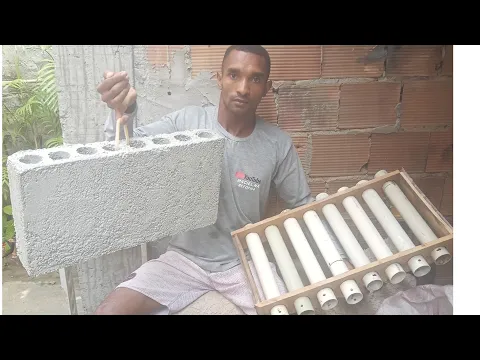

Despite the advantages, the DIY foam block is not structural. It should be used exclusively in partition walls, such as dividing walls, closing openings, and internal dividers. It is not recommended for supporting heavy slabs or permanent structural loads.
Still, its thermal performance is superior to many ceramic bricks available on the market. In regions of intense heat, such as the northeast of Brazil, the material helps keep indoor environments cooler, reducing the thermal sensation and even the need for fans or air conditioning.
Another relevant point is the cost. The estimated value of R$ 0.40 per block represents significant savings compared to traditional systems. This allows for the construction of extensive walls spending only a fraction of the usual budget in conventional works.
In addition to financial savings, there is an environmental gain. The reuse of foam — a material that is difficult to recycle — transforms a problematic waste into efficient thermal insulation, combining sustainability, low cost, and practical innovation.




Be the first to react!