





 Portuguese
  English
  Spanish
  6 min of reading
  0 comments


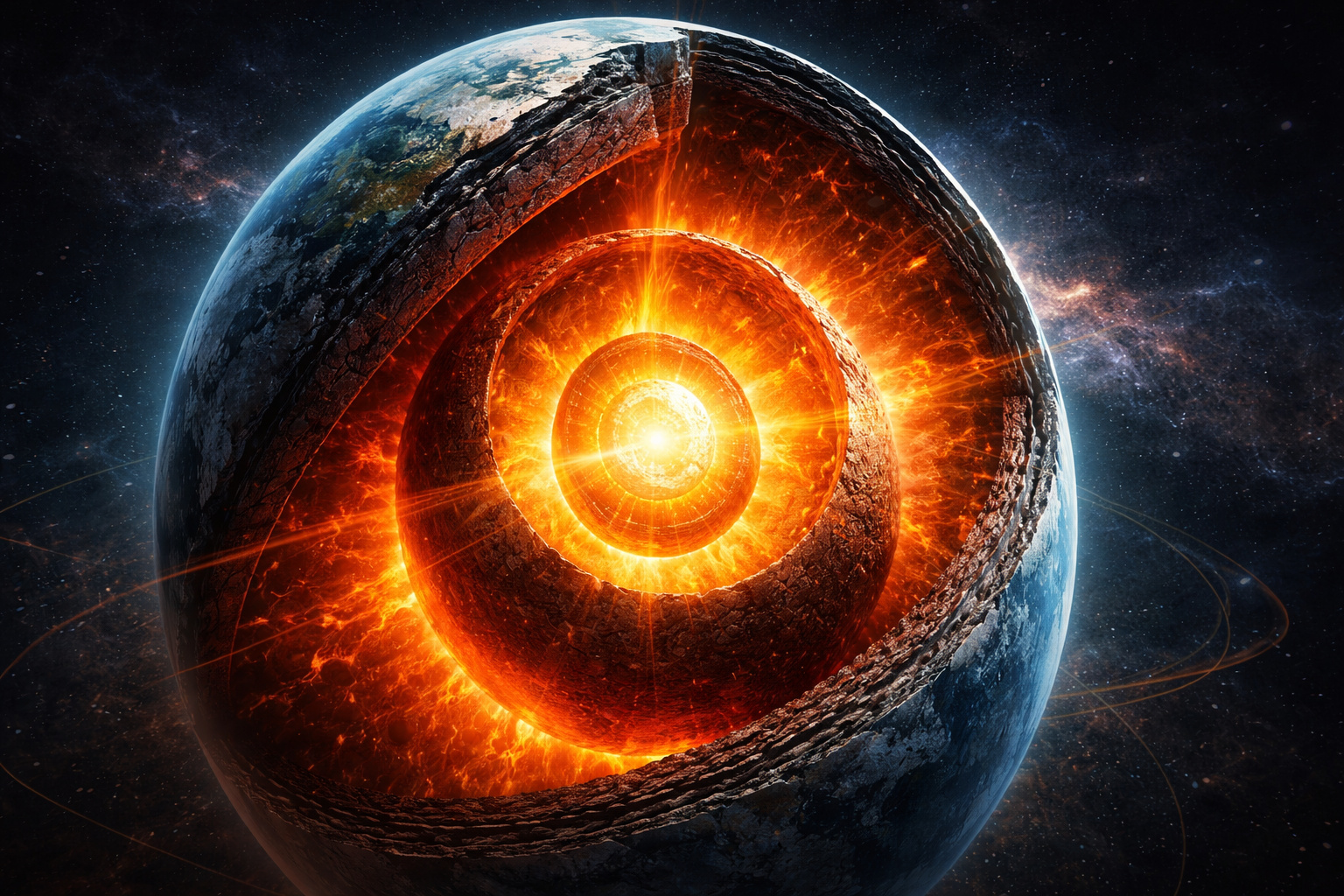
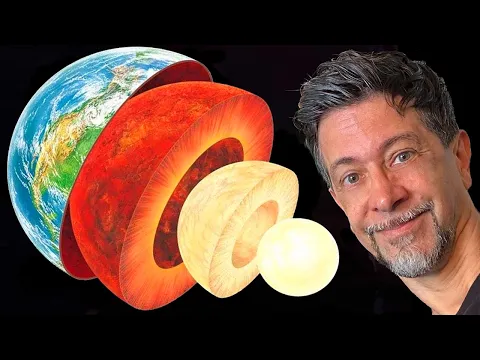
Seismic Studies Reveal That The Earth’s Inner Core May Hide An Even Deeper Structure. Scientists Identified An “Inner Within The Core” Located More Than 5,000 Km Deep.
For decades, geology textbooks taught that the Earth’s interior was divided into relatively well-defined layers: crust, mantle, liquid outer core, and solid inner core. However, new research in geophysics suggests that this structure may be even more complex. Studies based on seismic waves indicate that the planet’s inner core may hide an even deeper region, referred to by some researchers as “inner inner core”, or simply an inner within the core.
This structure would be located more than 5,000 kilometers below the surface, almost at the center of the planet, in a region where the pressure exceeds 3.5 million atmospheres and the temperature may reach 5,500 °C, comparable to the surface of the Sun. The discovery suggests that the heart of the planet may hold extremely ancient geological records, possibly linked to the early stages of the Earth’s formation.
How Scientists Study The Earth’s Interior Without Drilling Into The Planet
Investigating such deep regions of the planet is an enormous challenge. The deepest hole ever drilled by humans, the Kola Superdeep Borehole in Russia, reached just over 12 kilometers deep, which represents only a tiny fraction of the total thickness of the Earth, exceeding 6,300 kilometers in radius.
-
In a flooded well, archaeologists found a 1,700-year-old Roman egg that still contains clear and yolk intact inside the very thin shell.

-
Something is happening around the Earth: Inside the huge explosion of fireballs in 2026

-
A hot air bubble coming from Argentina expands over Brazil, causing thermometers to exceed 38 degrees with a thermal sensation of 40 degrees in late March, affecting 6 states at once.

-
The radish leaf that almost everyone throws away has more polyphenols, flavonoids, and fiber than the consumed root, and a 2025 study showed that the leaf contains compounds that protect the intestine, combat inflammation, and may inhibit the growth of cancer cells.


To study the deep regions of the planet, scientists use a technique called seismic tomography, which utilizes waves generated by natural earthquakes. When an earthquake occurs, seismic waves propagate throughout the planet’s interior and traverse different layers of the Earth.

These waves change speed and direction depending on the composition and density of the rocks they traverse. By carefully analyzing these variations with global networks of seismographs, researchers can reconstruct detailed images of the planet’s interior, similar to a medical tomography scan.
It was precisely by analyzing these patterns of seismic wave propagation that scientists began to notice that something unusual was happening within the Earth’s inner core.
Seismic Evidence Reveals An Unexpected Structure At The Center Of The Planet
The first strong evidence that the inner core might have a subdivision emerged when researchers observed that certain seismic waves traversed the center of the planet differently depending on the direction in which they propagated.
In some trajectories, the waves traveled faster, while in others they moved slightly slower. This difference indicated that the crystalline structure of iron in the inner core could vary between different regions.
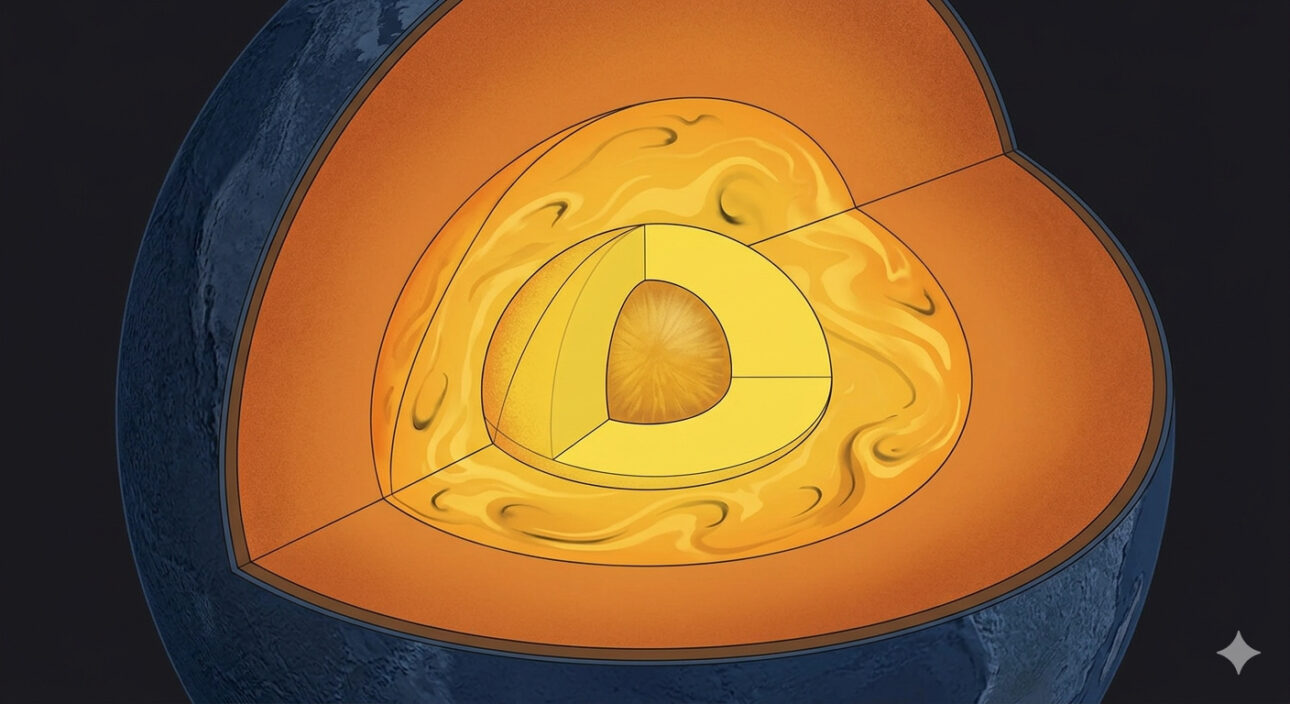
Subsequent studies suggested that there exists a deeper central region with distinct properties from the rest of the inner core. This area could represent a different phase of iron crystallization at the center of the planet.
In other words, the Earth’s inner core would not be completely uniform: it could have a central layer with a different crystalline structure, forming what scientists began to call “inner inner core”.
What Comprises The Earth’s Inner Core
The Earth’s inner core is primarily composed of solid iron, mixed with small amounts of nickel and other light elements.
Despite the extremely high temperatures, the material remains solid due to the massive pressure exerted by the planet’s upper layers. This pressure is so intense that it prevents the iron from melting, even at temperatures comparable to those found at the surface of the Sun.
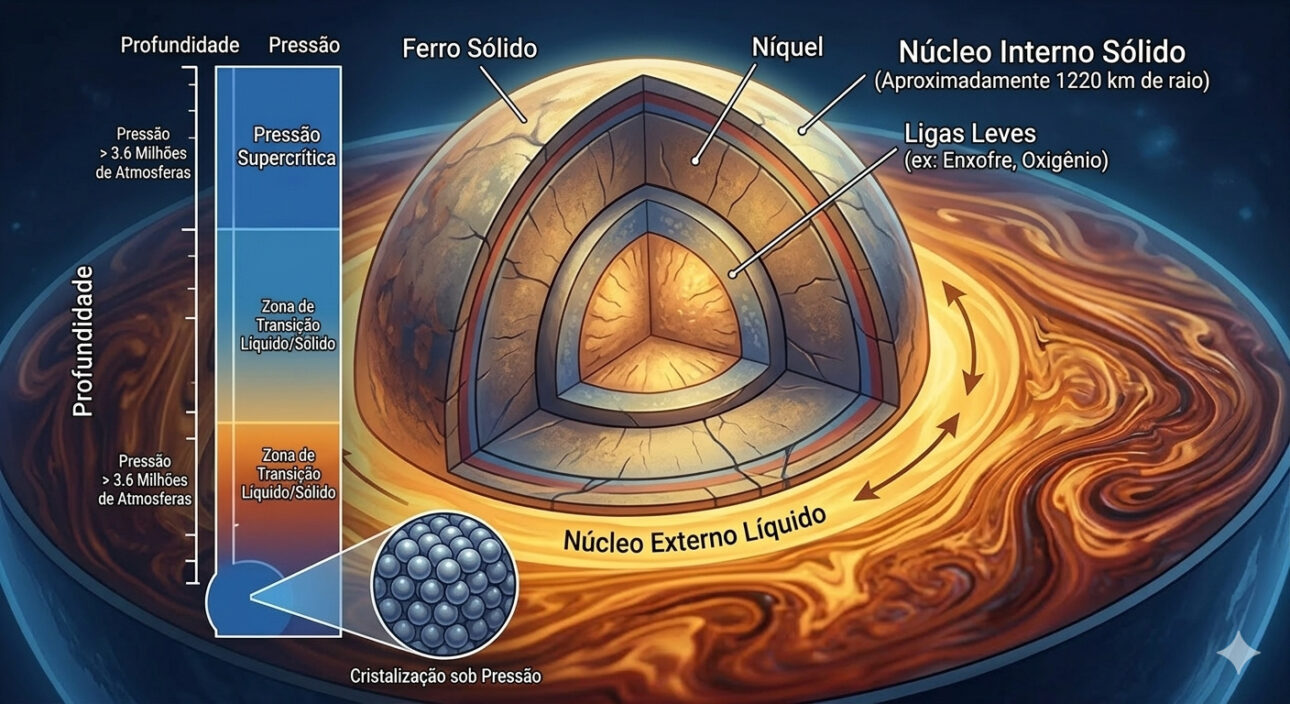
Surrounding the inner core is the outer core, a layer composed of liquid iron in constant motion. This movement of molten metal generates electric currents that are responsible for creating the Earth’s magnetic field.
This magnetic field acts as a shield that protects the planet against charged particles from the Sun, helping to preserve the atmosphere and enabling the development of life.
The Inner Within The Core May Hold Records Of The Earth’s Formation
One of the most interesting hypotheses raised by researchers is that this deeper region of the inner core may represent an ancient stage in the planet’s history.
It is believed that the inner core began to form about 1 billion years ago, when the Earth’s interior started to cool enough for liquid iron to begin crystallizing.
If this crystallization occurred in different phases over time, the innermost part of the core may have formed first, preserving the crystalline structure from that specific period of the planet’s evolution.
This means that the innermost core may function as a kind of deep geological archive, containing information about the physical conditions that existed inside the Earth billions of years ago.
The Role Of The Inner Core In The Dynamics Of The Planet
The structure of the inner core also has important implications for the global dynamics of the Earth. The process of iron crystallization in the inner core releases heat and light elements into the liquid outer core. This flow of energy helps maintain the convective movement of the molten iron that generates the Earth’s magnetic field.
If the internal structure of the core is more complex than previously thought, this could influence how the magnetic field evolves over time.
Some researchers suggest that changes in the crystalline structure of the inner core may be linked to phenomena such as magnetic field reversals, events in which the Earth’s magnetic poles reverse.
These reversals have occurred multiple times throughout the planet’s geological history.
The Center Of The Earth Still Holds Many Mysteries
Even with advancements in seismic tomography techniques, the Earth’s interior remains one of the least understood regions of the planet.
Much of the current knowledge about the inner core is based on theoretical models and indirect interpretations of seismic data. Small variations in this data can lead to different interpretations about the actual structure of the region.
Therefore, the idea of an inner within the core is still a topic of debate among scientists. Some researchers argue that the observed differences in seismic waves indeed indicate the presence of a distinct layer, while others believe that these variations can be explained by differences in the orientation of iron crystals in the inner core.
Regardless of the final interpretation, the discovery reinforces the idea that the planet’s interior is much more complex than previously thought.
The Earth’s Interior Is Still Being Discovered
As new seismic networks are installed around the world and data analysis techniques become more sophisticated, scientists continue to reveal surprising details about the Earth’s interior.
In recent years, geophysical studies have also identified giant structures in the deep mantle, enormous mountains at the boundary between the core and the mantle, and regions where ancient tectonic plates remain preserved thousands of kilometers deep. These discoveries show that the planet still holds a huge amount of geological mysteries.
The possibility that there exists an inner within the core of the Earth is yet another example of how the planet’s interior can be much more complex than we imagined—and how earthquakes, accurately analyzed, can reveal secrets hidden more than 5,000 kilometers beneath our feet.






-

-

-

-

-

-

11 pessoas reagiram a isso.