





 Portuguese
  English
  Spanish
  5 min of reading
  0 comments


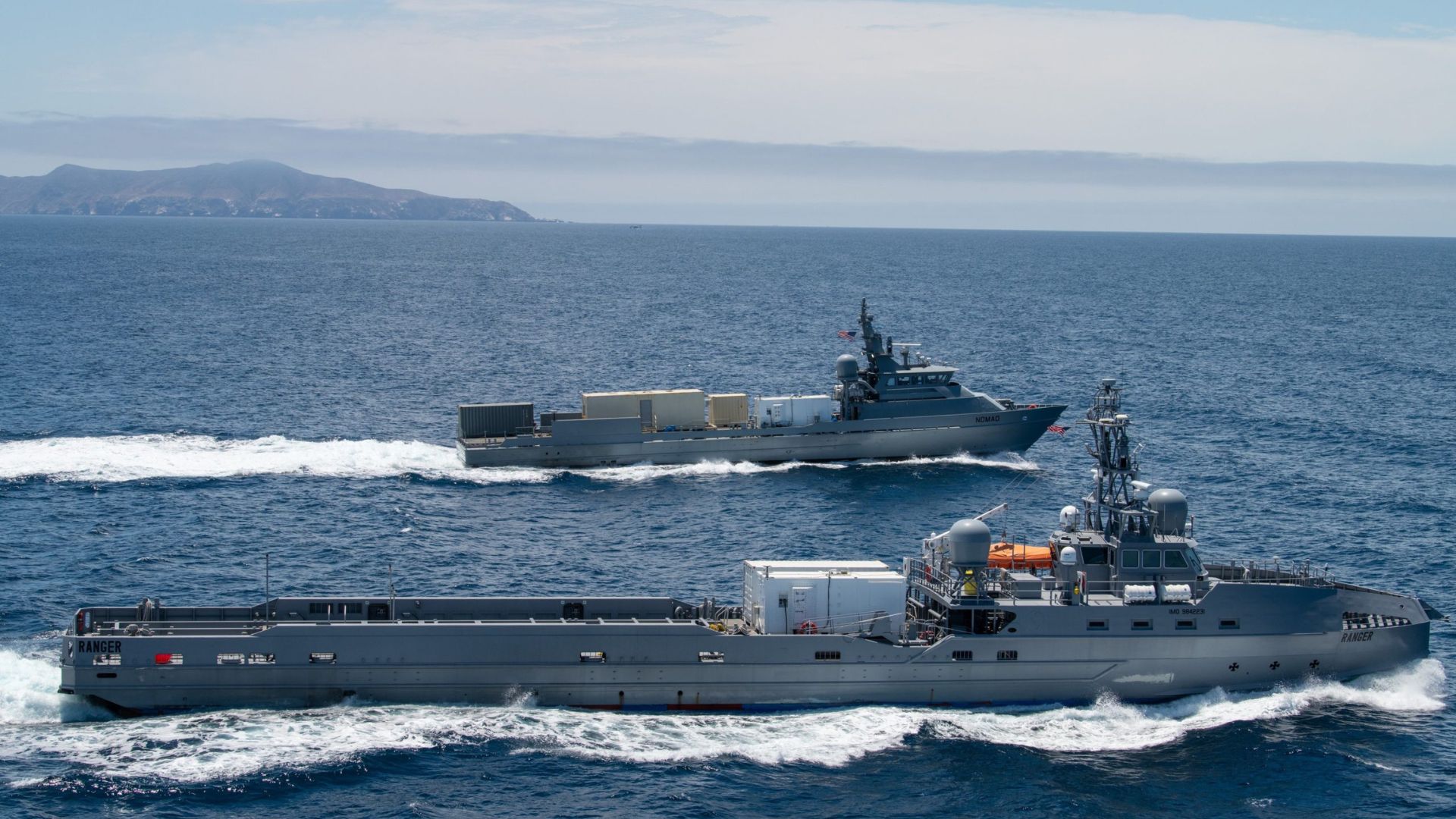
US Navy Program Places Containers at the Center of Unmanned Vessels, with Modular Loads That Can Be Swapped Based on the Mission and Integrated Quickly, Bringing Standardized Logistical Autonomy and Operational Flexibility at Sea to Expand Options for Presence, Surveillance, and Employment.
The United States Navy has formalized a program that places containers at the center of a new type of unmanned attack vessel, designed to receive modular loads and be reconfigured quickly according to the mission.
The proposal focuses on an unintuitive detail for the audience outside the naval sector: instead of relying solely on warships built around fixed systems, the idea is to use crewless vessels that transport ISO-standard modules as if they were “cargo” and can be swapped between platforms.
Modular Attack Surface Craft and the Bet on Modular Loads
The program is called Modular Attack Surface Craft, known by the acronym MASC, and was publicly presented through a request for contributions from industry, led by Naval Sea Systems Command, the naval acquisition command responsible for a large part of the Navy’s shipbuilding and modernization programs.
-
He started running at 66 years old, broke records at 82, and is now a subject of study for having a metabolic age comparable to that of a 20-year-old, in a case that is intriguing scientists and inspiring the world.

-
Oldest tree on the planet reappears after 130 years of searches: Wattieza, 385 million years old, was 10 meters tall and had no leaves or seeds; Gilboa fossils in New York solved the mystery in 2007.

-
A 48-square-meter house assembled in hours with 4,000 bricks made of recycled plastic that does not absorb moisture, has natural thermal insulation, and costs less than 90,000 reais in a complete kit.

-
Luciano Hang revealed that Havan’s air fleet has already accumulated more than 20,000 landings, 10,000 flight hours, and 6 million kilometers traveled, and he says that without the planes, the company would never have grown so quickly.

The official announcement states that the Navy sought to receive technical materials, such as white papers and presentations, to map solutions and capabilities that meet the MASC concept, focusing on the combination of autonomy, range, speed, and the ability to carry “modular payloads.”

The most striking element of the concept is the use of standardized containers as the physical mission unit, allowing the vessel to be prepared for different tasks without relying on a permanent structural modification of the hull.
ISO Container as Mission Unit at Sea
In practical terms, the container ceases to be just a logistical shell and begins to function as a support for sensors, electronic warfare, surveillance systems, command and control modules, and, in some publicly foreseen scenarios, armaments that can be embarked modularly.
The structure behind the concept relies on a known advantage of global transport chains: ISO containers are an international standard, compatible with existing infrastructure in ports, ships, and land facilities, which reduces the need to create a completely new logistical ecosystem to move mission modules.
By placing this standardization at the center of the design, the MASC emphasizes rapid reconfiguration, as the main set can be replaced by swapping the container module instead of reconstructing the platform for each specific function.
Requirements and Public Request Led by NAVSEA
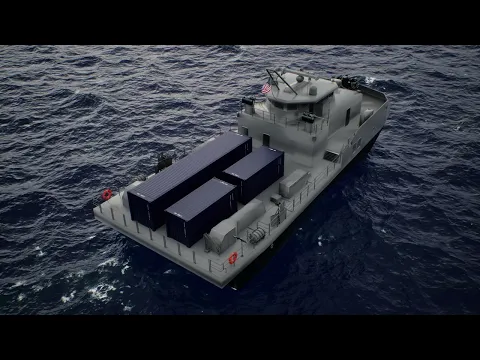

The solicitation published by the Navy details that the objective is not only to experiment with autonomous vessels but to obtain concrete alternatives for a family of unmanned platforms that can be employed in multiple scenarios, with loads that change according to operational needs.
This framework aligns with the path already taken by the US Navy in experiments with medium and large unmanned vessels, used to test autonomous navigation, integration with manned fleets, and the employment of embarked loads.
What Public Analyses from the US Congress Say
Public reports from the Congressional Research Service, the research agency of the US Congress, describe that the MASC appears as a reorganization that incorporates previous lines of unmanned vessels and begins to treat modularity as a development axis, with an emphasis on loads that can be developed separately and then integrated into the program.
This helps explain why the MASC is presented as a program around capacity, and not just about “a specific ship,” since part of the model’s value lies in the fact that the same hull can receive different modules, keeping the platform available for various tasks over time.
Platform Variations and Integration with Different Loads
Specialized defense and naval affairs vehicles have also detailed that the Navy is evaluating more than one vessel configuration within the concept, with variations based on load capacity and the number of container modules that each platform would be able to carry, precisely to accommodate different mission profiles.
This modular architecture also connects to a characteristic of the modern maritime environment: the sea is a vast space, with a high volume of traffic and great demand for persistent surveillance, which encourages models that allow distributing sensors and capabilities across more platforms, rather than concentrating everything into a few high-value units.

In public communication about the program, the Navy describes the search for solutions that can be scaled, indicating interest in projects that are not limited to a few prototypes but that can evolve to larger acquisitions, provided they meet technical and operational requirements.
Unmanned Vessels, Maritime Presence, and Risk Reduction
The use of unmanned vessels, in itself, introduces an additional layer of public interest, because it changes the debate on maritime presence, risk to crews, and persistence in long missions, since operations do not depend on keeping people aboard throughout the employment.
The core of the concept, however, lies in the combination of autonomy and the “interchangeability” of the content, since the same type of vessel can alternate between functions by receiving a container with surveillance sensors, another with electronic warfare equipment, or a module aimed at attack and deterrence tasks, as long as the package is compatible with the planned integration.
Existing Logistics and Speed of Reconfiguration
The Navy publicly explained that the request for the program was opened in a limited time period, and that the immediate objective was to collect proposals and technical information to support the next steps of the MASC within the acquisition process, including the evaluation of solutions and the design of more detailed requirements.
Even without treating the container as “camouflage” or visual elements, the modular design produces a direct operational effect: capability can be more flexibly displaced, as the “core” of the mission can be transported and repositioned by existing logistical means, rather than being tied to a single ship built around that system.
The public discussion about modularity also often highlights the potential to reduce the time between concept and demonstration, as modules can be tested on different platforms, shortening learning cycles and accelerating integration validation, provided that safety and operational requirements are respected.
The very choice of the term “modular” in the program’s name reinforces that the focus is on the idea that capacity does not need to be monolithic, but rather composed of blocks that can be combined according to the scenario, connecting autonomous vessels, container loads, and integration with command and control networks.
By placing standardized containers at the center of the MASC, the US Navy presents a model in which “cargo” ceases to be merely supplies and becomes the main unit of capacity, repositionable and replaceable, with direct implications for how presence, surveillance, and offensive power at sea are imagined.
If standardized containers can become the “heart” of an unmanned attack vessel, what limits still separate common logistics from military capability in modern maritime operations?








-

2 pessoas reagiram a isso.