





 Português
  Inglês
  Espanhol
  3 min de leitura
  0 comentários


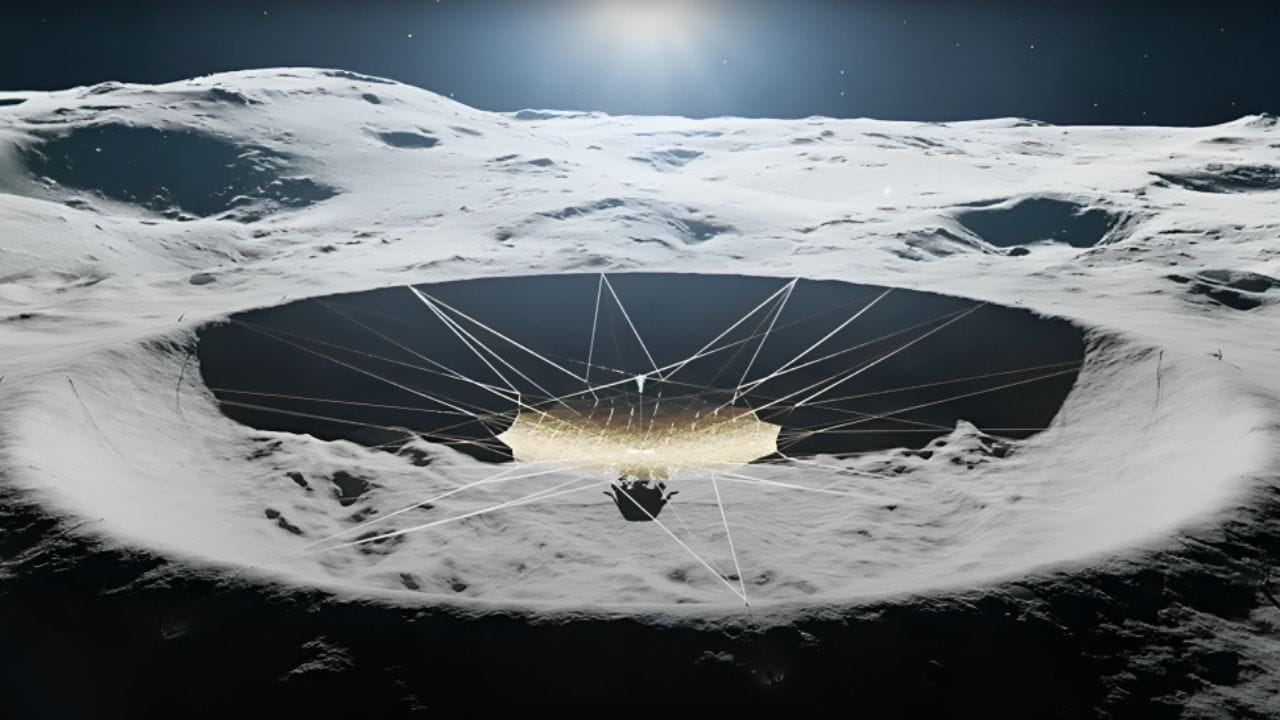
The Moon Telescope Project Is an Exciting Example of Scientific Potential and Innovation in Space Exploration. With an Estimated Cost Significantly Lower Than the James Webb Space Telescope, This Project Represents a Notable Advance in the Search for a Deeper Understanding of Our Universe.
NASA is planning a revolutionary project to build a telescope on the Moon, an initiative that promises to transform our understanding of the universe. Inspired by the success of the James Webb Space Telescope, which has already provided amazing images of the universe, this new project aims to go further by exploring the radio waves emitted in the primordial universe.
Overcoming the Limitations of Ground Telescopes
Ground-based telescopes, such as the famous Arecibo Observatory, face limitations due to atmospheric interference and light pollution. NASA’s proposal is to build a radio telescope on the Moon, using one of the many craters as a base. This telescope would be the largest ever built in space and, thanks to innovative engineering, could be significantly cheaper than the James Webb Space Telescope.
The basic concept involves using a lunar crater as a “bowl“, eliminating the need for heavy support structures. The idea is to build the telescope’s dish from wire mesh that naturally forms under the Moon’s gravity, creating a reflective dish. This method drastically reduces the system’s weight while maintaining the ability to reflect radio waves.
-
Found in one of the most radioactive places on Earth, this Chernobyl fungus may be doing something with radiation that no one has been able to explain to this day.

-
A bright yellow mushroom imported from Asia escaped from a cultivation farm in the United States in 2010 and is now aggressively spreading across 25 states, destroying entire communities of native fungi in American forests.

-
Buried under China, a colossal machine weighing 20,000 tons began operating as the largest neutrino detector on the planet and, in just 59 days, surpassed results that science took half a century to achieve.

-
Iran enters the center of a climate alert after the war emitted 5.6 million tons of CO2 in two weeks, surpassing the annual pollution of entire countries.


Below are some images taken by the James Webb Space Telescope.


Challenges and Innovative Solutions
Building structures on the Moon is not an easy task; the project requires finding the perfect crater, which must be on the far side of the Moon to avoid interference from radio noise from Earth. Moreover, the crater needs to have specific characteristics, such as suitable size and shape and a smooth terrain.
The telescope will focus on capturing information from the electromagnetic spectrum between 4.7 MHz and 47 MHz, which corresponds to wavelengths between 6.4 to 64 meters. For this, an ingenious design will be necessary, which includes the use of lightweight carbon fiber cables and a reflective mesh made of ultra-light material, such as gold-plated molybdenum.
Amazing Scientific Potential
This telescope on the Moon will not provide visual images like the James Webb Space Telescope, but it will offer data on the distribution of hydrogen in the universe. This could lead to new understandings of how the universe formed and evolved after the Big Bang. The BBC has an interesting article about the history of the universe.
Communication between Earth and the telescope will be a challenge, but with the increase in lunar missions, such as NASA’s Artemis program, it is expected that communication between the Moon and Earth will become more accessible and efficient.







-

Uma pessoa reagiu a isso.