





 Portuguese
  English
  Spanish
  4 min of reading
  0 comments


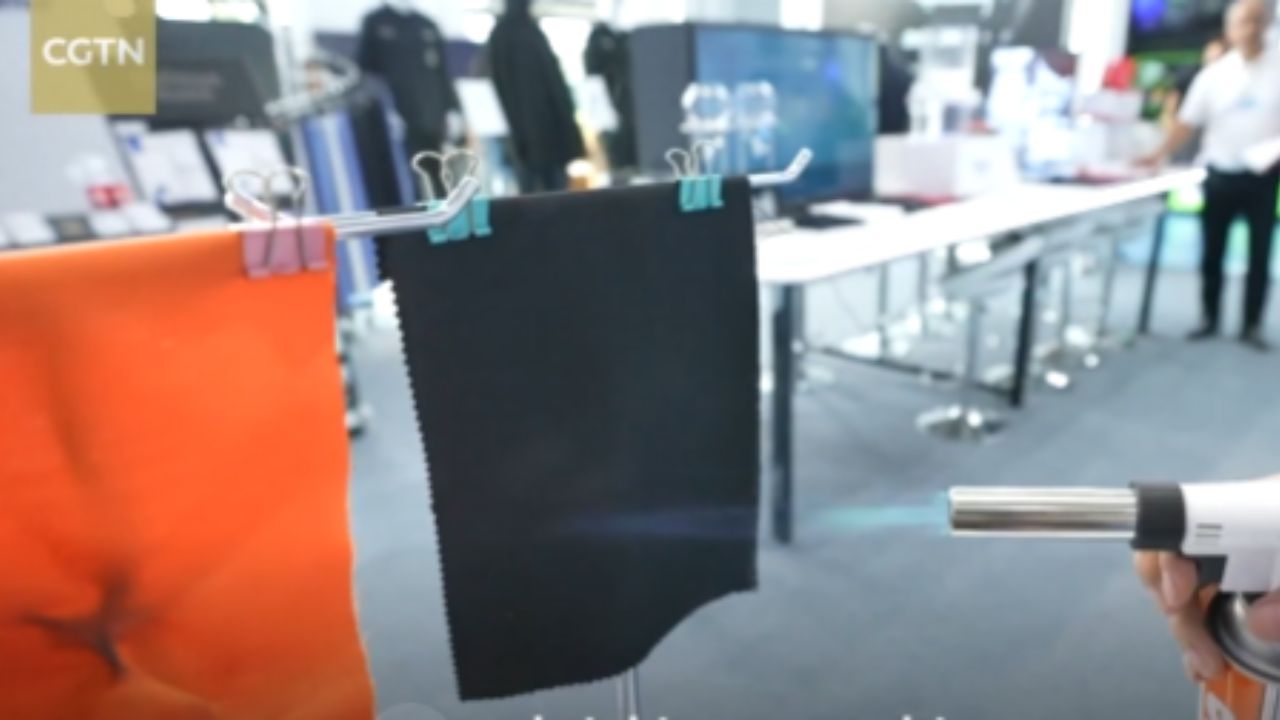
Safmax Presents Nanomembrane That Doesn’t Melt or Shrink, Technology That Could Revolutionize Fabric for Firefighters Globally.
A technological innovation from China promises to drastically increase the safety of firefighters. The company Safmax has developed a new fabric for firefighters capable of withstanding extreme temperatures of up to 1,200 degrees Celsius without deforming, shrinking or melting. The novelty was presented at the second Public Safety Technology Exhibition in Lianyungang, China, and reported by the portal Interesting Engineering.
The distinguishing feature of this material is not only its thermal resistance but also its structure. It is a nanomembrane that, according to the manufacturer, can be applied to common fabrics, offering extreme protection with lightweight properties. The development aims to address modern challenges, such as hard-to-control fires in electric vehicle batteries (NEV), becoming a solution considered “effective and convenient” for high-risk situations.
The Revolution of the Nanomembrane: Thin, Light, and Breathable
The most surprising aspect of Safmax’s technology is its dimension and functionality. Jiang Huangsen, the company’s CTO, revealed that the nanomembrane is only 1% the thickness of a human hair. Despite its thinness, the material has demonstrated to be simultaneously waterproof and windproof, crucial characteristics for protection against water jets and adverse weather conditions during firefighting.
-
How the terraforming of Mars can transform the planet: artificial aerosols can increase the temperature by up to 35°C in 15 years, creating conditions for liquid water.

-
Scientists drilled nearly 8,000 meters into the ocean floor above the fault that caused the 2011 tsunami in Japan and discovered that a layer of clay 130 million years old was responsible for making the wave much worse than any model had predicted.

-
Thousands of years after causing the largest eruption of the Holocene, one of the world’s largest supervolcanoes is rebuilding itself beneath the sea south of Japan, receiving new magma and alarming scientists with its transformation.

-
China has activated a magnet 700,000 times more powerful than the Earth’s magnetic field that operates for over 200 consecutive hours while consuming little energy, and now the world wants to know what Beijing plans to do with this technology in 2026.

However, the main complaint from firefighters regarding waterproof suits is the lack of breathability, which quickly leads to thermal stress and exhaustion. Safmax addressed this directly: during the demonstration, Huangsen proved that although water cannot penetrate the fabric, air is released quickly. This ability to “breathe” is vital for regulating the user’s body temperature during intense effort, combining external protection with internal comfort.
The Growing Problem of Battery Fires
The resistance of 1,200°C is not an arbitrary number; it targets one of today’s most dangerous problems: lithium-ion battery fires. These fires, common in electric vehicles, reach extremely high temperatures and are notoriously difficult to extinguish, as they can experience reignition (thermal runaway) even after hours. Safmax’s new material was specifically cited as ideal for fire blankets capable of isolating airflow in these incidents.
Unlike a conventional fire, where the focus is on cooling (water) or smothering (CO2), the thermal runaway of the battery generates its own oxygen internally. The ability of a fabric for firefighters to maintain its structural integrity without melting or shrinking under such intense heat is crucial for containing this type of fire. This offers rescuers a new tool for direct isolation, something that current materials cannot guarantee.
How Does the New Fabric Compare to Current Materials?
Currently, fire protection suits are complex, heavy, and expensive. As detailed by Interesting Engineering, they use multiple layers. The outer layer is usually made of aramid fibers, the most famous of which is Nomex, valued for carbonizing (forming a protective layer of charcoal) instead of melting and sticking to the user’s skin. Fibers like Kevlar are often incorporated to enhance tear and abrasion resistance.
Other fabrics, like cotton, rely on chemical flame retardant treatments (like phytic acid or ammonium polyphosphate) to gain resistance. These treatments can be reactive (binding to the fiber) or additive (coating the fabric). They work by releasing suppressive gases or creating an insulating layer, but the resistance is limited and can degrade with washing and use.
The proposal from Safmax, although the CTO did not disclose the exact chemical composition of the nanomembrane, seems to differ fundamentally. Instead of merely retarding the flame or carbonizing at lower temperatures, the nanomembrane promises to structurally resist up to 1,200°C. If this new fabric for firefighters can be produced at scale and at a viable cost, it represents a significant leap over conventional aramids, which degrade at much lower temperatures.
A New Era for Safety?
The introduction of this new material by Safmax could represent a paradigm shift in public safety. The ability to combine extreme thermal resistance with lightweight and breathability is the goal pursued for decades by the personal protective equipment (PPE) industry. The application would not be limited to firefighters but could extend to the metallurgical, military, and aerospace industries.









-

Uma pessoa reagiu a isso.