





 Portuguese
  English
  Spanish
  4 min of reading
  0 comments


Oi Can’t Survive: Company Declared Bankrupt, Leaving a Billion-Dollar Gap in the Brazilian Telecommunications Sector. Essential Services Will Temporarily Continue Under Judicial Management
The Court of Rio de Janeiro declared on Monday (10) the bankruptcy of Grupo Oi, one of the oldest and most emblematic operators in the country. The decision, signed by Judge Simone Gastesi Chevrand from the 7th Business Court of the Capital District, marks the end of a turbulent trajectory of attempts at judicial recovery and a past where the company was a symbol of the “national champions” project in the telecommunications sector.
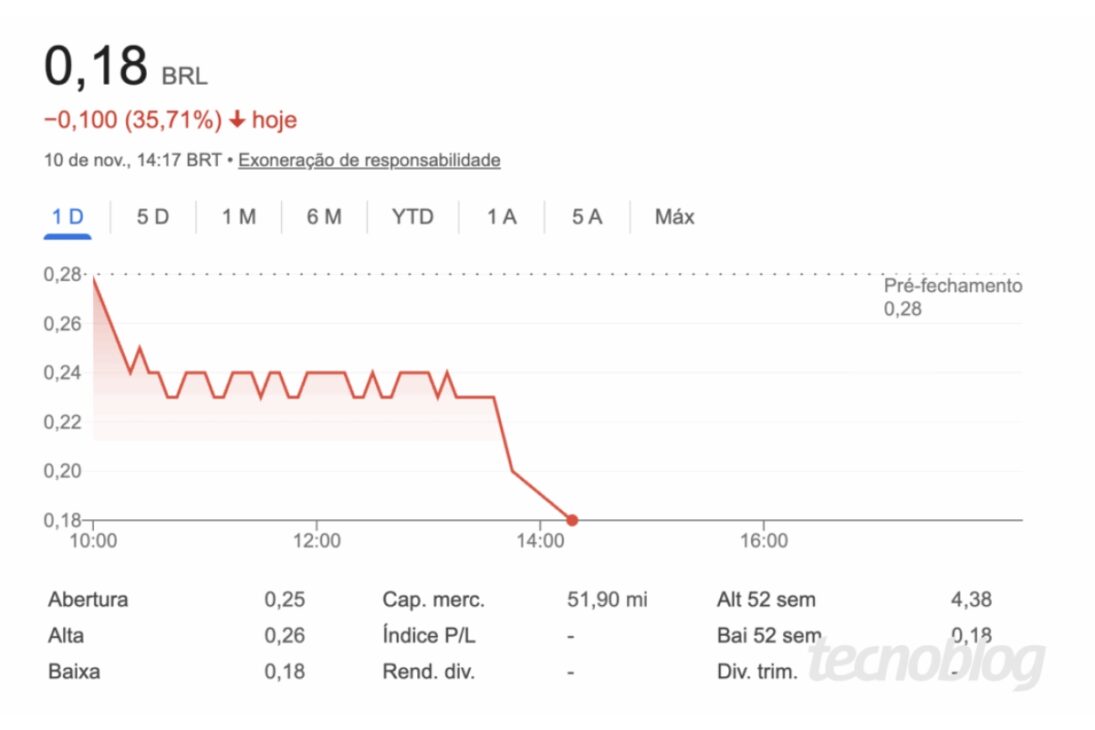
According to the magistrate, the company is “technically bankrupt” and “no longer presents sufficient business activity to justify its maintenance”. The announcement had an immediate impact on the market: Oi’s shares plummeted more than 35%, trading at only R$ 0.18 on B3, the Brazilian stock exchange.
Services Will Temporarily Continue
Despite the declaration of bankruptcy, some operations will be temporarily maintained. The subsidiaries Oi Soluções, Serede, and Tahto will continue to operate under judicial supervision to ensure the provision of essential services.
-
The institute that trained the greatest aerospace engineers in Brazil has just opened its first campus outside São Paulo after 75 years: ITA Ceará will have R$ 445 million, new courses in energy and systems, and classes are expected to start in 2027.
-
Luciano Hang, owner of Havan, goes to Juiz de Fora after the tragedy in February, brings R$ 1 million, hands out R$ 2,000 cards, and donates up to R$ 15,000 to victims in the region.

-
The Brazilian passport allows legal residence in dozens of countries without the need for a prior visa, and most Brazilians are unaware that they can apply for residency directly upon arriving in nations in South America, Africa, and even Europe.

-
Petrobras sends a message to Brazilian truck drivers after fuel collapse and reveals plan to have 100% domestic diesel.


Oi is still the only provider present in all states of Brazil, responsible for strategic contracts with public agencies and private companies. Among the critical services are the telephony and data systems for bank branches, ministries, and Cindacta, the Air Force agency responsible for national air traffic control.
According to the newspaper O Globo, some of these operations are already in transition. Cindacta, for example, will start being served by Claro, in a contingency move to avoid disruptions in high-priority systems.
Cash in Collapse and Imminent Bankruptcy
Oi’s situation had been deteriorating for months. Last Friday (7), both the judicial administration and the company’s management had already filed motions suggesting the liquidation of the company, with gradual discontinuation of services.
According to the process, Oi no longer generates enough cash to cover costs and operating expenses, in addition to having failed to comply with the Judicial Recovery Plan — the second since 2016. The management indicated that the available free cash was only R$ 50 million, while debt exceeded R$ 1.7 billion.
As a result, the Justice decided to remove the board of directors, paving the way for the direct action of the judicial administrator, who will oversee the orderly cessation of operations and the transfer of contracts to other companies in the sector.
From “National Champion” to Symbol of Collapse
Founded under the name Telemar, Oi was a protagonist in one of the largest restructurings ever seen in Brazilian telecommunications. During the early mandates of President Luiz Inácio Lula da Silva, the government encouraged mergers between large operators with the goal of creating “national supertelecoms”.
In this context, Oi merged with Brasil Telecom and later with Portugal Telecom, in an ambitious project that promised to turn Brazil into a regional powerhouse in the sector. However, the expansion became a financial burden, exacerbated by mismanagement, rising debts, and difficulties in adapting to the digital market.
Starting in 2019, the group began to divest from its main operations. The mobile service was sold to Claro, TIM, and Vivo, while the neutral network infrastructure was transferred to V.tal. The fiber optic arm became a new company, Nio, which surprised the market by freezing prices until 2028 — a strategy viewed by analysts as an attempt to preserve part of the legacy of the former operator.
An Uncertain Future for Customers and the Sector
Even with the declared end, Oi’s story will still have developments. TIM, which had already shown interest in acquiring Oi Soluções, is studying expanding its presence in the corporate market, which could mean incorporating part of the infrastructure and contracts of the bankrupt company.
Experts consulted by Valor Econômico state that Oi’s bankruptcy represents a milestone in the consolidation of Brazilian telecommunications, opening up space for new investments, but also raising concerns about reduced competition and the risk of market concentration.
“Brazil loses a company that, with all its mistakes, was essential in bringing internet and telephony to regions where other operators did not reach,” said economist and infrastructure consultant Fernando Oliveira, in an interview with the portal Poder360.
For now, the judicial administrator will continue to control the subsidiaries and try to ensure a minimally orderly transition. However, for many analysts, Oi’s collapse seals the end of an era — and symbolizes the price the country pays for poorly planned industrial policies and decades of accumulated debts.










Seja o primeiro a reagir!