





 Portuguese
  English
  Spanish
  4 min of reading
  0 comments


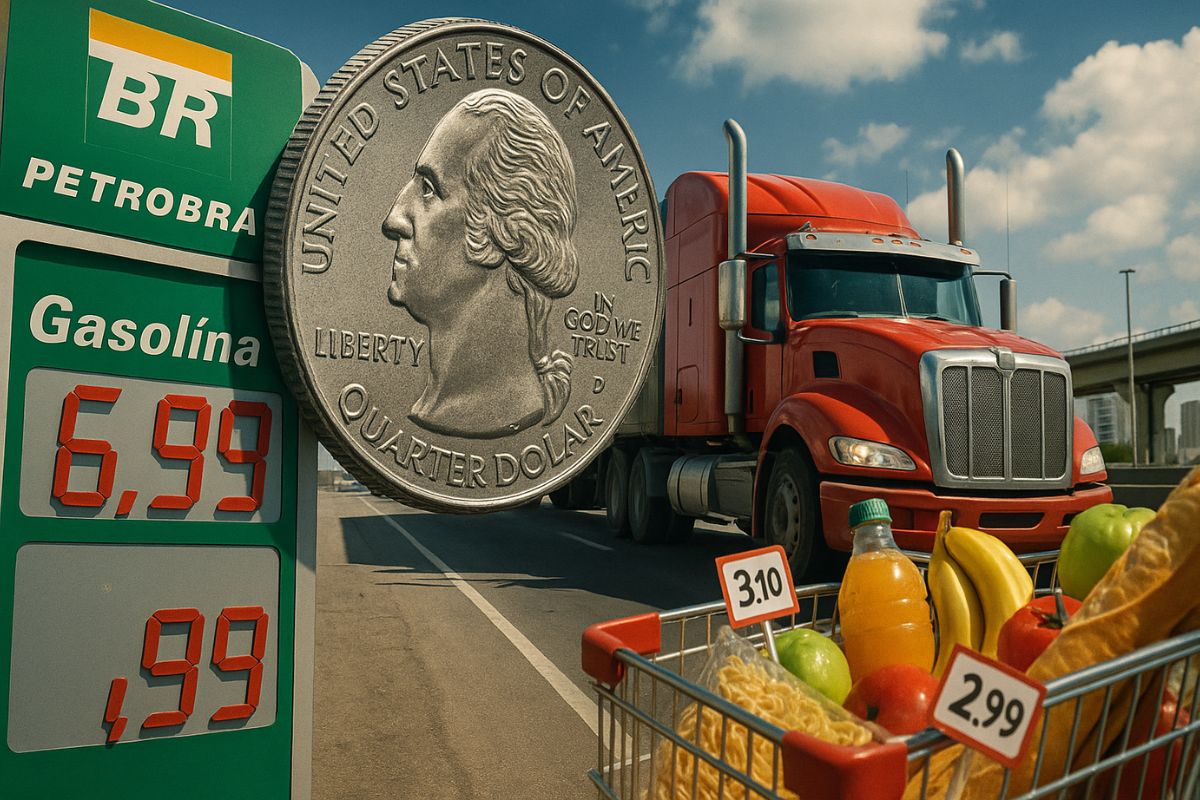
The Price Policy of Petrobras, Which Keeps Gasoline Influenced by the Dollar and the International Market, Impacts the Entire Brazilian Economy by Increasing Transportation Costs, Driving Up Freight and Directly Reflecting on the Price of Food and Products on Shelves.
The price policy of Petrobras defines how much Brazilians pay for gasoline, diesel, and indirectly, for almost everything they consume daily. Even with the formal end of the old Import Parity Policy (PPI) in 2023, fuels continue to be influenced by fluctuations in the dollar and the oil barrel, as Brazil still depends on imports to balance its domestic supply.
In practice, when the dollar rises, the price of oil and derivatives also increases in reais, raising the cost of fuel at refineries and, in turn, the price at the pump. This variation directly affects cargo transport, which is mostly road-based, creating a domino effect that increases the prices of food, manufactured products and services across the country.
Understanding the Old PPI and the New Pricing Model
Implemented in 2016, the PPI determined that the prices charged by Petrobras should be equivalent to those in the international market, considering the value of the oil barrel, the dollar exchange rate, and import costs.
-
Brazilian city bets on the business environment to generate jobs and attract investments in the energy sector — secretary reveals strategy at Macaé Energy 2026.

-
50 viaducts, 4 tunnels, 28 bridges, and 40 kilometers of bike paths: BR-262 in Espírito Santo will receive 8.6 billion reais for the largest engineering project in the state’s history, inspired by the Immigrant Highway in São Paulo.

-
Brazil produces too much clean energy and doesn’t know what to do with it: over 20% of solar and wind capacity was wasted in 2025 while investors flee and 509 renewable generation projects were abandoned in the last year.

-
Piauí will produce a new fuel that replaces diesel without needing to change anything in the truck’s engine and reduces pollutant gas emissions by half: truck drivers from all over the Northeast are already celebrating the news that will arrive later this decade.


The goal was to ensure competitiveness and avoid losses for the state-owned company, but the result was greater volatility in domestic prices, sensitive to any exchange rate or geopolitical variation.
In 2023, Petrobras replaced the PPI with a policy that takes into account domestic production costs, logistics and internal competition, reducing direct dependence on international pricing.
However, oil and exchange rates still strongly influence prices, as part of the fuels sold in the country is imported and paid for in dollars.
In other words, even with the new model, the Brazilian economy remains vulnerable to external fluctuations, which explains why international oil price increases or depreciation of the real are still quickly felt at the pumps and in supermarkets.
The Direct Impact on Fuels and Transportation
When the price of oil rises or the dollar appreciates, fuel becomes more expensive for distributors, who pass the increase on to gas stations.
Diesel, an essential fuel for cargo transport and buses, is the most sensitive to this variation.
With diesel more expensive, transport companies and independent truck drivers raise freight prices to compensate for increased operational costs.
This increase is passed on to production and retail companies, which in turn impacts the final price of products.
According to economists, about 60% of everything sold in the country reaches consumers via road transport, making fuel costs a determining factor in the formation of prices in the economy.
The Domino Effect: From Fuel to Food Inflation
The increase in fuel prices has a domino effect that crosses the entire production chain. It starts at refineries, goes through transport companies, and ends up in the shopping cart.
In the field, rural producers spend more on freight and inputs, many of them also priced in dollars, such as fertilizers and agricultural pesticides.
As a result, the cost of food production rises.
Processing industries and supermarkets, in order not to reduce their profit margins, pass the increase on to the final consumer, raising the prices of basic items such as rice, beans, fruits, meat, and milk.
This mechanism explains why hikes in fuel prices often precede periods of food and transportation inflation, two categories that weigh most on the budgets of Brazilian families.
The Dependence on Road Transportation and Brazilian Logistics Costs
Brazil is a country of continental dimensions, but still depends almost exclusively on road transportation to move its production.
It is estimated that over 65% of goods are transported by trucks, which operate on diesel.
This dependence makes the country extremely vulnerable to variations in Petrobras prices.
When fuel prices rise, the logistical costs for companies increase, and since transportation is an essential part of the supply chain, inflation spreads to various sectors—from agriculture to industry.
While countries with strong use of rail or water transportation can cushion these fluctuations, Brazil feels the impact almost immediately, which helps explain the weight of the state-owned company’s pricing policy on the cost of living.
The Search for Balance and the Challenges Faced by Petrobras
The Petrobras seeks a balance between financial sustainability and the social impact of its prices.
As a mixed-economy company, with majority ownership by the Union, it needs to maintain competitiveness and profitability without exerting excessive pressure on inflation.
However, fuel pricing is a sensitive and political issue.
Artificially reducing prices can generate losses and deter investors; on the other hand, keeping them aligned with the international market directly penalizes consumers and productive sectors.
Experts argue that, to reduce dependence on the dollar, the country needs to diversify its logistics matrix, invest in domestic refining, and strengthen the use of biofuels and electric energy in transportation.









Seja o primeiro a reagir!