





 Portuguese
  English
  Spanish
  4 min of reading
  5 comments


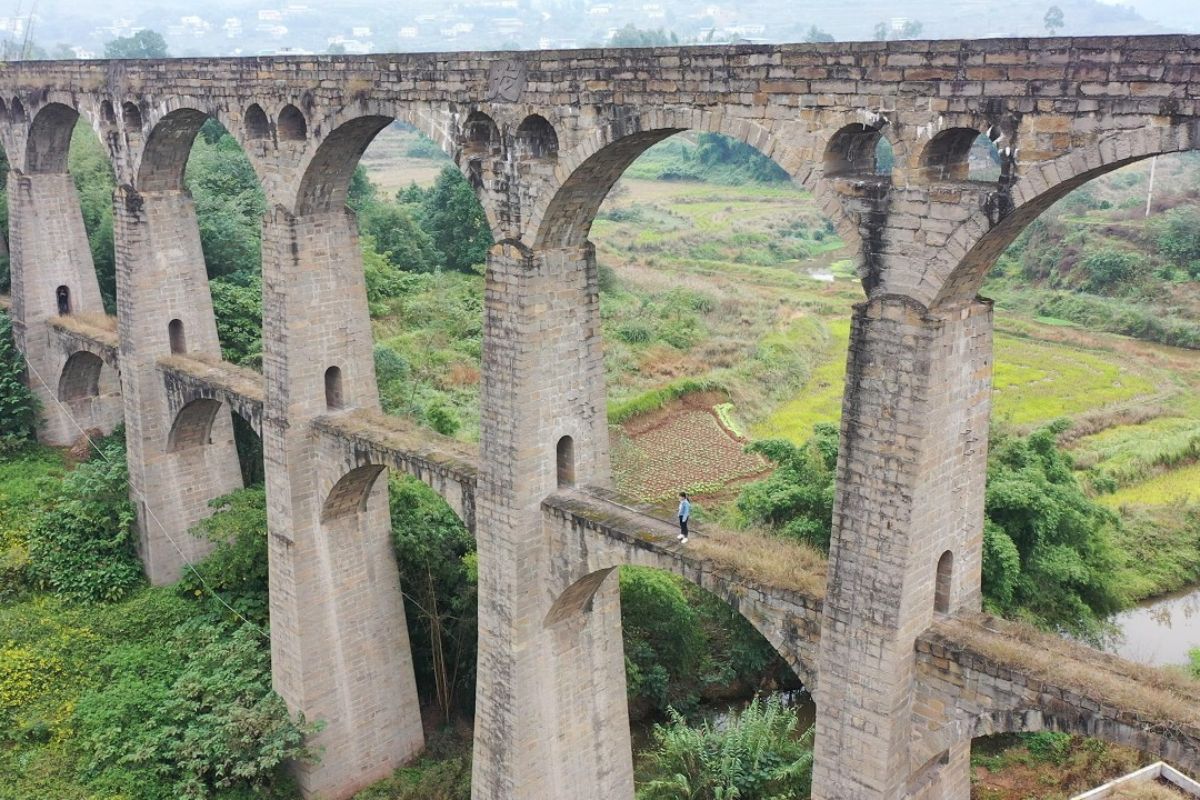


Eriged in Yongchuan, in Chongqing, this Chinese two-story bridge functions as an aqueduct on the upper part and pedestrian passage on the lower part, bridging traditional engineering and rural landscape.
The Chinese bridge known as Flying Dragon Aqueduct is a rare example of a two-layer structure where water flows above while people walk below. Built in the late 1970s in Yongchuan, a district of Chongqing, it combines the function of aqueduct and bridge, crossing two hills and following the course of a river paved with stone slabs.
Made of stone masonry, without a single steel bar and built practically by hand, in an era of limited machinery, this Chinese bridge features 11 arches, seven of which are two-story structures, reaching about 30 meters at its highest point. With over 40 years of continuous use, the Flying Dragon Aqueduct remains stable, adapted to local daily life and recognized as a historical building in Chongqing.
A Chinese Two-Layer Bridge
What makes the Flying Dragon Aqueduct unique is its design in two levels.
-
A gigantic dam project in the Himalayas could solve one crisis but silently create another for millions of people.
-
Nikola Tesla said that intelligent people tend to have fewer friends, and now science partially confirms this: a study with over 15,000 people showed that for the more intelligent, socializing too much can even reduce life satisfaction.

-
A superyacht worth US$ 17 million is delivered in impeccable condition, sets out to sail, and hits a bridge in the Bahamas just two hours later.

-
Residents of Australia woke up to a sky completely red like blood before the arrival of Cyclone Narelle, which hit the coast with winds of 250 km/h, tearing off roofs and lifting iron dust in a scene they described as apocalyptic.


On the upper layer, the ancient water channel runs, designed to divert and distribute water resources to plantations and agricultural lands.
On the lower layer, beneath the stone arches, is the passage meant for pedestrians and local residents.
This Chinese bridge was built between two hills, with a river flowing below and the bed paved with stone slabs, allowing for pedestrian passage during dry periods.
The set of 11 arches, seven of which are two-story, creates a sequence of spans that shapes the landscape of Yongchuan, in Chongqing, and reinforces the unique character of this aqueduct.
Yongchuan and Chongqing as the Stage for the Flying Dragon Aqueduct
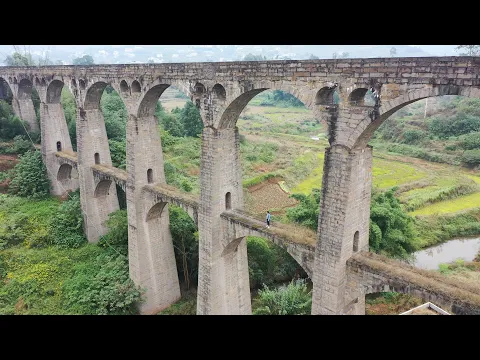

Located in Yongchuan, a district of Chongqing, the Flying Dragon Aqueduct is part of the regional historical heritage.
A plaque affixed to the structure identifies the work as “historical building of Chongqing – Flying Dragon Aqueduct,” reinforcing the symbolic and cultural value of this Chinese bridge to the community.
Over more than four decades, the Flying Dragon Aqueduct has witnessed the transformation of its surroundings.
It carries the memories of residents, rural workers, and travelers who use it daily, establishing itself as a visual and emotional reference in Yongchuan.
The landscape formed by the stone arches, the hills, and the vegetation that has settled on the structure is already part of Chongqing’s local identity.
Stone Engineering and Manual Labor
The main technical characteristic of this Chinese bridge is the exclusive use of stone masonry. There are no fired bricks or visible steel reinforcements.
Each block was hand-carved and laid, as evidenced by the tool marks preserved on the stone surfaces.
Completed in 1979, the Flying Dragon Aqueduct was born in a context of low mechanization and limited availability of large construction machinery.
The solution was to rely on intensive manual labor and traditional masonry techniques, resulting in a robust aqueduct, with a height close to 30 meters and an estimated length of 300 to 500 meters.
The upper channel, about 1.5 meters deep, acts as a continuous trough, designed to carry a significant volume of water.
The structural design, with successive arches and well-distributed weight, explains why this aqueduct remains solid after more than 40 years, even exposed to rain, wind, and vegetation growth at the edges.
From Agricultural Aqueduct to Suspended Road
In the early years, the Flying Dragon Aqueduct was dedicated to irrigation.
Water flowed through the upper level to feed crops and agricultural lands in Yongchuan, taking advantage of the natural slope of the terrain and eliminating complex pumping.
The aqueduct was central to the rural infrastructure of the region.
With the advancement of new irrigation technologies in Chongqing, the channel ceased to be essential for agricultural supply and gradually fell out of its original use.
The upper bed, once dominated by water, now displays herbs and plants at the edges but maintains a clean central path, visibly used by residents as an elevated passage.
The lower part continues to be active as a pedestrian route.
Local people, animals, and even dogs cross the Chinese bridge daily, turning the old aqueduct into a kind of suspended road.
The structure, which once served solely as a hydraulic equipment, has transformed into multi-functional infrastructure, with logistical and social roles.
Living Heritage That Resists for Over 40 Years
Although the upper channel no longer fulfills the continuous function of water transport, the Flying Dragon Aqueduct remains in use and in good structural condition.
Trees have grown on the sides, likely from seeds brought by birds, integrating into the landscape of the Chinese bridge without compromising its visible stability.
The classification as a historical building of Chongqing reinforces the value of this aqueduct as cultural and technical heritage of the Yongchuan region.
At a time when large structures depend on steel, reinforced concrete, and heavy machinery, the fact that a stone structure, built manually, remains strong four decades later is a testament to the local constructive intelligence.
The Flying Dragon Aqueduct is, at the same time, a Chinese bridge, an aqueduct, a rural path, and a monument to human capacity to adapt the landscape.
And you, would you dare to cross this Chinese bridge walking through the old water channel, nearly 30 meters above the valley?







Acho que os romanos já faziam isso A.C. (Antes de Cristo).Alguns aquedutos funcionam até hoje. Os aquedutos que alimentavam Roma foram todos destruídos pelos “bárbaros” invasores.
Sempre copiaram tudo. Fato.
Será que ela é mais antiga do que o aqueduto romano que foi construída o mesmo propósito