





 Portuguese
  English
  Spanish
  5 min of reading
  0 comments


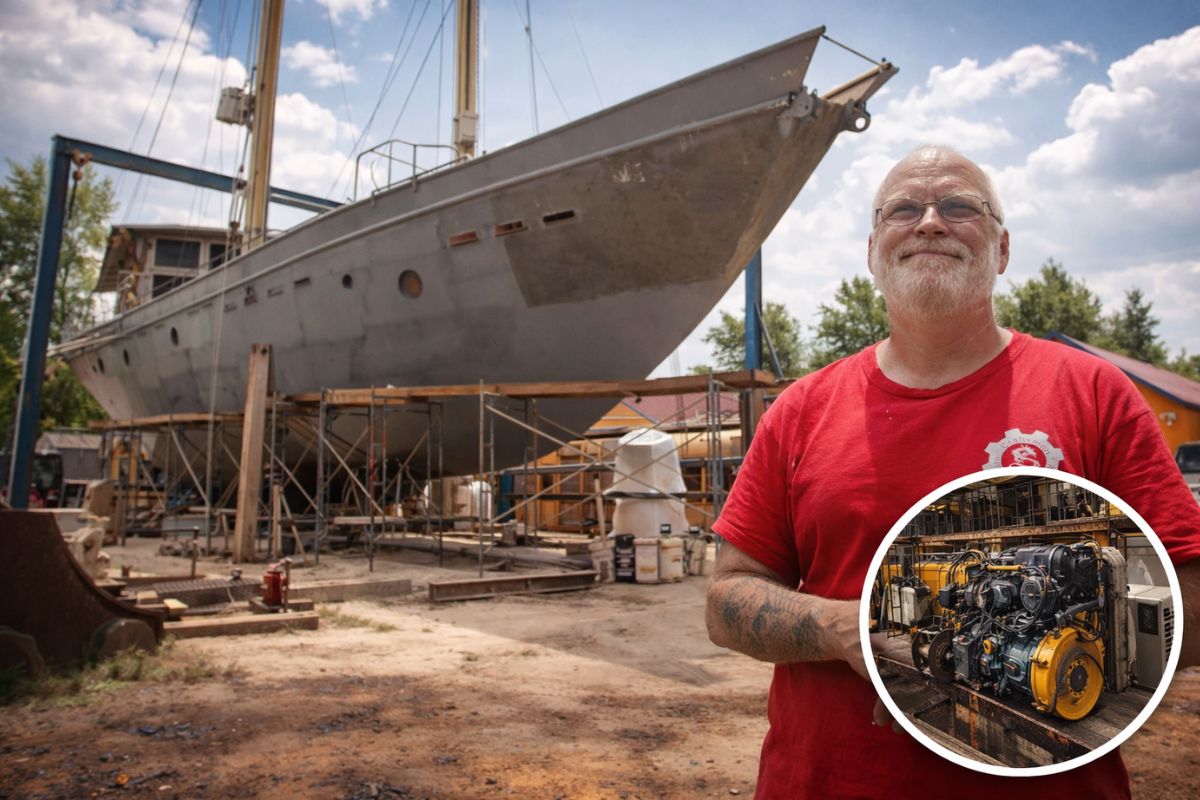
Doug Jackson, IT retiree from Tulsa, Oklahoma, spent eight years building a 22-meter sailboat in his backyard. The SV Seeker was built with a school bus engine, light poles for masts, and handmade waterproof doors, and will function as a free scientific research vessel for oceanographers and marine biologists.
In Tulsa, Oklahoma, a city hundreds of miles from the nearest ocean, an IT retiree decided to build a 22-meter sailboat in his backyard. Doug Jackson, a former Oracle database administrator, worked for eight years on the SV Seeker project, a steel sailboat with an origami hull, a diesel engine taken from a school bus, and masts made from utility poles. The boat is not a luxury yacht. It is a functional vessel that Jackson plans to turn into a floating laboratory for free research.
What makes this story unique is not just the scale of the boat—22 meters is larger than many houses—but the way it was built. Jackson invested about 300 to 350 thousand dollars in the project, partly from his own funds, partly from material donations, and from hundreds of volunteers who traveled from all over the world to help with the construction. The result is a boat made from repurposed parts, ingenuity, and a motivation that Jackson humorously summarizes as being “the redneck version of Jacques Cousteau.”
A 22-meter boat made with parts that no one else wanted

The list of materials for the SV Seeker looks like a junkyard inventory, and largely it is. The engine is a 210-horsepower Cummins diesel taken from a school bus that was parked on the lot next to Jackson’s house.
-
China is building a city in Brazil: a complex with an investment of R$ 5.5 billion comes to light, but allegations involving workers draw attention.

-
While Argentina buys old war equipment, Brazil is keeping an eye open and joins the select group of nations with advanced military technology by investing $5.2 billion, producing 36 Gripen fighters in the country, and reducing operational costs.

-
Brazil on alert? Why invading Brazil is a NIGHTMARE for the USA: 8.5 million km², 213 million inhabitants, Amazon covering 60% of the territory, trillion-dollar war, and resistance that even 13,000 aircraft could not control.

-
How to build a floating island from scratch with reeds, giant blocks, and stakes in the lake in a process that needs to be repeated almost every day.

The masts of the boat are utility poles: one came from Illinois and the other from a junkyard in Tulsa. The anchor winch came from a demolition truck.
The waterproof doors have a story of their own. Jackson tried to buy them at an auction in Oklahoma City, thinking that no one would be interested in waterproof doors in the middle of rural America.
They were sold for 2,600 dollars each, so he decided to make his own from scratch, by hand, incorporating art into each piece.
The deck supports throughout the boat are mermaids cut on a CNC plasma machine. The interior tiles are made of ipe, a Brazilian wood purchased as leftover scraps from decks discarded by others.
The fear that made Jackson start building the boat
The motivation behind the SV Seeker was not a passion for sailing—it was fear. Jackson stated that he built the boat because he was afraid of doing big things and decided to change his life. “I looked at the world and people were doing fantastic things, and I wasn’t one of them. I decided to grow,” explained the IT retiree.
This mindset was not new. Since childhood, Jackson built things with his father—tractors, plumbing, hoes. The most memorable experience before the boat was the Argonaut Jr., a wooden submarine that he effectively launched in a lake.
The submarine worked, sank, and came back to the surface, and the experience taught Jackson that concepts like Boyle’s law gain real meaning when you hear the wood creaking around you because you forgot to put enough air pressure inside the hull.
The YouTube channel that transformed the boat into a collective project
Jackson needed a way to document the construction and created the SVseeker channel on YouTube. What started as a personal record turned into a global community that brought volunteers, ideas, material donations, and money to the project. Over the eight years of construction, hundreds of people traveled to Tulsa to help with the work.
The process was simple: someone saw a video of Jackson welding, showed up in the backyard to help, and both learned from each other.
“I thought it would be me building this boat, but it turned out to be much better”, said Jackson. Donations came in the form of materials, technical knowledge, and volunteer labor, and each contribution transformed the boat into something better than Jackson could have built alone.
A Chinese sailboat made of junk with a double keel and an origami hull
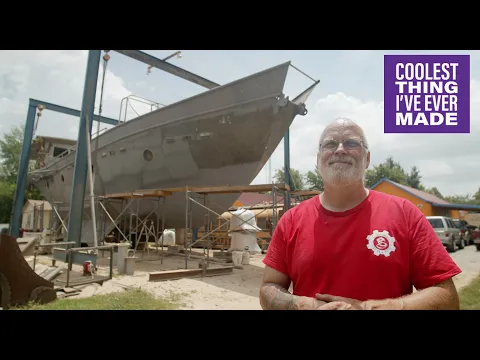

The SV Seeker is not a conventional boat. It is a Chinese sailboat with a double keel a design that allows the boat to park on its own keels when the tide is low, enabling the crew to get out and perform maintenance on the hull, scrape barnacles, and work on the propeller without needing a dry dock. For Jackson, it is the cheapest way to keep a boat at sea.
The hull was built using the origami method: steel sheets are folded into shape and welded, creating a boat with ripples and imperfections that Jackson accepts without issue.
“If you’re making a fancy yacht, you smooth everything out. We don’t care. We’re going to dent it anyway”, he explained. The sails follow the traditional Chinese plan without any Western modifications, and the boat will be piloted from a pilothouse on the upper deck, where navigation and sail handling are controlled.
How to transport a 22-meter boat from Oklahoma to the ocean
The question everyone asks Jackson is how he will get the boat to the water. The answer is surprisingly practical: wheels and a truck. The plan involves two sets of double axles positioned on each side of the boat, connected by a carriage. The boat becomes the trailer itself, towed by a truck with a fifth-wheel hitch.
The destination is the Port of Catoosa in Tulsa just 24 kilometers straight from Jackson’s backyard. From there, the boat will travel through waterways until it reaches the ocean.
When asked how long it will take, Jackson deflects: “I used to work with deadlines, and they’re great for corporations. But for fun and when you have time to learn, you need time. It will take as long as it takes.”
The boat that will offer free scientific research
The SV Seeker was not designed for leisure cruises. Jackson intends to turn the boat into a free research vessel, available for oceanographers, marine biologists, and archaeologists who need access to the sea to conduct science but do not have the budget for chartering.
The inspiration comes directly from Jacques Cousteau, whom Jackson watched on television during his childhood.
The boat features crew accommodations with bunks, a bathroom with a shower, a cargo hold, and a complete pilothouse. “I think I’m so happy now because I’m getting closer to being the redneck version of Jacques Cousteau”, summarized Jackson.
An IT retiree, a backyard in Oklahoma, junkyard parts, and eight years of work, and in the end, a 22-meter boat ready to take science to the ocean.
What did you think of Doug Jackson’s story? Would you have the courage to build a boat in your backyard? Leave your opinion in the comments.





Seja o primeiro a reagir!