





 Portuguese
  English
  Spanish
  6 min of reading
  0 comments


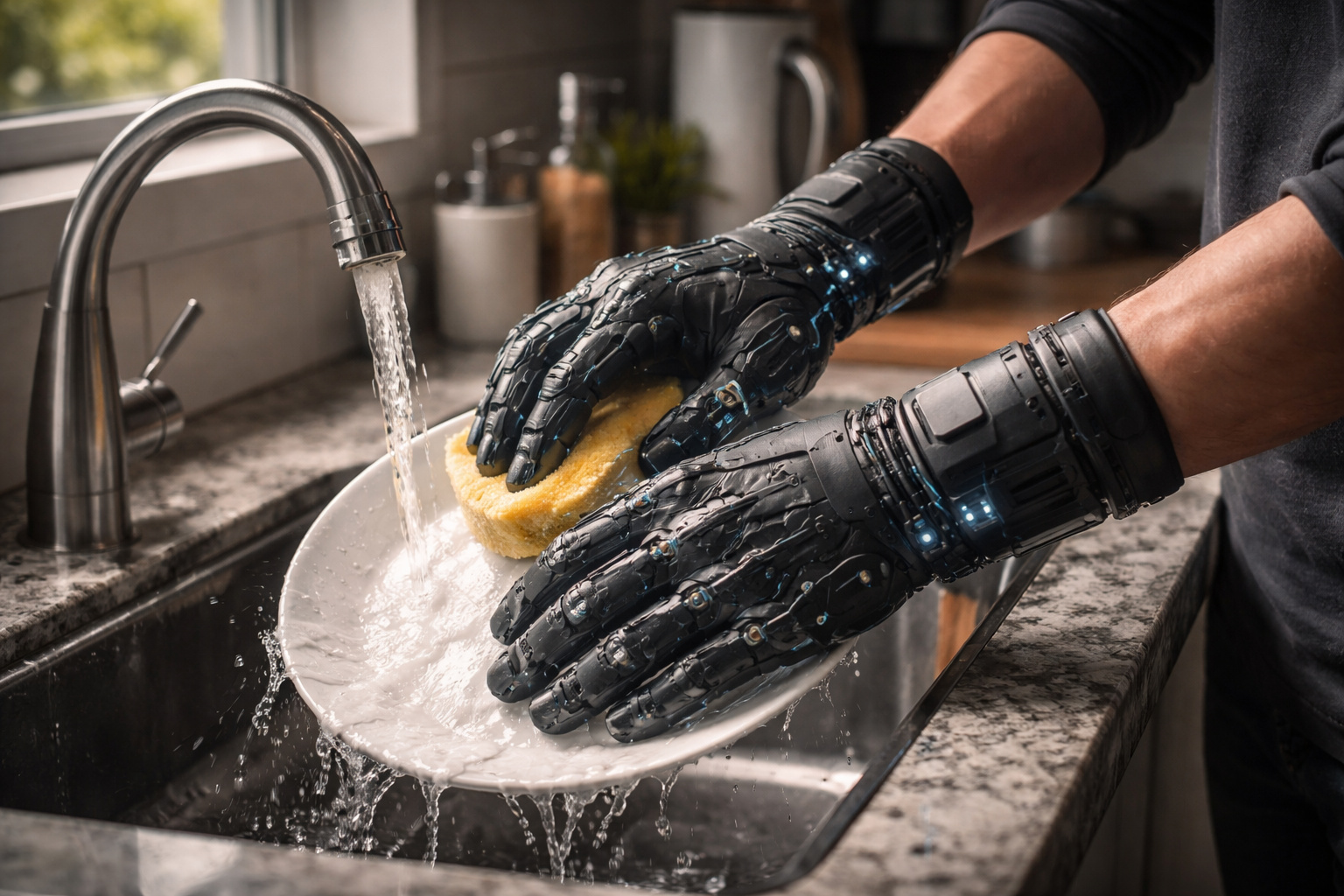
Robotic gloves capture human movements at home and train household robot with 10 million real tasks collected in the US
In 2025, according to a report from AI Business, the startup Sunday Robotics, founded by PhD researchers from Stanford University, began sending robotic gloves to homes in the United States with the aim of capturing human movements in real household tasks. The initiative resulted in the creation of a database with about 10 million episodes of household activities collected from over 500 homes, considered one of the largest in the world for training household robots.
The technology allows for real-time recording of the position, pressure, and angle of each finger, directly feeding artificial intelligence systems that train the robot Memo, capable of cleaning tables, loading dishwashers, folding clothes, and making coffee. The project represents a structural change in how robots are trained, replacing controlled environments with real-world data.
The problem of domestic robotics: why robots fail in real homes
Industrial robots operate with high efficiency in factories because they work in predictable environments, where objects are always in the same positions and conditions. In the home environment, this logic does not apply.
-
In a flooded well, archaeologists found a 1,700-year-old Roman egg that still contains clear and yolk intact inside the very thin shell.

-
Something is happening around the Earth: Inside the huge explosion of fireballs in 2026

-
A hot air bubble coming from Argentina expands over Brazil, causing thermometers to exceed 38 degrees with a thermal sensation of 40 degrees in late March, affecting 6 states at once.

-
The radish leaf that almost everyone throws away has more polyphenols, flavonoids, and fiber than the consumed root, and a 2025 study showed that the leaf contains compounds that protect the intestine, combat inflammation, and may inhibit the growth of cancer cells.

Kitchens vary in layout, utensils change shape, objects appear out of place, and unpredictable factors, such as pets or children, constantly alter the scenario. This creates a central challenge for domestic robotics: the lack of sufficient real and varied data to train artificial intelligence systems in dynamic environments.
CEO Tony Zhao summarizes the problem by stating that robots trained in laboratories rarely function in unpredictable environments. This limitation has stalled the advancement of domestic robots for years.
200-dollar robotic glove replaces 20-thousand teleoperation systems
The traditional method for training robots involves teleoperation, where humans remotely control machines while their actions are recorded. This process is expensive, slow, and restricted to the environment where the robot is physically present.

Sunday Robotics replaced this model by sending robotic gloves directly to homes. The Skill Capture Glove costs about 200 dollars to produce and serves the same data capture function.
The critical difference lies in scale and diversity, as the collection occurs in thousands of real environments, eliminating the need to replicate domestic scenarios in a laboratory.
How the robotic glove that captures finger movements works
The Skill Capture Glove is designed to exactly replicate the geometry of the Memo robot’s hands. This allows the captured data to be transferred directly to the robotic system without loss of precision.
During tasks like washing dishes, the sensors record:
- Movement of each finger
- Force applied to objects
- Rotation of the hands
- Positional adjustments
This process, called Skill Transform, converts human actions into robotic commands with a success rate of approximately 90%.
This eliminates one of the biggest barriers in robotics: translating complex human movements into machine commands.
Memory Developers: ordinary people train robots without technical knowledge
The users who receive the gloves are called Memory Developers. They have no technical training and perform household tasks normally while data is captured.

The diversity of environments is essential. Each household has unique variations, allowing the artificial intelligence model to learn to handle unpredictable scenarios.
Among the collected data, there are unusual situations that would be difficult to replicate in a laboratory, such as out-of-pattern objects or unexpected interferences. This variability is what makes the training more robust and applicable to the real world.
Database with 10 million real household tasks
The system has already accumulated about 10 million episodes of household tasks in over 500 homes in the United States.
Each episode represents a complete sequence of actions, such as organizing a dishwasher, from collecting the dishes to activating the equipment.
According to investors like Eric Vishria from Benchmark, this volume still represents only a fraction of what is needed. Even so, it already constitutes one of the largest databases in the world for domestic robotics, with sufficient diversity to train advanced models.
Robot Memo: machine trained with real data for complex household tasks
Memo is the robot developed by Sunday Robotics to operate based on the data collected by the gloves.
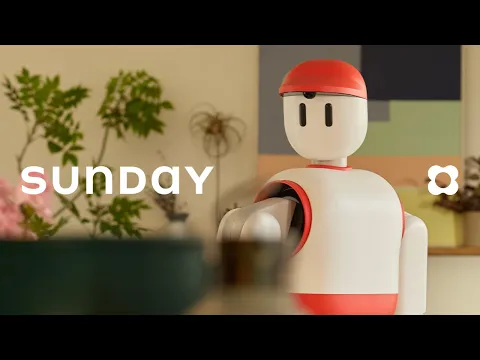

Unlike humanoid robots with legs, Memo uses a wheeled base, eliminating the balance challenge and concentrating processing in the hands and arms. This decision allows for greater efficiency in tasks such as:
- Cleaning tables
- Organizing utensils
- Loading dishwashers
- Making coffee
- Folding clothes
The focus on object manipulation makes Memo more functional in the home environment than complete humanoids.
Complex tasks of domestic robotics and ACT-1 model
The tasks performed by Memo are classified as “long-horizon,” meaning they require multiple steps and contextual decisions.
Cleaning a table involves dozens of different interactions, including delicate manipulation of fragile objects. The ACT-1 model, trained with data from the gloves, allows the robot to perform these actions with precision.
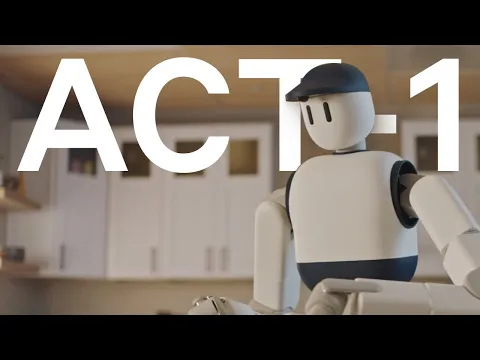
A practical example is the ability to hold two wine glasses simultaneously without breaking them, something that requires refined control of force and coordination.
35 million dollar investment boosts domestic robotics
Sunday Robotics was founded by Tony Zhao and Cheng Chi, both PhDs in robotics from Stanford. The company started in a garage equipped with 3D printers operating continuously.
The project received 35 million dollars in investments from funds like Benchmark and Conviction. Currently, the production cost of the Memo robot is about 20 thousand dollars, with expectations of reducing it to less than 10 thousand at industrial scale.
This positions the robot as a future high-end appliance, not just an industrial tool.
In November 2025, the company opened applications for the Founding Family Beta program, which will select 50 families to test the Memo robot.
Participants will receive customized units and direct support from the engineering team. The goal is to identify flaws and improve the system before commercial launch. The robot is not yet available for purchase and will only be released after complete validation of the beta program.
8 billion humans as a training base for artificial intelligence
Sunday Robotics’ strategy is based on the idea that every person in the world can contribute to training robots.
With billions of individuals performing household tasks daily, capturing these movements creates an unprecedented volume of data.
If the scale reaches hundreds of thousands of users, the company can establish a competitive advantage that is virtually impossible for competitors to replicate.
Memo has been designed with a focus on home safety. Its body is covered with soft material, with no sharp edges, and can be cleaned with common products.
The low center of gravity and wide base prevent tipping. The arms have touch-sensitive control, yielding to human contact. The speed is limited to 50% of that of a human, allowing for greater control and safety. These features make the robot suitable for environments with children, pets, and tight spaces.
Billion-dollar market of domestic robotics and data collection for AI
The activity of Memory Developers is part of a growing market for data collection for artificial intelligence.
Companies like DoorDash and Sunain already use workers to capture data on human tasks. In China, state centers operate robots remotely to generate data.
Goldman Sachs projects that the humanoid robot market could reach 38 billion dollars by 2035, while the data collection sector for AI could reach 17 billion by 2030.
The robotic glove from Sunday represents a convergence point between human labor, artificial intelligence, and large-scale domestic automation.










Seja o primeiro a reagir!