





 Portuguese
  English
  Spanish
  4 min of reading
  0 comments


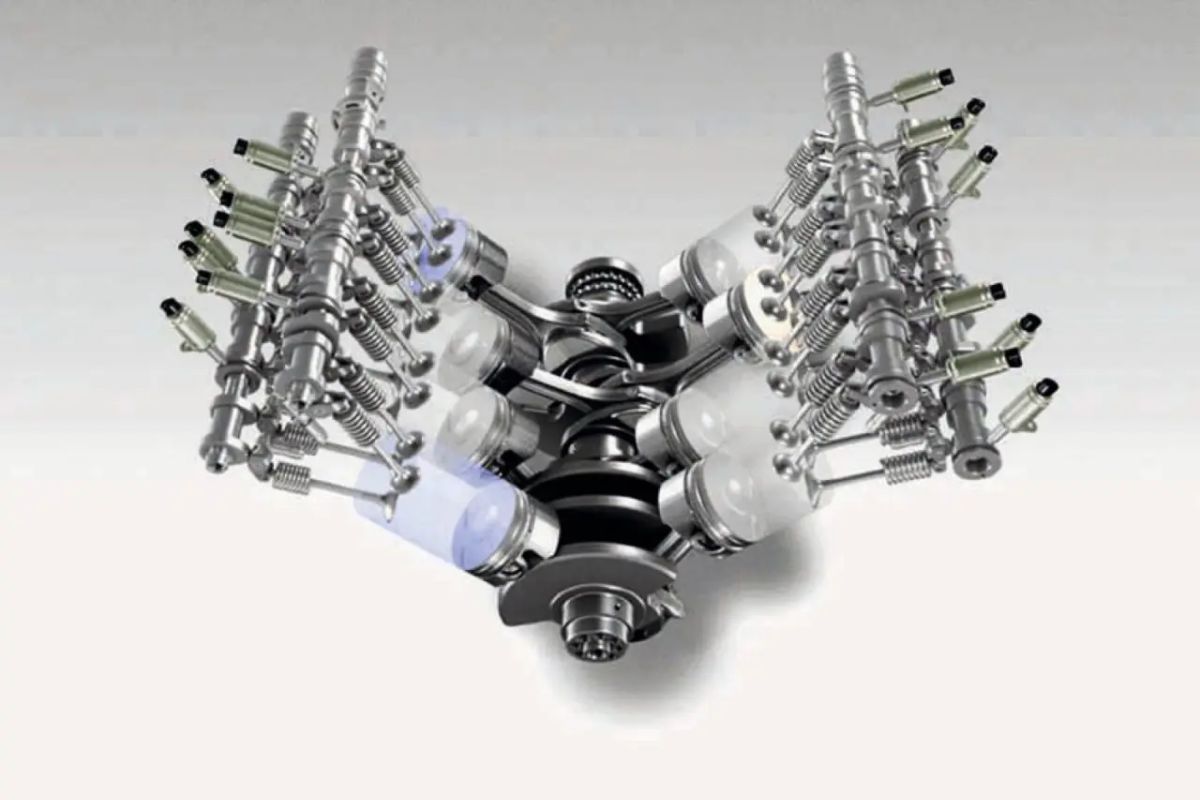
An Analysis of the Dynamic Fuel Management (DFM) System That Promises to Combine the Power of a V8 with Efficiency. Understand Its Functioning, Results, and Reliability Challenges.
Balancing the power of a V8 engine with the growing need for fuel efficiency is a significant challenge for the automotive industry. The Chevrolet Silverado, an icon among pickups, addresses this issue with an innovative solution: cylinder deactivation technology.
This system, in its most advanced version called Dynamic Fuel Management (DFM), promises a large engine to “drink like a small one.” This article deeply analyzes this technology, its real impact on consumption, and the important debates about its reliability.
What Is and How Does Cylinder Deactivation Technology Work?
Cylinder deactivation technology (CDA) optimizes the efficiency of large engines, such as V6 and V8, in low load situations, such as in urban traffic or at cruising speed. Its main benefit is the reduction of pumping losses.
-
A retired IT professional built a 22-meter boat in his backyard in Oklahoma with a school bus engine, light pole masts, and handmade watertight doors to become the redneck version of Jacques Cousteau.

-
China is building a city in Brazil: a complex with an investment of R$ 5.5 billion comes to light, but allegations involving workers draw attention.

-
While Argentina buys old war equipment, Brazil is keeping an eye open and joins the select group of nations with advanced military technology by investing $5.2 billion, producing 36 Gripen fighters in the country, and reducing operational costs.
-
Brazil on alert? Why invading Brazil is a NIGHTMARE for the USA: 8.5 million km², 213 million inhabitants, Amazon covering 60% of the territory, trillion-dollar war, and resistance that even 13,000 aircraft could not control.


When a large engine operates with low acceleration, the pistons expend energy to pull the air-fuel mixture against the vacuum in the intake manifold. By deactivating some cylinders, the ones that remain active work with greater load and efficiency. For a cylinder to be deactivated, its intake and exhaust valves remain closed, trapping air that acts as a “pneumatic spring,” minimizing energy expenditure.
The Evolution of General Motors: From AFM to Dynamic Fuel Management (DFM)

GM has a long history with cylinder deactivation technology. Before DFM, the company used the Active Fuel Management (AFM) system, which typically deactivated half of the cylinders (a V8 operated as a V4) in a fixed pattern.
The Dynamic Fuel Management (DFM), introduced in the Silverado starting in 2019, is a much more sophisticated evolution. Based on Tula Technology’s Dynamic Skip Fire (DSF) technology, DFM can deactivate any of the eight cylinders, individually or in combinations. This allows for up to 17 different firing patterns. The engine’s Electronic Control Unit (ECU) calculates the required torque 80 times per second and selects the optimal pattern, being able to operate with only two cylinders in very light load situations.
Impact on Fuel Consumption: Can a V8 Be Efficient?
DFM’s promise is a remarkable fuel economy. GM suggests gains of 5% to 20% in its V8 engines. Real-world tests confirm this efficiency under certain conditions. A Silverado 6.2L V8 with DFM achieved 10.37 km/l in highway driving, exceeding the EPA’s official estimate of 8.5 km/l.
The EPA estimates for the 2025 Silverado with a 6.2L V8 engine are 6.38 km/l in the city and 8.5 km/l on the highway. The claim that it “drinks like a small one” should, therefore, be viewed with caution. Although DFM improves efficiency, the absolute consumption is still higher than that of genuinely smaller engines, but it makes the V8 much more versatile and less costly than it would be without the technology.
Challenges of Reliability and the Costs of DFM
Experts’ opinions and owners’ experiences reveal that, despite the consumption benefits, GM’s cylinder deactivation technology is not without its problems. The most critical and recurring issue is the failure of the special hydraulic lifters, responsible for deactivating the valves.
The causes are multifactorial. The constant cycle of activation and deactivation imposes significant mechanical stress. Proper operation depends on the pressure and cleanliness of the lubricating oil. Any deficiency in lubrication (low-quality oil, contamination by sludge, long replacement intervals) drastically increases the risk of failure. Symptoms include “ticking” noises in the engine, loss of power, and ignition failures. Repair costs are high, ranging from R10,000 to over R25,000, and in extreme cases, requiring engine replacement.
Cylinder Deactivation Compared to Other Technologies
The search for efficiency continues, and cylinder deactivation technology is also evolving. Tula Technology is already developing eDSF (Electrified Dynamic Skip Fire), which integrates the system into a mild 48V hybridization. The electric motor helps to further smooth transitions and optimize energy regeneration during deceleration.
This technology coexists with other efficiency strategies:
- Downsizing with Turbo: Smaller engines with turbo to compensate for power. They are lighter but may have “turbo lag,” and their consumption can increase significantly under strong acceleration.
- Full Hybrids: Combine combustion and electric engines, offering excellent urban economy, but with higher cost and weight.
The cylinder deactivation technology occupies an important niche: preserving the capability and feel of a large engine while delivering substantial efficiency improvements, especially on highways.







-

Uma pessoa reagiu a isso.