





 Portuguese
  English
  Spanish
  6 min of reading
  1 comment





Based on the Atmospheric Effect Observed After the 1883 Eruption, the Technology That Promises to Cool the Planet Tries to Increase Albedo with Stratospheric Aerosols in the Stratosphere, Reducing Part of Solar Radiation, While Expanding Doubts About Geoengineering, Global Warming, Greenhouse Gases, International Governance, and Long-Term Human Dependence.
The technology that promises to cool the planet has returned to the center of climate debate by bringing back an extreme lesson left by the eruption of Krakatoa in 1883, when ash and sulfur dioxide spread through the atmosphere, altered sunsets, and temporarily lowered global temperature. The current interest did not arise from technological fascination, but from the realization that global warming continues to advance while emissions reduction targets remain distant.
In this scenario, geoengineering emerges as an emergency brake based on the dispersion of stratospheric aerosols between 11 and 17 kilometers in altitude, depending on latitude, to reflect part of the solar radiation back into space. The promise is simple on paper and profoundly complex in practice: reduce heat without addressing the root of the problem, which remains tied to the greenhouse gases accumulated over decades.
What Krakatoa Taught About Global Cooling

In 1883, Krakatoa produced a brutal demonstration of what happens when the atmosphere receives a colossal load of particles and sulfur dioxide.
-
Something is happening around the Earth: Inside the huge explosion of fireballs in 2026

-
A hot air bubble coming from Argentina expands over Brazil, causing thermometers to exceed 38 degrees with a thermal sensation of 40 degrees in late March, affecting 6 states at once.

-
The radish leaf that almost everyone throws away has more polyphenols, flavonoids, and fiber than the consumed root, and a 2025 study showed that the leaf contains compounds that protect the intestine, combat inflammation, and may inhibit the growth of cancer cells.

-
A planet that seemed to defy the laws of physics has intrigued scientists for decades, until the James Webb revealed what is really affecting Saturn’s rotation.


The sound of the eruption was heard over 3,000 kilometers away, a distance greater than the separation between Belo Horizonte and Buenos Aires, while the material released high into the atmosphere formed a thin layer capable of modifying light and climate on a planetary scale.
The episode was not only a geological disaster; it was also an involuntary global-scale experiment.
It is from this precedent that the logic of the technology that promises to cool the planet emerges. If a volcanic eruption could increase the Earth’s albedo and temporarily reduce the temperature, the idea would be to reproduce this effect in a controlled manner through geoengineering.
The principle is known: the more radiation reflected, the less energy remains trapped in the climate system.
The problem begins when a violent natural reference is treated as an operational model for continuous intervention.
The comparison helps explain why stratospheric aerosols have gained so much attention.
Major eruptions show that suspended particles can remain long enough in the upper atmosphere to spread effects over wide areas.
But copying a natural effect does not mean mastering all its consequences, especially in a climate system described as complex and chaotic.
How Stratospheric Aerosols Would Factor Into the Climate

The most discussed proposal within geoengineering is the injection of stratospheric aerosols.
In practice, aircraft or balloons would launch sulfur compounds into the stratosphere, at altitudes of 11 to 17 kilometers, to increase solar light reflection.
The reasoning is similar to an energy budget: the Sun continues to deposit energy at almost the same rate, but the Earth stops returning part of that balance because the greenhouse gases hinder heat escape.
By increasing albedo, stratospheric aerosols would try to act on the other side of this equation, preventing part of the radiation from even entering the system.
Oceans with low albedo, such as 0.06, absorb most of the energy; surfaces like snow, with an albedo of 0.80, reflect much more.
The technology tries to force the atmosphere to behave more like a reflective surface, albeit artificially and temporarily.
This mechanism is not treated as fiction because the basic elements already exist.
There are known compounds, there are aircraft capable of reaching the desired altitude, and there are indirect observations of this type of effect in cloud formation associated with maritime traffic.
Even so, technical viability does not eliminate the central question: the technology that promises to cool the planet may produce a quick response, but speed is not synonymous with climate safety.
The Risk of Masking Global Warming and Creating Dependence
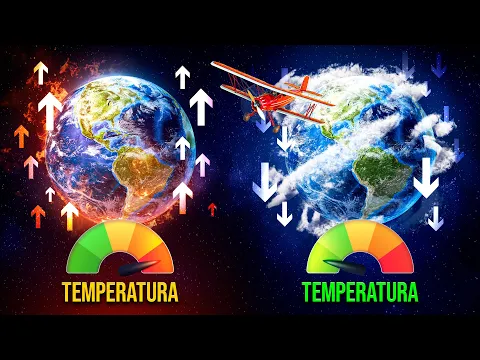

The biggest criticism of geoengineering with stratospheric aerosols is that it does not remove excess carbon from the atmosphere.
About half of the carbon dioxide emitted is absorbed in about 100 years, but the rest remains for a long time, which keeps global warming active even if emissions were to be zeroed immediately.
On the other hand, stratospheric aerosols last only one or two years in the stratosphere.
This difference in permanence creates an intergenerational dependence. Once initiated, the technology that promises to cool the planet would require constant maintenance to continue masking the global warming produced by greenhouse gases.
This is not a cure, but a temporary containment, with the aggravating factor that carbon accumulation would continue advancing if the use of this intervention served as an excuse to delay real emission cuts.
The most feared scenario is the so-called Termination Shock. If the injection of stratospheric aerosols were to be suddenly interrupted, the masked effect of over a century of global warming could emerge in a short time, with rapid and potentially catastrophic warming.
The logic is straightforward: carbon would remain in the air, but the reflective shield would disappear. When the disguise falls, the temperature takes the full bill at once.
There is also a precedent observed outside of deliberate geoengineering. In 2020, a regulation by the International Maritime Organization limited the sulfur content in marine fuel, with the expectation of cutting about 77% of emissions of these compounds.
According to the survey cited in the base, the reduction of 80% in sulfur emissions from ships was one of the main explanations for the rapid warming recorded during that period and could even double the rate of ocean warming this decade.
This does not turn the rule into a mistake, because atmospheric sulfur is associated with acid rain and health damage, but shows how removing this cooling effect also produces a rapid response.
Oceans, Energy, and Politics Enter the Same Equation
Even if geoengineering reduces part of surface temperature, it does not solve everything that comes with excess carbon. Oceans continue to absorb carbon dioxide and become more acidic, which maintains stress on marine ecosystems.
Cooling is not the same as restoring. The technology that promises to cool the planet can act on a visible symptom while the chemistry of the ocean continues to deteriorate in the background.
Relevant energy impacts also emerge. The studies mentioned in the base point out that geoengineering could increase the frequency of prolonged periods of low solar potential and harm two decisive sources for decarbonization: solar and wind.
If less radiation reaches the surface, solar generation loses efficiency; if the atmospheric system changes, wind behavior can also be affected.
It is an important strategic contradiction: trying to buy time against global warming while weakening precisely part of the infrastructure needed to replace fossil fuels.
On the political front, the impasse is even more delicate. Who would authorize, monitor, and distribute the risks of a planetary intervention based on stratospheric aerosols?
A country acting unilaterally over its territory could provoke climatic changes in distant regions, opening disputes over responsibility, sovereignty, and compensation.
Instead of reducing tensions, geoengineering could inaugurate a new frontier of international climate conflict.
The discussion also carries a psychological and diplomatic effect.
If it is already difficult to convince governments to cut emissions at the required speed, the existence of a technology that promises to cool the planet could weaken the sense of urgency and offer a misleading sense of control.
When this happens, greenhouse gases continue to accumulate, global warming loses political priority, and the emergency resource begins to take the place of a structural solution.
The discussion about the technology that promises to cool the planet does not revolve around scientific fantasy, but rather an intervention that, in theory, can be initiated with means already available and produce effects in a short time.
Still, the very elements that make geoengineering seductive are what make it dangerous: quick responses, global reach, multiple uncertainties, and potential dependence for generations.
In the end, the most solid conclusion remains the most difficult to execute. The only proven way to stabilize global warming is to rapidly reduce emissions of greenhouse gases, not just temporarily reflect solar radiation with stratospheric aerosols.
If a measure like this could lower the temperature for some time, but increased climate, political, and energy risks in the future, would you accept this shortcut or see it as too high a cost for future generations?







Não vale o risco, ainda mais pelo potencial poluente desses aerossóis e pelo modo como poderia afetar as plantas que precisam de luz intensa. Melhor continuar investindo em captura de carbono, em substituição de fontes energéticas e em reflorestamento.