





 Portuguese
  English
  Spanish
  7 min of reading
  0 comments


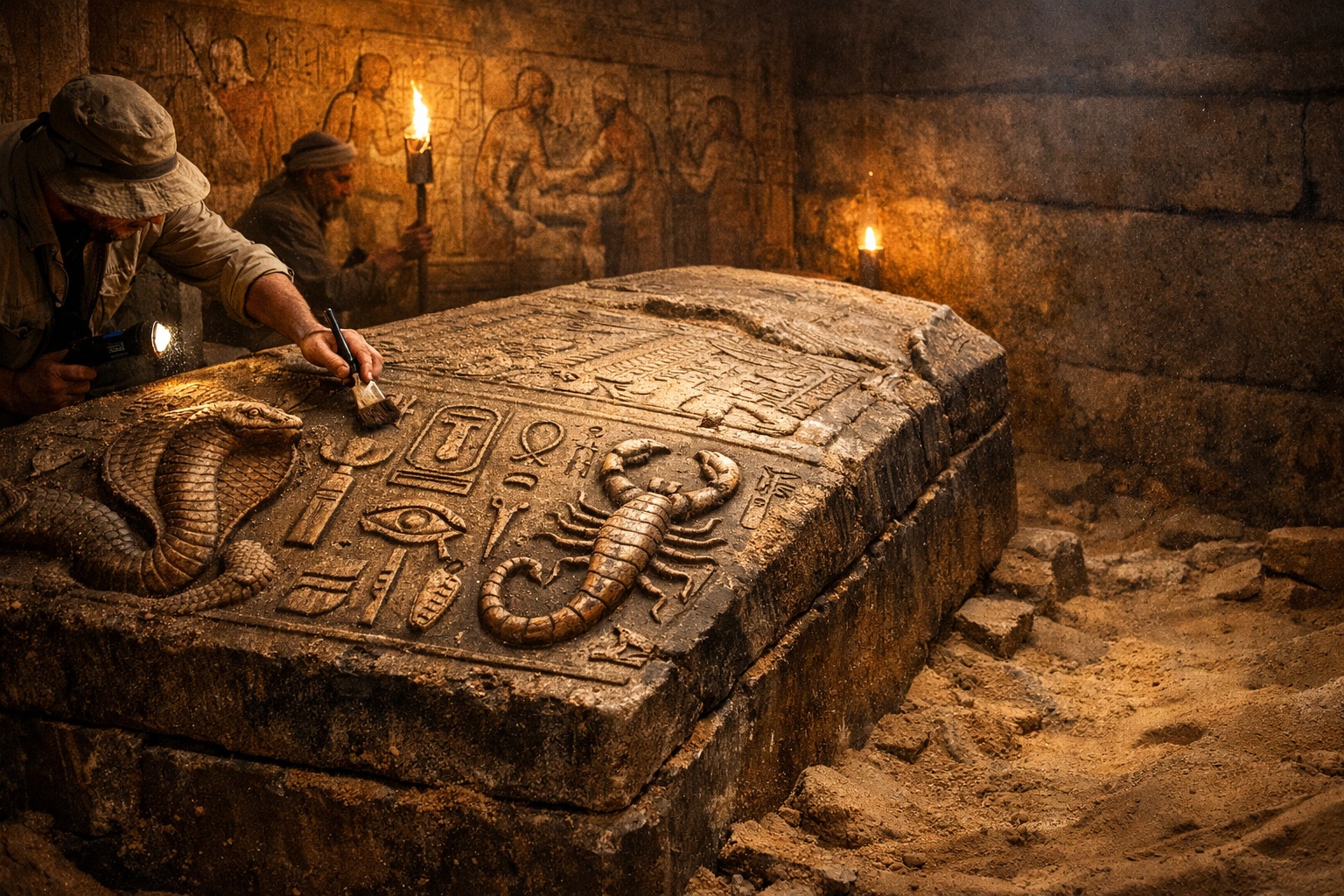
Tomb of 4,100 Years Found in Saqqara Reveals Pharaoh’s Doctor Who Was Chief Dentist, Poison Specialist, and Director of Medicinal Plants in Ancient Egypt
Archaeological Discovery in Saqqara Reveals Tomb of a Court Physician of the Pharaoh in Ancient Egypt: On the vast plateau of Saqqara, south of Cairo, where thousands of graves have spread across the sand since the early centuries of Egyptian civilization, an apparently ordinary tomb turned out to reveal one of the most interesting pieces of evidence regarding specialized medicine in Ancient Egypt. During the 2024 archaeological season, the Franco-Swiss team of the Saqqara Archaeological Mission (MAFS) opened a small well excavated in the rock. The structure appeared similar to many others found in the region: built with mud bricks, with a vaulted ceiling and relatively modest dimensions.
This type of burial is known by archaeologists as a “oven-tomb”, a fairly common model in the necropolis that, in most cases, has been looted over the centuries. Typically, this type of discovery does not bring major surprises, as funerary objects and sarcophagi often disappear well before the arrival of scientific teams.
Therefore, the researchers initially did not expect to find anything extraordinary. Everything changed when they began to analyze the inscriptions carved on the walls of the tomb. The hieroglyphic inscriptions revealed that the occupant of the tomb had been one of the most important physicians of the pharaoh’s court over four thousand years ago.
-
Archaeologists find a colossal 2,000-year-old vessel at the bottom of the sea near Alexandria linked to the elite of Egypt and reveal a pleasure barge from the last dynasty of the pharaohs that the sea has hidden for centuries.

-
United Kingdom clears 40 tons of shells and concrete into the sea in an innovative project that promises to restore a marine ecosystem lost for over 200 years and improve water quality.
-
With emergency diversion to abandoned mining craters, engineers save villages from a devastating flood that was advancing through the desert and threatening to destroy entire communities in a matter of hours.

-
It seems simple, but it enriches: from R$ 500 to R$ 6,000 per piece and up to 10 days of handcrafted production, how is the couple from Praia Grande making a high income with hyper-realistic miniatures and turning a hobby into a money-making machine?


Sarcophagus Reveals Impressive Medical Resume in Ancient Egypt
On the stone sarcophagus found in the tomb, archaeologists identified the name Tetinebefou, accompanied by a series of rarely seen titles together in any Egyptian funerary inscription. The inscriptions listed highly specialized functions:
- chief physician of the palace
- priest
- chief dentist
- director of medicinal plants
- invoker of the goddess Serqet
The presence of all these titles on the same sarcophagus immediately caught the researchers’ attention. The inscription suggests that Tetinebefou was not just an ordinary physician, but the primary responsible for the health of the pharaoh and the royal court.
Among the titles, one stood out particularly: the “Invoker of the Goddess Serqet”.
Serqet was the Egyptian deity associated with protection against poisons and scorpion stings. According to Philippe Collombert, leader of the archaeological mission and researcher at the University of Geneva, this title indicates that Tetinebefou was likely a specialist in poisoning caused by venomous animals. In modern terms, this means that about 4,100 years ago, there was already a physician in the Egyptian court specialized in treating snake and scorpion bites.
Tetinebefou Served during the Reign of Pharaoh Pepi II
The inscriptions found in the tomb indicate that Tetinebefou lived during the Sixth Dynasty of Ancient Egypt, likely during the reign of Pharaoh Pepi II. Pepi II is known to have had one of the longest reigns in Egyptian history. According to historical estimates, he ruled for somewhere between 60 and 90 years, having ascended to the throne as a child.
It is still unclear exactly which pharaohs Tetinebefou served during his career. It is possible that he worked directly for Pepi II or for rulers who came shortly after him. What seems evident, according to archaeologists, is the extremely high position he occupied within the court hierarchy.
As Collombert explained in an interview with Live Science: “He was certainly the chief physician of the royal court and probably treated the pharaoh himself.”
Chief Dentist of the Palace Reveals Specialized Medicine in Ancient Egypt
Among the titles recorded on the sarcophagus, one of the most surprising for researchers was “chief dentist.” This title is extremely rare in historical Egyptian records.
According to Professor Roger Forshaw, a specialist in dentistry of Ancient Egypt at the University of Manchester, evidence of dentists in Egyptian society is scarce and highly valued by medical historians.
Despite this, it is known that the Egyptians treated various dental problems. Medical records indicate that they performed procedures such as:
- treatment of cavities
- tooth extraction
- dental abscess drainage
- treatment of gum inflammation
- removal of dental calculus
These skills are documented in famous medical texts such as the Edwin Smith and Ebers Papyri. There is even archaeological evidence of surgical drainage of mandibular abscesses as early as the Fourth Dynasty (circa 2625–2510 BC).
The existence of a chief dentist in the court indicates that the pharaoh had a professional dedicated exclusively to oral health.
Poison Specialist Reveals Link Between Medicine and Religion in Egypt
The title “Invoker of Serqet” also reveals another important aspect of Egyptian medicine: the strong connection between medical practices and religious rituals. Serqet was represented as a woman with a scorpion on her head and was considered the protector against poisons.
In Ancient Egypt, medicine and religion were not separate fields. Medical treatments often combined natural remedies with sacred rituals and divine invocations. When someone was bitten by a snake or scorpion in the royal court, Tetinebefou was likely the professional responsible for the treatment.
Ancient medical texts confirm that this type of specialization existed. The Brooklyn Papyrus, for example, describes at least 21 species of snakes, including the effects of their bites and possible treatments. Among the documented therapies are local bandaging, mixtures with onion, salt, fermented beer, and magical formulas.
Director of Medicinal Plants Suggests Role Similar to Chief Pharmacist
Another title found on Tetinebefou’s sarcophagus also caught the researchers’ attention: “Director of Medicinal Plants.” This position is extremely rare in Egyptian inscriptions.
To date, this title had only been identified in one other known inscription in archaeological literature. The role likely involved overseeing the use of medicinal plants in the court, including collection, storage, and preparation of remedies.
In modern terms, this could be compared to the role of chief pharmacist of the royal court. The famous Ebers Papyrus, written around 1550 BC, records 876 medical recipes containing 328 different ingredients, mostly of plant origin. The document is about 20 meters long and is considered the most complete medical treatise of antiquity.
Tetinebefou was likely part of a similar medical tradition centuries before the compilation of this papyrus.
Tomb Was Looted, but Inscriptions Preserved the Doctor’s Story
Although the tomb was looted long ago — with the disappearance of the body and funerary objects — the inscriptions on the walls survived. According to Collombert, the interior had been “almost completely looted”, something common in ancient Egyptian tombs.
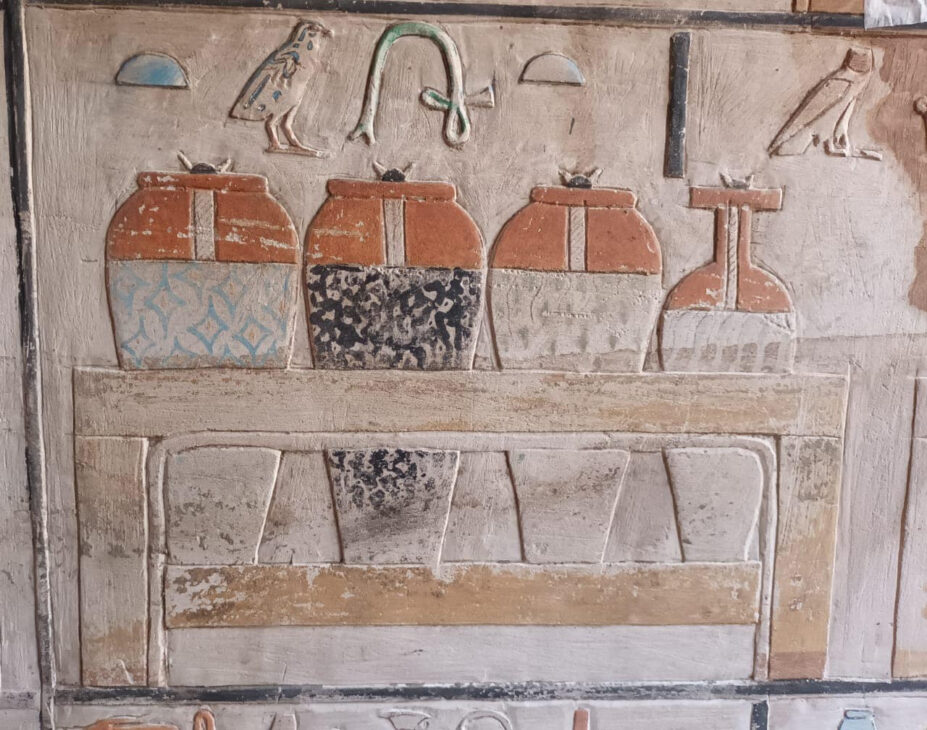
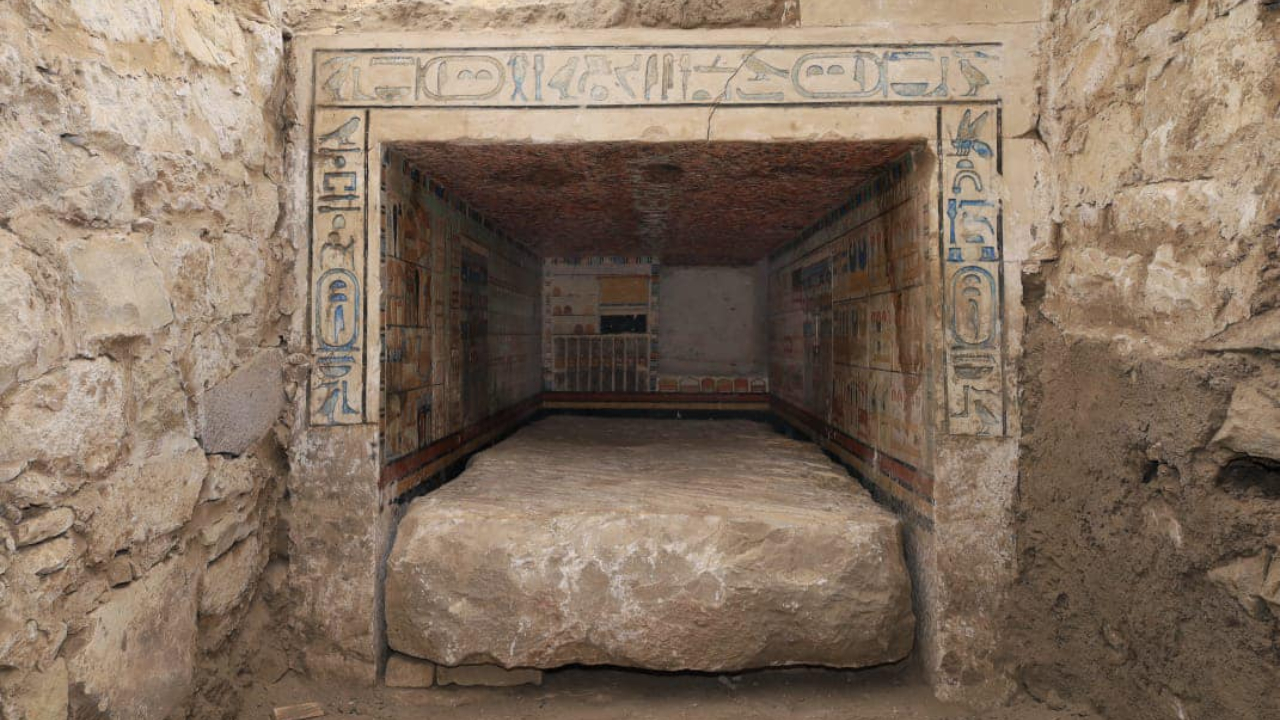
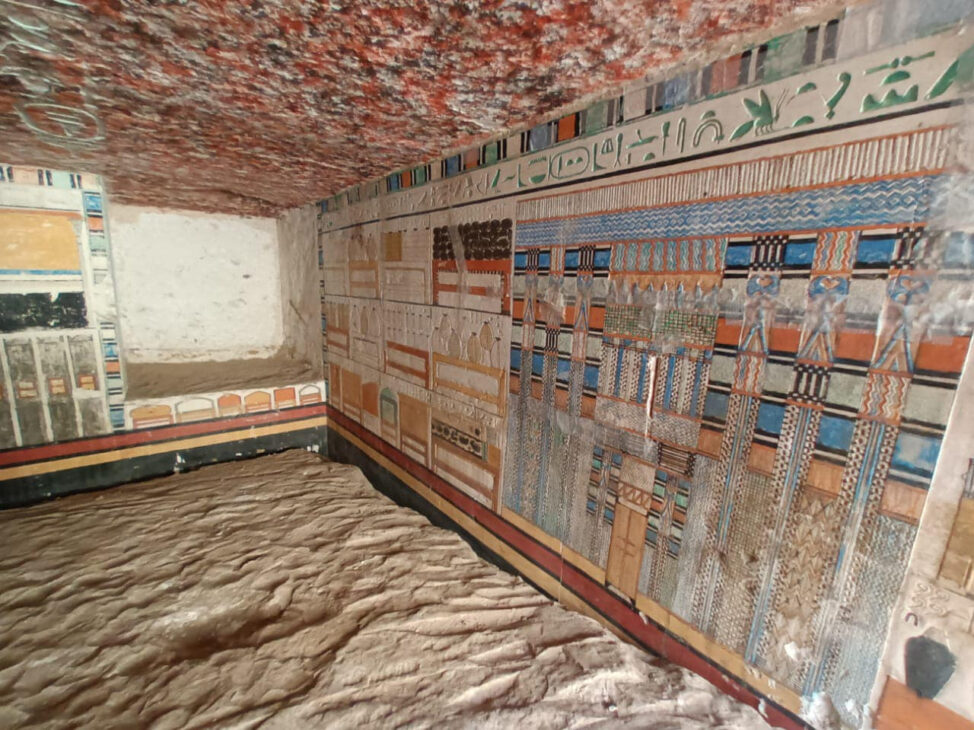
Even so, the walls preserved important decorative elements. The tomb contains carvings, vibrant paintings, and a painted false door, a typical element of Old Kingdom tombs. This symbolic door represented the passage between the world of the living and the afterlife, allowing offerings to reach the spirit of the deceased.
The paintings also depict containers, vases, and jars that may have been part of Tetinebefou’s medical work.
Herodotus Already Described Specialized Physicians in Ancient Egypt
Centuries after the death of Tetinebefou, the Greek historian Herodotus visited Egypt and was impressed by the organization of local medicine. He wrote that Egyptian physicians specialized in different areas, each responsible for treating a specific type of disease.
According to Herodotus:
“Each physician treats only one disease. There are physicians for the eyes, physicians for the teeth, physicians for the stomach, and physicians for hidden diseases.”
The tomb of Tetinebefou archaeologically confirms that this medical specialization existed long before Herodotus’s visit to Egypt.
Saqqara Continues to Reveal Secrets of Ancient Egyptian Medicine
The necropolis of Saqqara remains one of the most important archaeological areas in the world. The site houses monuments dating back to the earliest Egyptian dynasties, around 5,000 years ago, including the famous Pyramid of Djoser.
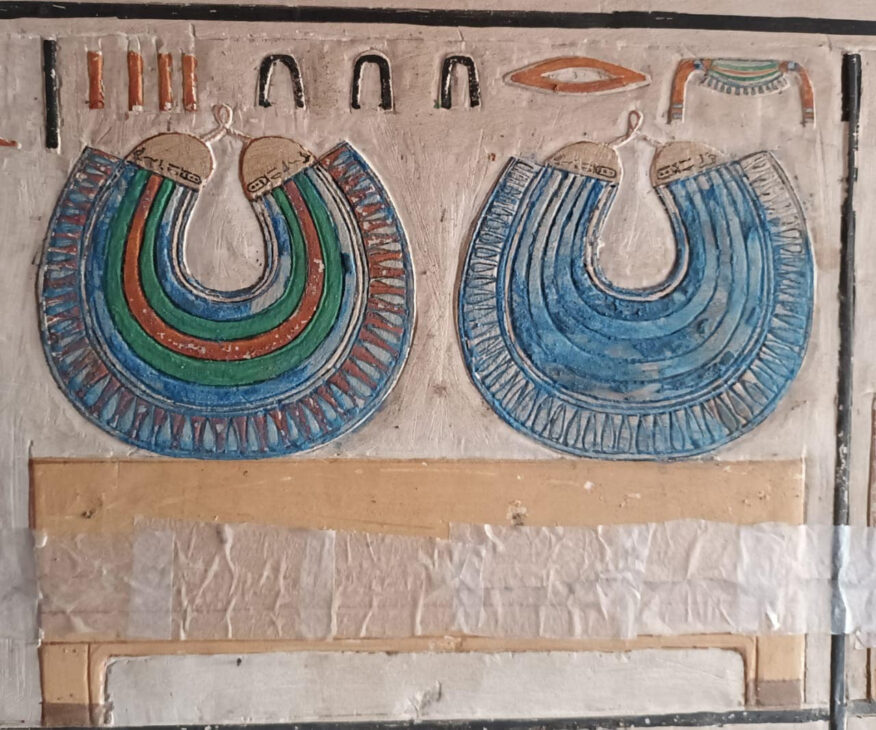
Since 2022, the Saqqara Archaeological Mission has been excavating the southern region of the archaeological site and identified the tomb of Tetinebefou among a set of smaller graves located in front of a larger mastaba. The combination of the five titles recorded on the sarcophagus — chief physician, chief dentist, priest, poison specialist, and director of medicinal plants — is considered extremely rare.
This discovery suggests that Ancient Egypt possessed a highly specialized medical structure long before the emergence of the classical medical systems of Greece or Rome.
Future Studies May Reveal More About Egyptian Medicine
Archaeologists continue to analyze the pigments of the paintings and the inscriptions of the tomb in detail. Future research may uncover more information about the medications used by Tetinebefou, the medicinal plants he administered, and how medicine was practiced in the court of the Sixth Dynasty.
One question remains open for researchers: Was Tetinebefou an isolated case, or was there an entire network of specialized physicians working in the pharaoh’s court? For now, the discovery is already sufficient to alter the historical understanding of ancient medicine.
The tomb of Tetinebefou demonstrates that a highly specialized medical system existed in Egypt about four thousand years before classical Western medicine.







-

-

3 pessoas reagiram a isso.