





 Portuguese
  English
  Spanish
  5 min of reading
  0 comments


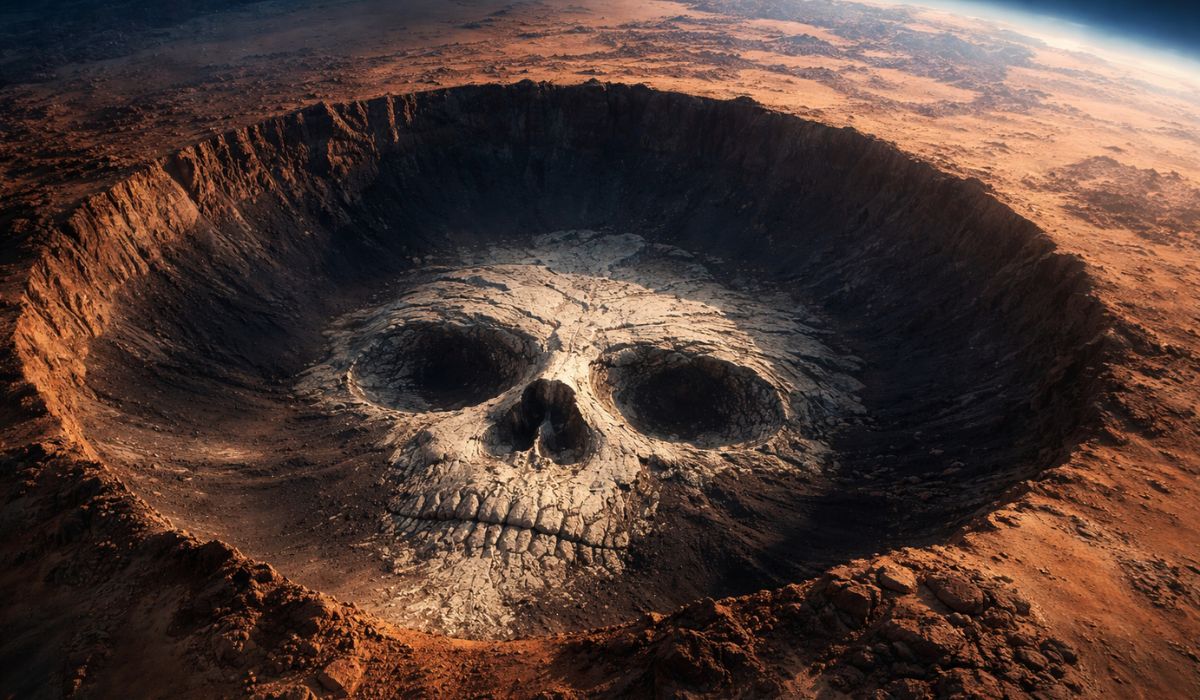
A formation in the Sahara Desert, recorded from space, gathered volcanic relief, mineral deposits, and shadow contrast in an image that gained attention for associating science, geology, and visual perception in the same scenario.
An image recorded by an astronaut aboard the International Space Station showed, in northern Chad, a formation that resembles a human skull facing space.
The visual effect appears inside the Trou au Natron, also called Doon Orei, a large volcanic caldera located in the Tibesti massif, in the center of the Sahara.
Viewed from above, the combination of light mineral deposits, dark volcanic cones, and the shadow of the crater rim produces the design that caught attention in scientific outreach publications.
-
The Chinese translator said that the time has come for China to understand Brazil beyond trade, and now The Brazilian People by Darcy Ribeiro is receiving its first edition in Mandarin with a ceremony in Beijing and the delivery of the volume to six of the largest academic institutions in the country.

-
Backpack theft in pub ends with Fabergé egg, watch, cigars, rare jewelry, and other luxury accessories worth R$ 15 million missing.

-
With tons of daily production, a potato famous for its curved shape surprises with a standardized industrial process, a dough that includes dehydrated potato flakes and a crunch that impresses the entire world.

-
In Japan, the fastest motorcycle in the country is manufactured with advanced technology, extreme precision in its parts, and a focus on performance and stability at high speeds.

Where is the Trou au Natron in the Sahara
The Trou au Natron is part of one of the most well-known volcanic areas of central Sahara.
The site is part of the Tarso Toussidé system, at the far west of the Tibesti chain, and is classified by the Smithsonian Global Volcanism Program as a Pleistocene caldera.
On the crater floor, the contrast between whitish areas and darker reliefs creates, in orbital images, a figure that resembles a human face.
How the volcanic caldera forms the image of a skull
On the ground, however, this appearance changes.
What, from space, resembles a face corresponds, up close, to a mineralized, irregular, and dry relief.
The light part observed in the image is neither ice nor rock altered by natural painting.
It is natron, a mixture of salts rich in carbonates, bicarbonates, chlorides, and sodium sulfates.

This material accumulates at the bottom of the caldera and can take on a whitish and brittle appearance.
The darker areas, which in the image resemble eyes and nasal cavity, correspond to scoria cones, conical elevations formed around ancient volcanic emission points.
The shadow cast by the elevated edge of the crater also contributes to the visual effect observed from orbit.
According to this set of characteristics, the image results from the combination of geology, lighting, and observation angle.
Orbital records often cause reliefs to be associated with shapes known to the human eye, and the Trou au Natron has become an example of this type of visual perception.
Still, the scientific interest in the area is not limited to the appearance captured in the photograph.
What the fossils indicate about the desert’s past
Today, the caldera is described as an arid environment with no relevant visible biological cover.
However, research mentioned by scientific outreach publications based on NASA data indicates that the site holds evidence of a different past.
Under the mineral crust of the crater floor, researchers identified fossils of aquatic organisms, such as snails and plankton, associated with ancient lacustrine phases.
These findings support the interpretation that the area once hosted a lake during wetter periods in the Sahara’s past.
Instead of the current desert landscape, the region would have presented distinct environmental conditions in earlier phases.
The record preserved in the caldera is treated by specialists as an indicator of long-term climate changes that affected northern Africa.
The chronology of these phases, however, requires caution.
Recent texts mention findings dated to about 14,000 years ago and also algal records that could date back much further.
As the consulted outreach sources present these references in a summarized manner, without detailing the dating methods and stratigraphic context at the same level, the safest formulation is that the Trou au Natron preserves signs of ancient aquatic environments.
Tarso Toussidé and volcanic activity in the region
In addition to the lacustrine history, the area is also relevant from a volcanic perspective.
The caldera is treated as an ancient feature, with no confirmed recent eruptive activity.
It is located, however, alongside a broader volcanic complex that continues to be monitored and studied by researchers interested in the geological evolution of the region.
The Smithsonian describes the Tarso Toussidé as a volcanic massif with fumaroles at the summit and lava flows considered very young in geological terms.
At the same time, the program’s database informs that there are no known Holocene eruptions for this volcano.

The last known eruption appears as “unknown”, although there is credible evidence of activity.
This distinction alters the way to present the geological picture.
Instead of stating that the volcano remains active unequivocally, the most consistent data is that the system shows signs of geothermal activity and geologically recent volcanic products.
On the other hand, there is no confirmed historical or Holocene record of eruption.
Why the image seen from space draws attention
The impact of the photograph can also be explained by the way the brain interprets visual patterns.
Structures that resemble faces are often quickly recognized by observers, even when they appear casually in clouds, mountains, craters, or buildings.
In the case of Trou au Natron, the organization of contrasts reinforces this reading.
In the orbital image, two dark areas occupy a position similar to that of the eyes.
In the center, a deeper feature suggests a nasal cavity, while the light band at the bottom resembles the jaw region.
This arrangement helps explain why the photograph circulated as an example of a natural formation with an unusual appearance.
What the formation reveals about the natural history of the Sahara
The interest, however, goes beyond visual similarity.
The caldera gathers, in one space, evidence of volcanism, mineral deposition, and environmental transformation.
For researchers, this set allows observing how distinct geological and climatic processes have left successive marks in an area now dominated by extreme aridity conditions.
For this reason, the image draws attention in science and curiosity reports.
The record obtained from space serves as a gateway to a broader theme: the ability of certain landscapes to preserve information about ancient phases of the Earth.
In the case of Trou au Natron, the photograph highlights a recognizable shape, but the main interest lies in what the structure reveals about the natural history of the Sahara.
Geologically, the caldera shows how major volcanic events can shape the relief and then serve as a basis for other processes, such as the concentration of salts and the accumulation of traces of aquatic environments.
From a climatic perspective, the fossils found in the area reinforce the notion that the current desert has not always had the same environmental configuration observed today.
Thus, the Trou au Natron appears simultaneously as a volcanic formation, paleoenvironmental record, and an example of how orbital images can enhance public interest in scientific topics.
The skull-like appearance helps explain the circulation of the photograph, but the informative value of the area lies in the geological and environmental evidence associated with the site.







Seja o primeiro a reagir!