





 Portuguese
  English
  Spanish
  5 min of reading
  1 comment


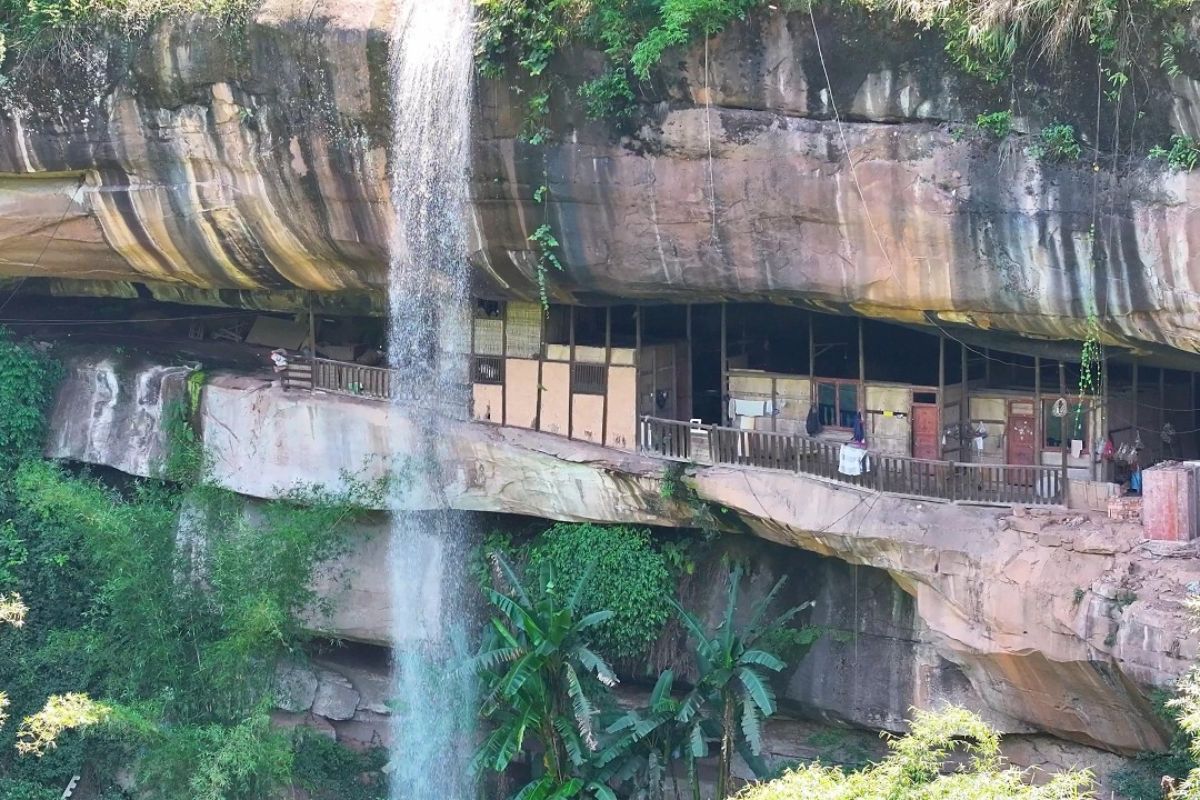


In The Hidden Village In The Mountains Of China, In Guizhou, The Shuilian Cave Shelters A Family That Spans Generations Living Among Waterfalls, Bamboos, And Solid Rock, In A Scenery That Seems Straight Out Of A Mythological Tale.
The hidden village in the mountains of China that occupies the Shuilian Cave resembles the Water Curtain Cave of Sun Wukong, but it does not belong to the world of fiction. There, in the interior of Guizhou, two elderly people in their 70s maintain a simple life, sheltered by a cave with a view of a waterfall, surrounded by green bamboos and with the constant sound of falling water as a permanent soundtrack. According to them, their ancestors have lived in that place for over a hundred years, maintaining a rare continuity of territory, memory, and way of life.
In this hidden village in the mountains of China, the house is literally nestled within the Shuilian Cave, taking advantage of the natural protection of the rock and the abundant presence of water. Fifty, sixty years of living with the same scenery have made the space part of the couple’s identity. While children and grandchildren migrated to the city, they decided to stay in the cave, taking care of chickens, fish, corn, and their own time, in a self-sufficient rhythm that contrasts with the urban daily life of contemporary China.
The Hidden Village In The Mountains Of China And The Scenery Of The Shuilian Cave
The hidden village in the mountains of China is set in a rock cavity shaped like a half-moon, known as the Shuilian Cave, in the mountainous region of Guizhou.
-
New 100% clean fuel produced in Brazil could retire diesel.

-
Plastered walls become a trend and end up being the perfect choice for finishing; the secret of the 2 coats that prevent waste in painting.
-
With 333 meters and equivalent to a 20-story building: China launches a supertanker that transports 2 million barrels, has 540,000 m² of area, and saves $5 million per year.

-
Brazil becomes a beacon of hope for ending plastic waste by leading a global plan that could prevent millions of tons from entering the oceans.


The entrance to the cave opens directly into a waterfall, with water cascading down the cliff, feeding the Chishui River below.
Surrounding it, a belt of bamboos covers slopes and valleys, reinforcing the impression of isolation and natural paradise.
Outside the Shuilian Cave, there are waterfalls at different points of the land, which change in intensity during the rainy season.
In May and June, the water volume can fill the entire front of the cave, reminiscent of the famous water curtain from Chinese myths.
At the same time, the interior of this hidden village in the mountains of China remains protected, with a dry floor and solid rock, allowing for stable domestic life even during heavy rains.
The Daily Life Of The Elderly In The Shuilian Cave

Within the hidden village in the mountains of China, the daily routine of the two elderly people is built around simple tasks.
They stack firewood, store corn, and take care of chickens, cats, dogs, and fish raised in a pond they dug themselves.
Self-sufficiency is the foundation of their daily life, with small plantings, raising animals, and utilizing the water that flows from the rocks.
According to the couple, at least five or six generations have passed through the Shuilian Cave, always keeping someone from the family at the same spot, in the middle of the mountains of Guizhou.
Their children now live in the city, owning houses acquired over time, but the couple prefers to stay in the hidden village in the mountains of China, where they say they feel more comfortable.
For them, rural life is sufficient to cover basic expenses, with modest consumption and a strong connection to the land.
A Cave House Among Waterfalls And Bamboos
The central structure of the hidden village in the mountains of China is a cave house built within the Shuilian Cave itself.
The foundation is made of irregular stones stacked one by one, with the use of cement in some spots, and some areas are closed off with simple walls to form rooms, a kitchen, and storage areas.
There are traces of old houses around, now reduced to ruins, showing that other families have lived there before moving to the city.
Despite its rustic appearance, the Shuilian Cave is not as primitive as it seems at first glance.
The elderly have access to electricity, washing machines, and a water collection system through pipes that carry the resource directly from the upper part of the cliff to a small reservoir.
The combination of waterfalls, bamboos, and solid rock creates a particular microclimate, with a dry environment inside the cave, more humid at the edges, and mild temperatures, warm in winter and cool in summer.
Over 100 Years Of History In The Same Cave
According to the residents’ account, the family has lived in the Shuilian Cave for over a hundred years, encompassing five or six generations on that same slope in Guizhou.
The grandfather, great-grandfather, and earlier ancestors already occupied the space before the opening of roads and the descendants left for urban jobs.
Today, there remain the elderly couple and a few auxiliary structures, such as the chicken coop, the stove for smoking meats, and the small bathroom built at the edge of the cliff.
This continuity makes the hidden village in the mountains of China a rare case of permanence at the same spot, while most families migrated.
The sound of falling water has become part of the identity of the place, something that could disturb visitors but is described by the residents as background noise they have grown accustomed to.
For them, living surrounded by waterfalls and bamboos, inside the Shuilian Cave, is more comfortable than living permanently in the city.
And you, could you trade urban life for a peaceful routine inside a hidden village in the mountains of China, like the one in the Shuilian Cave, living every day next to waterfalls and bamboos?





I would love to live like that in total peace with nature