





 Portuguese
  English
  Spanish
  5 min of reading
  0 comments


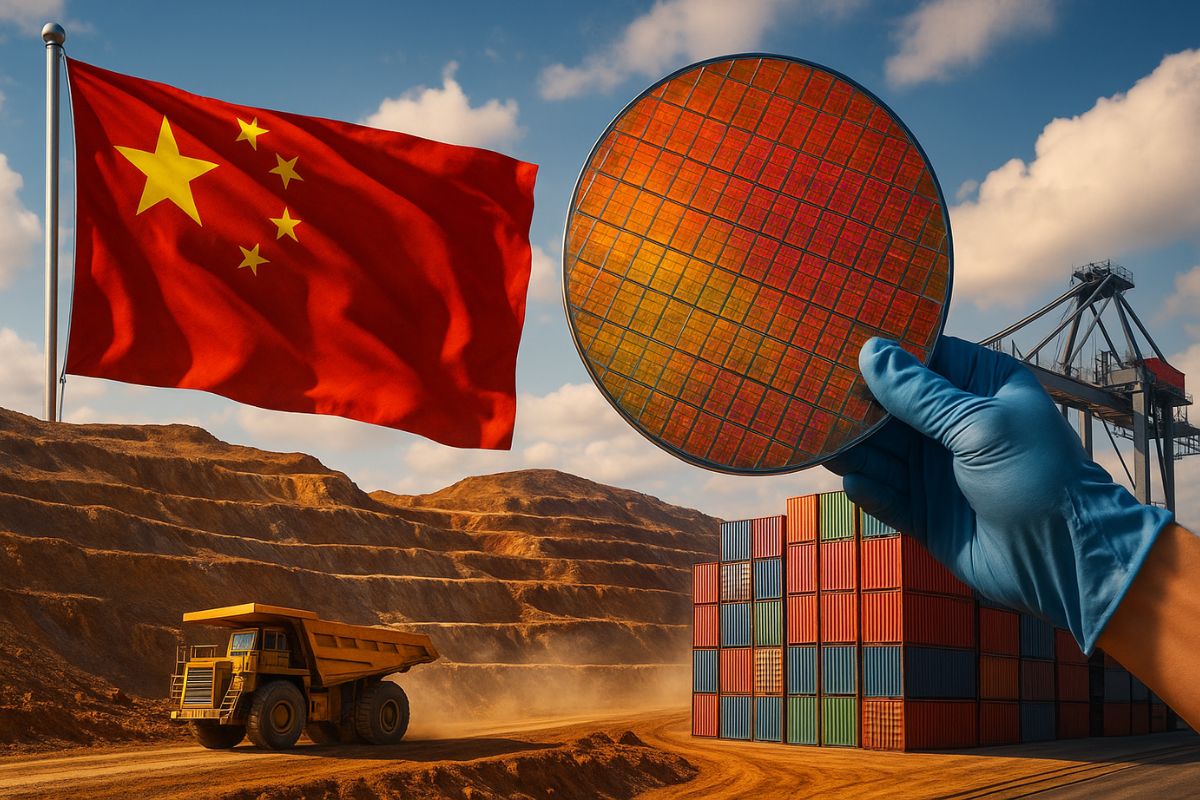
China Uses Rare Earth and Semiconductor Control to Pressure the U.S. and Allies, Highlighting Its Dominance in Critical Points of the Global Technology Chain.
China has moved from a defensive position and started using its strategic assets to demonstrate that it can limit the world’s access to essential technology inputs. The message is simple and direct to the United States and anyone in the U.S. orbit: if the siege on Chinese products continues, Beijing can make life difficult for the entire electronics chain, from the defense industry to electric cars. This shift exposes that China is not just a major producer but also the guardian of stages that no one else dominates at the same level.
According to the UOL portal, the strategy appears in two recent movements that fit perfectly. First, the tightening of rare earth exports and the technology to process them. Then, the response to the case involving a Chinese semiconductor company operating in Europe, an episode that showed that the dispute has moved from the commercial field to the sovereignty field. In both cases, the message was the same: China knows where the world is dependent and has begun to use this as a pressure tool.
Why China Turned the Tables
For years, the dispute seemed one-sided, with the United States restricting Chinese access to the most advanced chips, especially those used in artificial intelligence and military applications. However, this scenario has changed.
-
A new Brazilian shopping center worth R$ 400 million will be built in an area equivalent to more than 4 football fields, featuring 90 stores, 5 cinemas, a supermarket, a college, and parking for 1,700 cars, potentially generating 3,000 jobs.

-
Larger than entire cities in Brazil: BYD is building a 4.6 km² complex in Bahia with a capacity for 600,000 vehicles per year, but the discovery of 163 workers in conditions analogous to slavery has shaken the entire project.

-
With an investment of R$ 612 million, a capacity to process 1.2 million liters of milk per day, Piracanjuba inaugurates a mega cheese factory that increases national production, reduces dependence on imports, and repositions Brazil on the global dairy map.

-
Brazilian city gains industrial hub for 85 companies that is equivalent to 55 football fields.


China has understood that it also has key pieces on this board and has decided to use them, making it clear that it will no longer just respond later but will anticipate moves.
The central point is that the global technology chain does not depend solely on the cutting-edge chips that the U.S. is trying to protect.
It also depends on inputs and components that are considered less glamorous but absolutely essential for everything to function. And it is precisely in these areas that China is ahead.
Rare Earths as an Economic Weapon
The case of rare earths is the most didactic example. When the Chinese government started to speak about tightening control over the export of these minerals and, primarily, the processing technology, the message was direct.
It is not just the ore that is under China’s control. It is the knowledge of how to transform it into something usable, and almost no one has this stage mastered.
These materials are used in satellites, defense systems, electric motors, and an entire generation of high-tech equipment. If the faucet tightens, the impact is not immediate, but it will come.
Analysts remind us that developing the same capacity outside of China could take 5 to 10 years, meaning that countries wanting autonomy will have to negotiate with Beijing during this interval.
This gives bargaining power and political time to China.
Low-Density Chips Also Halt the World
There is another front that has begun to attract attention: the so-called simpler semiconductors. They are not the cutting-edge chips that make headlines, but they are the components that allow cars, smartphones, and electronics to function. Without these low-density components, a Tesla won’t work and an iPhone won’t work.
When a Chinese company in this sector comes under Western restrictions and China responds by saying it will decide what can or cannot be exported, the risk becomes a disruption in the supply chain.
European automakers already see this scenario as a real threat, with forecasts that a disruption could take months to recover from. It is the type of bottleneck that cannot be resolved merely by purchasing from another supplier.
Intervention in U.S. Allies
The episode involving the Dutch government’s actions regarding a subsidiary of a Chinese company showed another aspect of this dispute. U.S. allied countries were pressured to act against a company originating from China.
The Chinese response was to say, in practice, that everything this company produces in China would now depend on Beijing’s permission to exit.
This movement is important because it shows that China is willing to carry the conflict into the territory of U.S. allies, not just confront Washington directly.
When this happens, the entire European technology and automotive supply chain goes into alert mode because it then depends on political decisions from both sides at the same time.
Economic and Technological Effects
What is at stake is not just trade. It is the pace of innovation. If entire sectors need to wait 6 to 9 months to replace basic chip suppliers, the consequence is a slowdown in production lines, increased costs, and loss of competitiveness.
Companies operating with lean production do not have the margin to remain idle waiting for a component.
Additionally, by controlling inputs and processing, China places the rest of the world in a position of requesting access to Chinese technology, and not the other way around.
Countries with rare earth reserves, such as Brazil, still depend on external technology to process these materials. This means that, even with the ore, they need to negotiate with those who control the more complex stage, which today is China.
What This Turn Indicates
The trade conflict between China and the United States has entered a phase of maturity. The U.S. still has an advantage in the most advanced chips, but China has shown that it dominates areas that are equally vital and that, if blocked, will have a global impact. It is a dispute over who can inflict more pain without paralyzing their own economy.
At the moment, China has identified very sensitive points and is using them to show that it will not accept staying in a market position disciplined by Americans.
This posture also reveals that the technological war will not be decided over a single product. It will be decided over the accumulation of bottlenecks.
Whoever controls rare earths, processing, low-density semiconductors, and market access can create a network of pressure that is hard to ignore. And in this, China has advanced.
China has proven that it is not just the factory of the world, but the guardian of critical stages of modern technology and can pressure even U.S. allies when it sees its space threatened.
This new response pattern is likely to make the dispute more unpredictable and longer, with direct impacts on price, supply, and innovation speed.
Now tell us in the comments: do you think the U.S. can regain an advantage without relying on China again, or has the game truly turned to China’s side?









-

Uma pessoa reagiu a isso.