





 Portuguese
  English
  Spanish
  5 min of reading
  0 comments


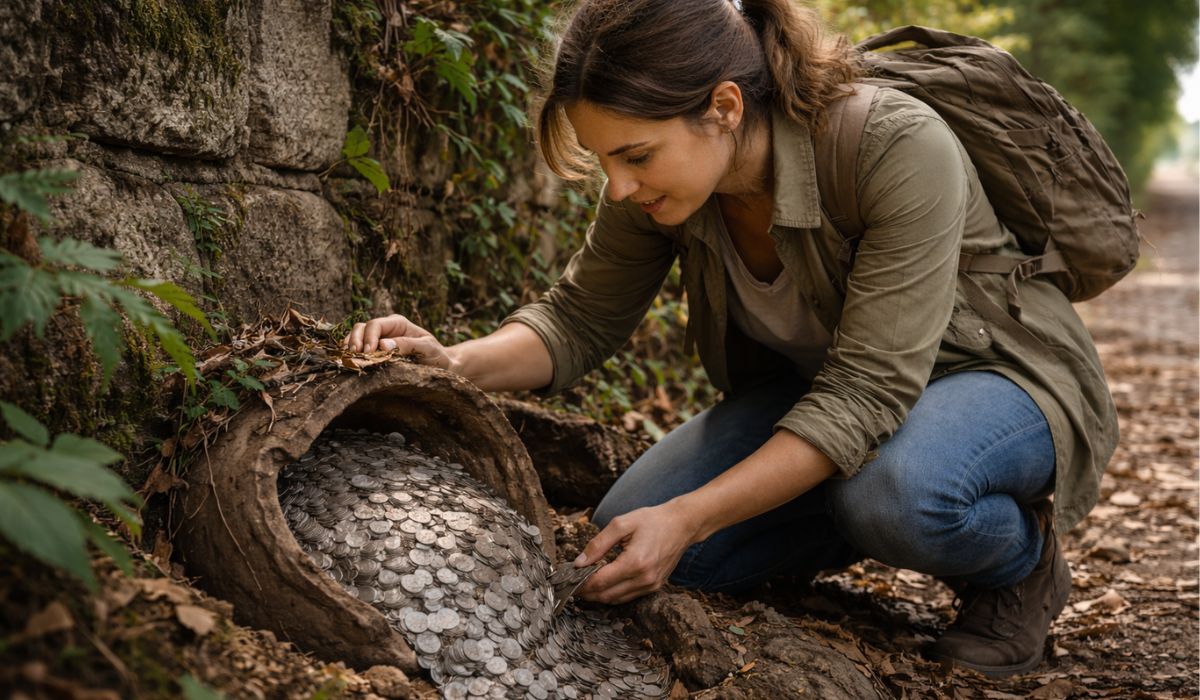
A common walk in an apparently surprise-free landscape ended up revealing a hidden medieval treasure for centuries, with thousands of silver coins and clues about a period of disputes, wealth, and archaeological silence.
A walk through a plowed area in the Kutná Hora region of the Czech Republic ended with an unusual discovery.
Upon noticing coins scattered on the surface and under the soil, a woman reported the find to the authorities.
The collected material includes more than 2,150 silver denarii from the early 12th century and is being analyzed by specialists from the Institute of Archaeology of the Czech Academy of Sciences in Prague and the Czech Silver Museum in Kutná Hora.
-
Scientists revealed 11 signs that very intelligent people exhibit in their daily lives, and most people have no idea that some of these common behaviors are directly linked to an above-average brain.

-
From space, Buenos Aires appears as a colossal spot of light surrounded by kilometers of darkness, revealing at a single glance the exact boundary between the metropolis and the countryside, seen from 400 km altitude.

-
NASA spent over 118 million reais to build a single bathroom that works in zero gravity, and it has just gone to space on the first crewed mission to the Moon in more than 50 years.

-
Man never set foot on the Moon? 5 scientific proofs confirm that humanity has been there and definitively dismantle conspiracy theories.


The collection draws attention not only for the quantity of pieces.
It is also significant that the coins were stored in a ceramic container, now almost destroyed, but still capable of preserving the contents over centuries.
Medieval treasure found in the Czech Republic
Preliminary dating indicates that the treasure was buried in the first quarter of the 12th century.
According to researchers, this period was marked by internal disputes in the Přemyslid dynasty for control of the princely throne of Prague.
In this context, hiding valuables in ceramic containers was a practice consistent with times of political and military instability.
The Kutná Hora region also helps to situate the find.

According to specialists, the area was frequently traversed by troops linked to rival princes, reinforcing the connection between the burial of the coins and an environment of tension.
In such situations, large sums could be hidden and remain forgotten if the owners did not return to the site.
The Czech Academy of Sciences classified the collection as one of the most significant finds in recent years in the country.
Still, researchers avoid stating who might have been the owner of the treasure.
From the available information, what appears most consistently is the relationship between the burial and the political scenario of the time.
Silver coins help understand medieval Bohemia
The initial analysis attributes the pieces to three Přemyslid rulers: King Vratislaus II and Princes Bretislav II and Borivoj II, in an approximate interval between 1085 and 1107.
According to specialists, the denarii were minted at the Prague Mint with silver imported to Bohemia during that period.
In addition to silver, the metal alloy includes copper, lead, and small amounts of other elements.
This data is relevant because it can help researchers more accurately identify the origin of the metal used in the production of the coins.
For this, the collection will still undergo more detailed laboratory examinations.
Commenting on the value of the lot, archaeologist Filip Velímský stated that precise data on the purchasing power of the currency at the turn of the 11th to the 12th century is lacking.
Even so, he declared that it was an amount inaccessible to an ordinary person.
In a statement reproduced by the Czech Academy of Sciences, the archaeologist compared the amount to a million-dollar lottery prize, a reference used by the institution to gauge the economic relevance of the collection.
The volume found, combined with the historical context, led specialists to consider possible links with troop payments or war spoils.
However, the institutions involved do not treat these possibilities as a definitive conclusion.

What is known about the treasure buried for centuries
The coins remained underground for an estimated period of about 900 years.
According to researchers, this suggests that the person responsible for hiding them was unable to return to the site.
This interpretation is associated with the instability of the time, but it is not presented as certainty by the archaeologists.
So far, what is documented is that part of the pieces was already visible on the surface of the plowed land, while another part remained buried when the team began the inspection with metal detectors.
The documentation of the discovery point was treated as a central step of the work.
In archaeology, the position of objects and the remains found around help reconstruct the context in which the material was buried.
For this reason, the immediate communication to the authorities was considered important to preserve the scientific value of the find.
According to the Czech Academy of Sciences, the information provided by the woman who found the material allowed for the quick arrival of archaeologists at the site.
This made it possible to record the distribution of the coins and the remains of the ceramic container before the context was altered more profoundly by land use.

Examinations may reveal new clues about the find
The current stage involves recording, cleaning, restoration, photography, cataloging, and numismatic identification of the coins.
The collection will also undergo X-rays and spectral analyses, with the aim of determining the metallic composition of each piece.
This work is conducted by specialists from the museum and the archaeology institute.
From these procedures, researchers aim to gather information about the manufacturing of the coins, the circulation of silver in medieval Bohemia, and the conditions under which the lot was buried.
The expectation announced when the case became public was that the treasure could be presented to the public in the summer of 2025, integrated into an exhibition at the Czech Silver Museum in Kutná Hora.
So far, however, verified sources do not securely confirm the opening of a specific exhibition dedicated to this collection.
The institutional material consulted from the museum highlights permanent and temporary exhibitions, but does not visibly provide a direct reference to the public display of this lot of denarii.
The find expands the available knowledge about monetary circulation and political disputes in medieval Central Europe.
At the same time, it shows how a collection preserved for centuries can still open new avenues of investigation into periods for which historical documentation is limited.








Seja o primeiro a reagir!