





 Portuguese
  English
  Spanish
  3 min of reading
  0 comments


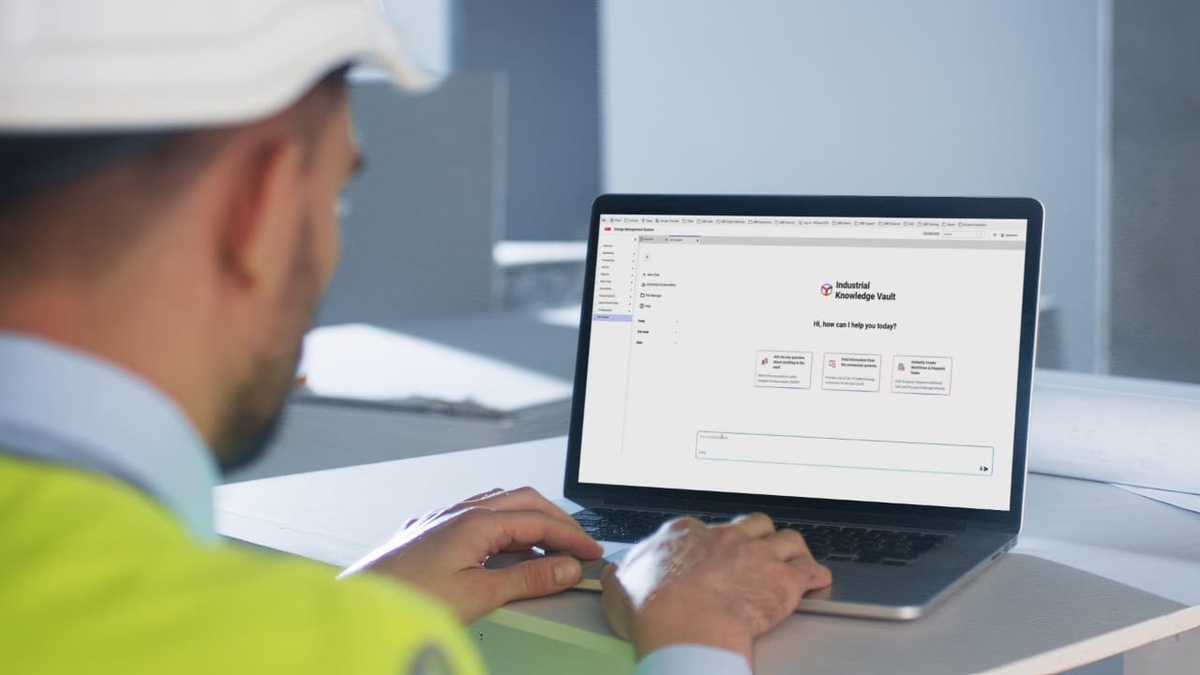
ABB’s solution uses generative AI to transform energy data into accessible insights through natural language, increasing efficiency and operational control
Furthermore, in April 2026, in São Paulo, ABB announced the integration of generative artificial intelligence into the ABB Ability™ Energy Management System (EMS). Thus, the solution incorporates the ABB Ability™ Industrial Knowledge Vault (IKV).
In this way, users can access operational insights through natural language, which, in turn, enhances efficiency, sustainability, and industrial decision-making.
Additionally, according to ABB itself, the solution strengthens the use of energy data in sectors such as mining, pulp and paper, metals, and cement.
-
For the first time in 2,000 years, a sarcophagus was opened in the Tomb of Cerberus, revealing a mummy lying face down, a preserved shroud, and funerary objects in Naples.

-
In the south of South Korea, thousands of islands, salt pans, and coastal structures create a mosaic so jagged that, viewed from space, they resemble a human puzzle scattered among tides, mud, and channels.

-
Equatorial Group invests R$ 21 million in the Delfos Project with artificial intelligence and launches a new customer experience management model in the Brazilian electric sector.
-
In the interior of São Paulo, a giant lagoon in the shape of a human body appears on Google Earth, flanked by 12 symmetrical chapels, and no one knows why.

Generative AI applied to energy management
Moreover, by integrating the co-pilot feature of the Industrial Knowledge Vault into the EMS, ABB aims to simplify access to critical information.
Thus, in practice, operators, energy managers, and sustainability teams can ask direct questions about energy consumption, emissions, costs, and performance.
In this way, the system responds with structured data and actionable insights, without the need for complex navigation.
Furthermore, as reported by ABB, the feature eliminates the need to use multiple systems.
Consequently, it also reduces the use of complex filters and manual data compilation.
Thus, the interpretation of information is accelerated, while faster and more accurate decisions can be made.
At the same time, according to the company, transparency and operational rigor are maintained, even in demanding industrial environments.
Operational efficiency and industrial challenges
Moreover, ABB states that the choice of the EMS as the foundation occurred due to the platform’s maturity.
Thus, the robust data model allows for generating reliable insights from large volumes of energy data.
In this way, the integration ensures quality and consistency in operational analyses.
Furthermore, the current industrial scenario demands greater energy efficiency, emission reductions, and cost control.
Consequently, companies face more complex production systems and increasing demands for reliability.
In Brazil, for example, sectors such as mining, pulp and paper, metals, and cement are highly energy-dependent.
Thus, quick access to data can directly impact competitiveness and operational results.
In this way, the use of artificial intelligence applied to energy management becomes strategic to enhance productivity and efficiency.
ABB’s statement and practical application
Moreover, according to Sanjit Shewale, Global Head of Digital for ABB’s Process Industries division, there is increasing pressure on industries.
“Industrial organizations are under increasing pressure to improve energy efficiency, reduce emissions, and strengthen operational resilience,” said the executive.
Additionally, he highlighted that by integrating generative AI into the energy management system, ABB enables faster access to insights.
Thus, more informed decisions are made without increasing operational complexity.
Industrial Knowledge Vault and knowledge management
Furthermore, the Industrial Knowledge Vault was developed to preserve and structure industrial knowledge.
Thus, it functions as a centralized repository of critical information, accessible through natural language.
In this way, the solution also assists in creating step-by-step procedures and workflows.
Consequently, it contributes to the application of best practices, efficiency gains, and safer operations.
About ABB
Moreover, ABB is a global leader in technology in the areas of electrification and automation.
With over 140 years of operation, the company has around 110,000 employees worldwide.
Thus, the company combines engineering and digitalization to help industries achieve greater efficiency, productivity, and sustainability.
Additionally, ABB’s Process Automation division operates in the automation, electrification, and digitalization of industrial operations.
With approximately 20,000 employees, this area serves everything from power supply to production logistics.
In this way, ABB supports process, hybrid, and marine industries to operate more efficiently and sustainably.
In light of this technological advancement, can the integration of generative artificial intelligence and energy management redefine how industries make operational decisions?







Seja o primeiro a reagir!