





 Portuguese
  English
  Spanish
  6 min of reading
  21 comments


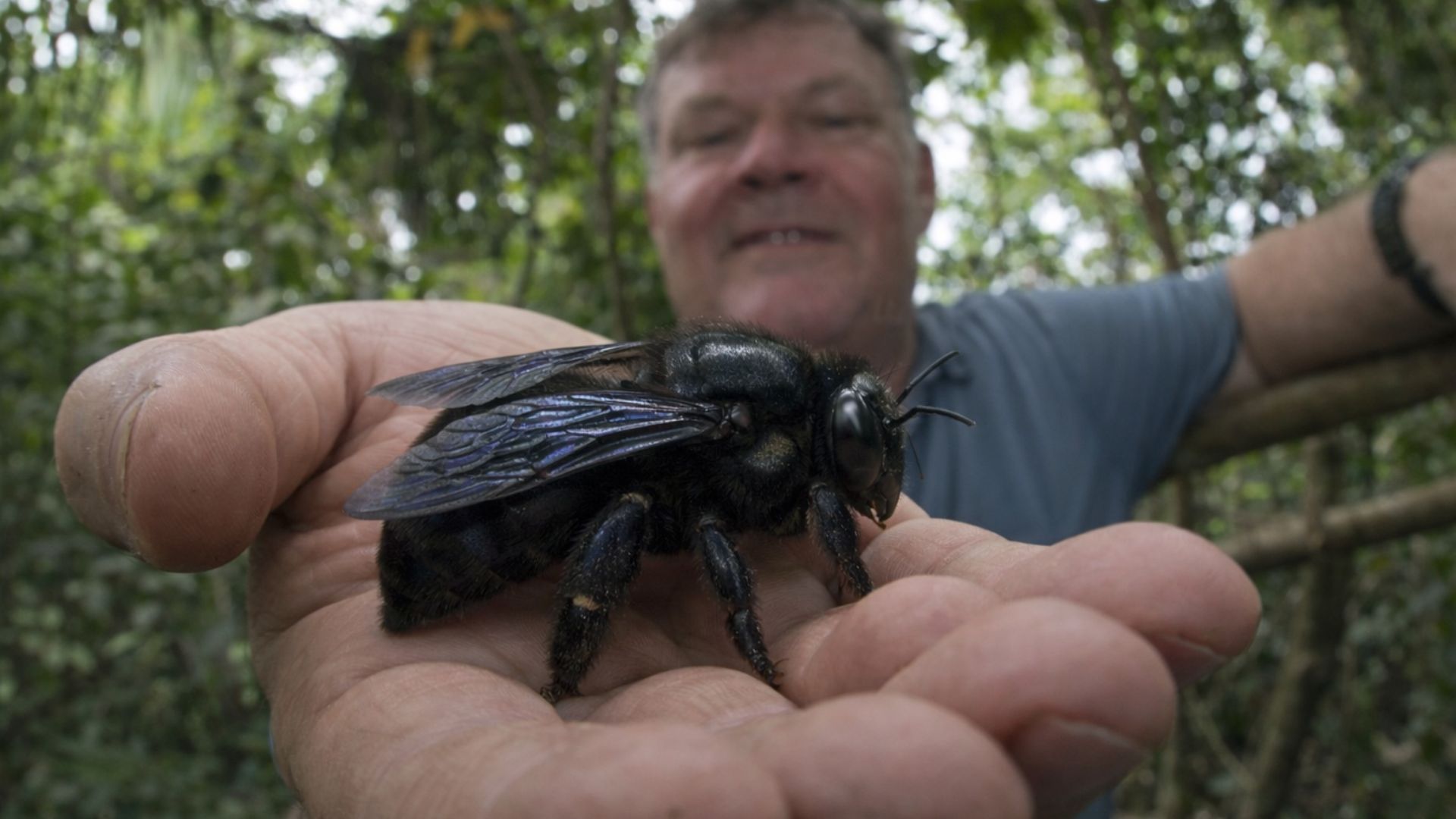


Rediscovery of Megachile pluto in Indonesia Reignites Global Interest in “Lost Species,” Highlights the Largest Bee in the World, and Reinforces How Tropical Forests Hide Rare Biodiversity for Decades, Despite Unusual Size, Discreet Habits, and Dependency on Termite Nests in Trees.
An unusually large bee, known for its large jaws and for living associated with termite nests in trees, has been recorded alive again after a long period without scientific confirmations in its natural environment.
Identified as Megachile pluto, an endemic species of Indonesia commonly called the Wallace’s giant bee, it has become one of the most talked-about cases of rediscovery of rare insects by combining three elements of significant impact: size, rarity, and a history of disappearance that fueled extinction perception.
Largest Bee in the World and Distinctive Characteristics
It is the largest known bee species today, according to scientific institutions and science communication outlets that monitored the reunion.
-
A Japanese mason transforms raw granite into small cups and handcrafted utensils, collects giant stones, cuts with precision, and impresses with detailed manufacturing and finishing.

-
With 1,066 acrylic panels, the building known as the friendly alien is supported by a steel skeleton, has a façade that functions as a giant screen, and impresses the world without any internal columns.

-
Scientists warn that a comet about 1 km in size that has started to release gases may actually change direction in space. It was spotted by NASA and surprises with potential impacts near Earth.
-
These living root bridges and ladders are over 700 years old and help indigenous people survive in one of the rainiest regions in the world.


Its appearance is striking due to its dark and robust body, the light band on the abdomen, and especially in females, the developed jaws, used for manipulating nest materials.
In technical descriptions and reports from specialists, the size can reach about 38 millimeters in length in females, with a wingspan of approximately 6.3 centimeters, numbers that help explain why the insect has become an icon among entomologists and conservationists.
Wallace, Science, and the First Historical Records
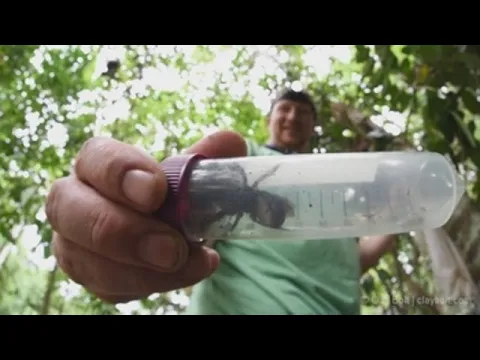

The rediscovery gained relevance for involving a species associated with the history of science.
The first record is attributed to the naturalist Alfred Russel Wallace, who collected a specimen in the 19th century in the Molucca region of eastern Indonesia, in a context of expeditions that helped consolidate modern biogeography.
From this material, the species was formally described in the scientific literature, but it remained for decades with few confirmed records, reinforcing the idea that it was an animal with a very restricted distribution and difficult to locate.
Remote Forest, Tree Termite Mounds, and the Reunion Site
The live reappearance in the forest occurred after targeted searches in areas where the insect had been observed in the past.
Public reports from conservation institutions and universities involved in disseminating the case describe that the team found a female in forest habitat in the North Moluccas, associated with an active arboreal termite mound.
This detail is central to understanding the animal’s ecology: the bee uses the external structure of termite nests as shelter and builds compartments inside with resin, creating a physical barrier that separates its galleries from the area occupied by the termites.
How the Bee Builds Its Nest with Resin
This nesting strategy has been described in previous studies when the species was recorded by scientists in the late 20th century.
In 1981, entomologist Adam Messer located nests on islands in the region and published observations about behavior, including how the bee uses resin and wood to reinforce the nest’s protection.
From that documentation, the species again disappeared from field confirmations for decades, fueling uncertainties about its survival amid accelerated transformations in land use across parts of the archipelago.
Lost Species, Targeted Searches, and Visual Documentation
The reunion also occurred at a time when the species was already appearing on lists of “lost species” used by conservation organizations to encourage searches and raise awareness for little-studied biodiversity.
In initiatives of this type, the giant bee was highlighted as one of the most sought-after species, precisely because of the combination of rarity and difficulty of observation.
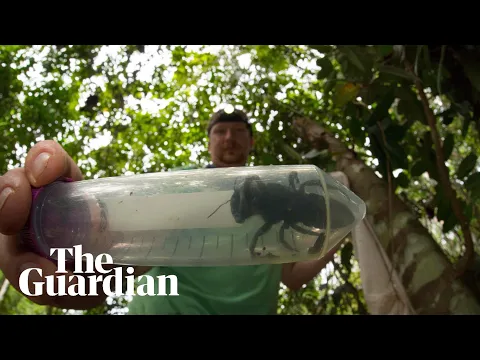
The live record, with photographic and video documentation, provided direct evidence that the insect continued to be present in the forest, in contrast to the absence of systematic observations for an extended period.
Trade of Rare Specimens and Risk of Illegal Collection
In addition to the biological aspect, the rediscovery brought to light another sensitive topic in conservation: the trade of rare specimens.
Before the widely publicized live record, scientific institutions and authors specialized in insect conservation reported the appearance of specimens for sale on online auction platforms, an episode cited in an academic article about the implications of trade for the protection of rare species.
The market activity reinforced the need to differentiate, in public communication, the scientific rediscovery from commercial interest, as the exposure of rare species can increase the risk of illegal collection and pressure on small populations.
Conservation Status and Habitat Threats

The conservation status of Megachile pluto is also monitored by international assessments.
On the International Union for Conservation of Nature’s Red List, the species appears classified as Vulnerable, a category that indicates a high risk of extinction in the medium term if threats persist.
This categorization is consistent with the type of environment associated with the insect and with its rarity history: it is a species linked to low-altitude forests on tropical islands, areas that, in many places in Indonesia, have been converted to agriculture and the expansion of plantations, including palm oil, according to records from scientific institutions and specialized reports that contextualized the rediscovery.
Why Such a Large Bee Can Remain Invisible for Decades
The animal’s biology itself helps explain why it can go unnoticed for long periods.
Unlike social bees that form large, visible colonies, Megachile pluto is a solitary or low-aggregation bee, dependent on specific nesting structures, such as suitable tree termite mounds, as well as resin resources and plants for foraging.
The female, which has the most developed jaws, uses this apparatus to collect resin and shape protective material, a behavior described in field observations and summaries from conservation-related institutions.
Record, Release of the Specimen, and Search Methodology

The rediscovery itself did not mean permanent capture of the specimen for collections.
Public reports emphasized that the record was made with documentation and release of the animal, a common approach when dealing with rare species and when the immediate goal is to confirm existence and record characteristics, without further reducing a potentially small population.
At the same time, the reunion reinforced the importance of targeted search methods, based on ecological knowledge and indirect habitat signals, such as the presence of arboreal termite mounds in specific forest areas.
Island Biodiversity and What the Rediscovery Reveals
The case of Wallace’s giant bee has solidified as an example of how science deals with species known from few historical records.
The combination of old documentation, field observations across distinct periods, and renewed attention through conservation initiatives created a scenario where a species considered lost for decades is recorded again with visual evidence and ecological context.
This type of record has practical value because it guides research on distribution, behavior, and threats, as well as informing conservation policies aimed at habitat and control of trade in rare specimens.
By bringing back a species that has become a symbol of the “lost and found,” the rediscovery also broadens the debate on how tropical island forests shelter highly specialized biodiversity, often dependent on microenvironments and less visible interactions.
In a rapidly changing scenario, the documented presence of Megachile pluto reinforces that part of the diversity may remain off the radar for long periods, even when it involves an animal with unusual dimensions, as long as its lifestyle is discreet and its habitat is restricted.






Pessoal diz que tem dela em casa, mas estão confundindo com a Mamangava que faz a Polinização do Maracujá. Elas são parentes distantes.
Imaginem uma picada desta abelha….
Sim encontrei uma aqui em casa