





 Portuguese
  English
  Spanish
 4 min of reading
  0 comments


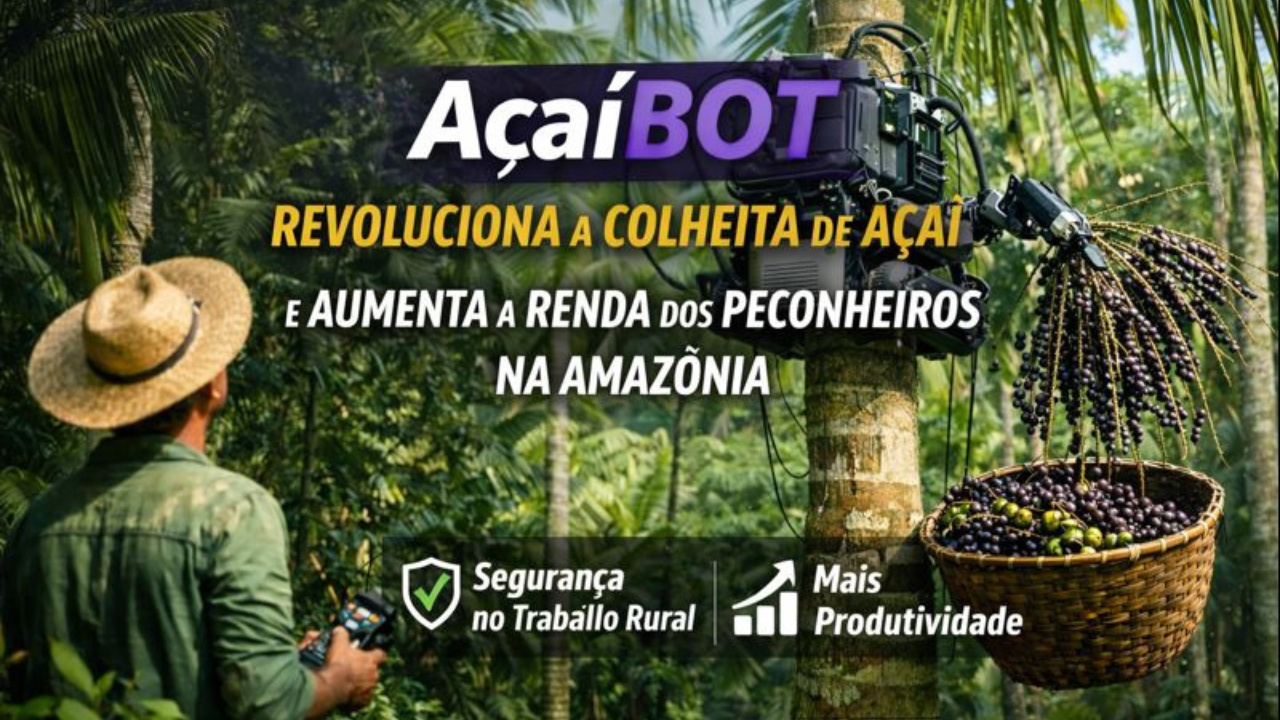
With Agricultural Robotics, Açaíbot Modernizes Açaí Harvesting, Reduces Accidents, and Strengthens Safety in Rural Work.
A agricultural robotics has taken on a new role in the Amazon rainforest.
Developed in Pará, the Açaíbot is a robot created to automate the açaí harvest, reduce accidents, and increase the income of harvesters.
The technology began to be tested in recent years in areas of native forest and gained prominence in 2025 by demonstrating significant gains in productivity, safety in rural work, and social inclusion.
-
With a cost per shot close to zero, the DragonFire laser could change naval warfare in 2027 and provide British ships with nearly unlimited defense against drones.

-
A British startup creates tires that generate electricity in electric vehicles when passing over potholes, speed bumps, and cracks.

-
Scientists have created robots made with living cells that have their own nervous system, swim on their own, explore the environment, and self-organize without any genetic engineering, and now they want to do the same with human cells.

-
Students create a solar-powered ambulance that operates without a plug, without fuel, and still keeps medical equipment running in remote areas.


The equipment climbs the palm tree, identifies the mature bunch, and makes the cut precisely.
As a result, daily production can jump from around 100 kilograms to up to one ton per worker.
The innovation arises as a direct response to one of the most dangerous extraction systems in the world and is already beginning to be commercially adopted in the Northern region.
Açaíbot Is Born to Solve Historical Bottlenecks in Açaí Harvesting
The idea for the Açaíbot emerged four years ago when a group of entrepreneurs planned to establish an açaí farm in Pará.
During this process, it became clear that the traditional model of açaí harvesting faced serious economic and social limitations.
“The current system of forest açaí production is doomed to remain informal and precarious. It pays poorly and is very dangerous,” says João Rezende, director of Kaatech.
In light of this scenario, the team decided to invest in agricultural robotics as an alternative to make the activity safer, more productive, and sustainable, without eliminating the central role of harvesters.
Agricultural Robotics Applied to the Amazon Rainforest
Unlike technologies designed solely for mechanized areas, the Açaíbot was developed and tested under real forest conditions.
The robot faced intense heat, high humidity, frequent rains, and logistical transportation difficulties.
The operation is simple. The equipment climbs the palm tree, locates the bunch, and executes the cut safely.
Thus, the operation occurs remotely, with only three commands: ascend, activate the saw — accompanied by a warning beep — and cut.
This simplicity increases access to the technology and facilitates training.
“It’s so simple that it allows the inclusion of people who couldn’t climb the trees,” says Rezende.
Productivity and Safety in Rural Work Advance Together
Thus, in addition to operational gains, the impact on safety in rural work is one of the main differentiators of the Açaíbot.
In this way, the International Labour Organization classifies açaí harvesting as the second most dangerous activity in the world, second only to honey collection on African cliffs.
The harvesters, who use a harness to climb palm trees up to 10 meters, have historically faced fractures, spinal injuries, and fatalities during the activity.
In states like Amapá, reports from the Regional Labor Court have already pointed out the high degree of danger associated with the job.
In this context, the robot was also presented to labor judges and to the ILO itself as a concrete alternative to reduce risks without eliminating jobs.
Technological Evolution Made the Robot Lighter and More Efficient
The first prototypes of the Açaíbot were almost artisanal. They used skateboard wheels, windshield wiper motors, and heavy metal structures, weighing up to 16 kilograms.
“We were on the right path, but we needed a different engineering approach,” admits Rezende.
Thus, after three years of improvement with specialists in aerospace, mechanical, electrical, robotics, and ergonomics engineering, prototype number eight achieved optimal performance in June 2025, weighing between eight and nine kilograms.
In this way, the battery life is four hours, with recharging taking about two hours through solar panels.
Institutional Interest and Commercial Expansion
Thus, the innovation caught the attention of the federal government during COP30 in Belém.
On this occasion, President Luiz Inácio Lula da Silva visited an açaí production area on Grande Island and got to know the robot up close.
“On the first day of COP, we were informed that the president wanted to see açaí production. We brought the robot, and he was excited, even posting about it on social media,” recounts Rezende.
Currently, around 500 units have already been sold.
Thus, the factory in Belém is operational, with the capacity to produce up to 3,000 robots per month.
The price of the equipment is R$ 19,569.20, with a 40% discount for upfront payments for producers under the Pronaf program.
Technology Also Aims at the Atlantic Forest
Thus, in addition to the Amazon, Kaatech’s agricultural robotics is advancing into the Atlantic Forest.
In partnership with the Association of Residents and Friends of the Atlantic Forest (Amama), a version of the Açaíbot is being developed for the harvesting of juçara, a species threatened by illegal palm heart exploitation.
“The idea is to transform a predatory activity into a sustainable chain, with income, conservation, and technology going hand in hand,” asserts Rezende.
Thus, the initiative reinforces how innovation, tradition, and safety in rural work can coexist in the new phase of açaí harvesting in Brazil.
See more at: Robot That Harvests Açaí Multiplies Collectors’ Income by Four in the Amazon








Seja o primeiro a reagir!