





 Portuguese
  English
  Spanish
  5 min of reading
  0 comments


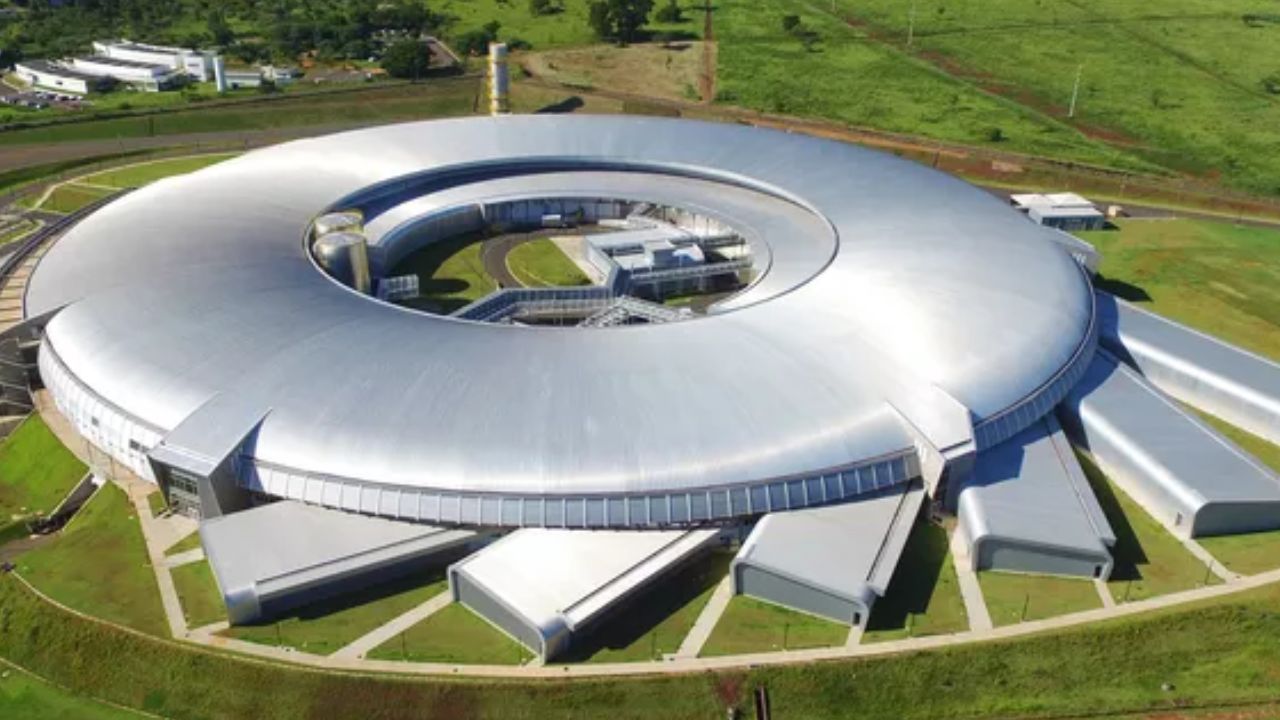
Located in Campinas, the synchrotron light laboratory places Brazil at the forefront of global research, allowing us to see matter at an unprecedented atomic level.
The Sirius, the Brazilian particle accelerator, is the largest and most complex scientific infrastructure ever built in the country. Considered one of only three fourth-generation electron accelerators in the world, it operates like a “super microscope” capable of revealing the structure of materials at an atomic level. According to information from the Estadão channel, which conducted a technical visit to the site, the main goal is not to collide particles, but to produce an extremely bright and focused light known as synchrotron light.
This cutting-edge technology, installed at the National Center for Research in Energy and Materials (CNPEM) in Campinas (SP), positions Brazil as a global research hub. The impact of Sirius goes beyond pure science, paving the way for innovations in strategic areas such as health, with the development of new drugs; agribusiness, in the creation of more efficient fertilizers; and energy, with research into materials for batteries and oil exploration.
What Is and Where Is the “Maracanã of Science”?
Nicknamed the “Maracanã of Brazilian science” due to its monumental dimensions, the Sirius occupies an area of 68 thousand square meters, as highlighted by the Estadão channel. The structure is supervised and funded by the Ministry of Science, Technology and Innovation, representing a milestone in Brazil’s scientific autonomy. The complex was designed to house not only the accelerators but also state-of-the-art laboratories called “research stations” or “beamlines,” where the actual experiments take place.
-
An impressive phenomenon in Northern Brazil causes rivers of different colors to flow side by side, revealing secrets about sediments, currents, and biodiversity.

-
While many schools are still struggling with the basics, a teacher in China went viral for having elementary school students build a two-stage rocket using plastic bottles, water, and pressurized air in a science class that caught the attention of the entire world.

-
10 million robots per year in unprecedented industrial scale place China at the forefront of automated production and raise the question of how far machines can manufacture other machines.

-
Researchers in Malaysia buried sensors at 15 and 30 cm and can now predict soil moisture with 95.49% accuracy, helping the field to irrigate only at the right time and reduce water waste.

It is essential to understand that, unlike other famous accelerators, the Sirius is not a particle collider. Its purpose is to accelerate electrons to a speed close to that of light so that they emit extremely bright electromagnetic radiation. This light is then directed towards the samples that scientists wish to study, functioning as a source of illumination capable of revealing details that would be impossible to observe with conventional microscopes, enabling the analysis of molecules, atoms, and their interactions.
How Does Sirius Generate a Brighter Light Than the Sun?
The process of generating synchrotron light is a feat of engineering and physics, occurring in three main stages within a tunnel with one-meter-thick walls to ensure radiation isolation. First, the electrons are generated and given an initial acceleration in a linear accelerator (Linac). Then, they are injected into a second circular accelerator, called the Booster, where their energy is drastically increased in a fraction of a second.
Once they reach the ideal energy, the electrons are transferred to the main ring, the storage accelerator, where they travel at a speed close to that of light, completing about 600 thousand laps per second. It is in this ring that the magic happens: a series of super-powered magnets forces the electrons to constantly change direction. According to the laws of physics, every time a charged particle, such as an electron, is diverted from its path, it emits energy in the form of electromagnetic radiation. In Sirius, this emission is the powerful and concentrated synchrotron light.
From Light to Discovery: A Visit to the Research Stations
Once produced, the synchrotron light is channeled from the main ring to the research stations, which are highly specialized laboratories. Each station, or beamline, is optimized for a different type of experiment. A notable example, cited by the Estadão channel, is the Manacá station, which gained prominence during the pandemic. It was used to map, with atomic precision, one of the proteins of the SARS-CoV-2 virus, which causes COVID-19, a crucial step for the development of medications and vaccines.
Inside a station, the light passes through a series of instruments before reaching the sample. First, in an “optical hut,” a device called a monochromator filters the light, selecting exactly the “wavelength” needed for the experiment. Then, in the “experimental hut,” this purified beam of light hits the sample, which can be a protein crystal much thinner than a hair. The way the light interacts with the sample generates patterns that are captured by detectors, and with the help of computers, scientists can reconstruct the three-dimensional structure of the material, atom by atom.
Why Is Sirius Strategic for Brazil?
The status of Sirius as one of the three only fourth-generation accelerators in the world, alongside projects in Sweden and France, gives Brazil a competitive advantage and scientific sovereignty. The fourth generation is distinguished by producing an extremely fine and concentrated beam of light, which allows for the analysis of tiny samples with unprecedented resolution. This means that Brazilian researchers can now answer complex scientific questions without needing to seek machine time in foreign laboratories.
This autonomous capability is vital for addressing national and global challenges. With Sirius, the country can lead research on the biodiversity of the Amazon, develop new materials for the industry, optimize food production, and be better prepared for future pandemics. As pointed out in the report by the Estadão channel, having such a versatile and powerful tool on national soil not only attracts talent but also ensures that the knowledge generated here can be directly applied to solve problems in Brazil and around the world.
The Sirius is much more than a grand machine; it is a strategic investment in the future of science, technology, and innovation in Brazil. It empowers the scientific community to work at the frontier of knowledge, generating discoveries that can transform health, industry, and the environment.
Is investing in a structure like Sirius the way to consolidate the future of science and technology in Brazil? Which area do you believe will be most impacted by this research in the coming years? Share your opinion in the comments; we want to hear your perspective.







-

Uma pessoa reagiu a isso.