





 Portuguese
  English
  Spanish
  4 min of reading
  0 comments


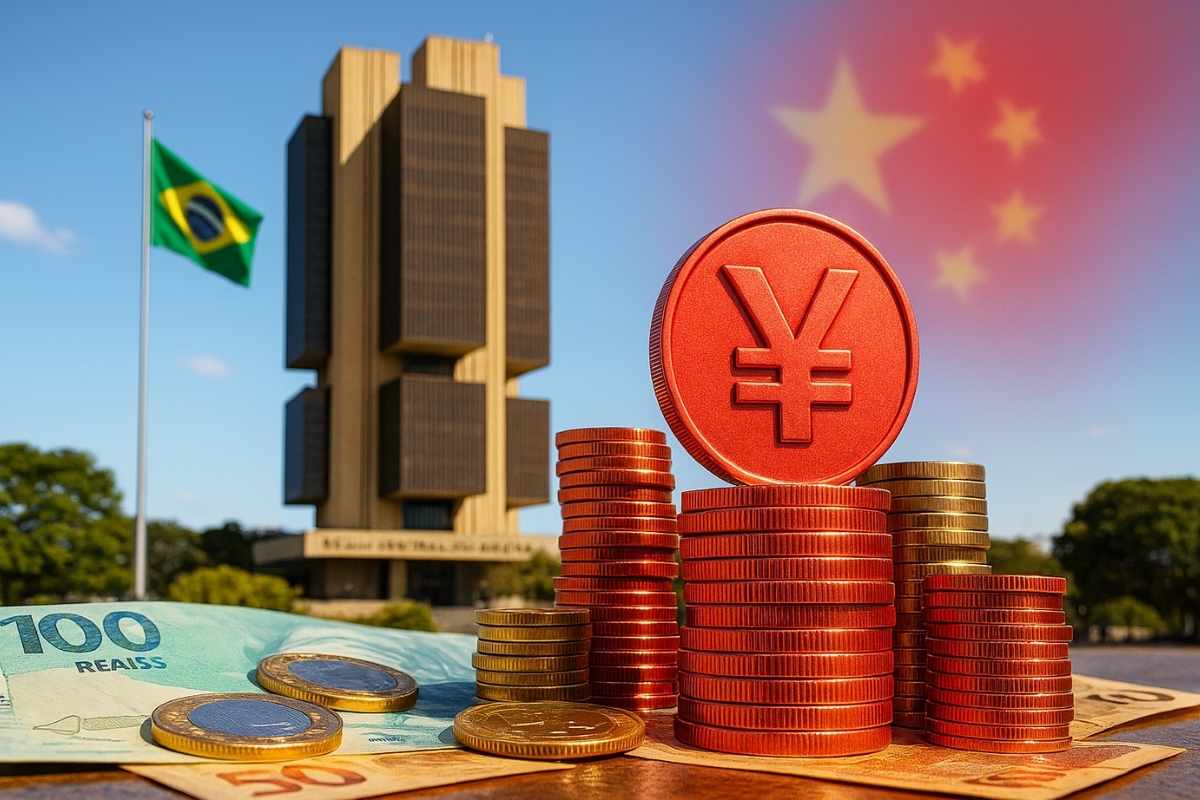
The Central Bank Agreement With China — Described by Analyst Bruno Musa as a Currency Swap of About Five Years to Expand the Use of the Yuan — Reopens the Debate About Liquidity in Times of Crisis, Financial Dependence on China, Capital Control Risks, and the Practical Effects for Exporters, Banks, and Brazilian Investors.
The Central Bank agreement with China was presented by Bruno Musa as a technical milestone with geopolitical implications: a currency swap that expands the use of yuan in transactions with Brazil. According to the analyst, the measure acts as a “liquidity cushion” in currency shocks, but it may also deepen the country’s dependence on the Chinese currency.
According to Bruno Musa, the swap would allow the Central Bank to access yuan directly in adverse scenarios — without dollar intermediation — while also strengthening the settlement of trade contracts in the East. For the analyst, the point of concern lies in the risks of a currency with capital controls, which would require prudence from companies, banks, and the government itself.
What Is a Swap and What Is It For
The swap mentioned by Bruno Musa is, in essence, an agreement between central banks for the exchange of currencies in a pre-defined amount, with agreed terms and conditions.
-
Brazilian city bets on the business environment to generate jobs and attract investments in the energy sector — secretary reveals strategy at Macaé Energy 2026.

-
50 viaducts, 4 tunnels, 28 bridges, and 40 kilometers of bike paths: BR-262 in Espírito Santo will receive 8.6 billion reais for the largest engineering project in the state’s history, inspired by the Immigrant Highway in São Paulo.

-
Brazil produces too much clean energy and doesn’t know what to do with it: over 20% of solar and wind capacity was wasted in 2025 while investors flee and 509 renewable generation projects were abandoned in the last year.

-
Piauí will produce a new fuel that replaces diesel without needing to change anything in the truck’s engine and reduces pollutant gas emissions by half: truck drivers from all over the Northeast are already celebrating the news that will arrive later this decade.


The aim is to ensure liquidity when one side faces currency stress, reducing costs and operational friction in international payments.
In practice, this arrangement facilitates commercial and financial operations in yuan, especially when there is a large volume of bilateral trade.
Bruno Musa notes that China is Brazil’s largest partner and that sectors like agribusiness, mining, and energy can benefit from lower costs and more predictable terms when settling directly in Chinese currency.
Where the Central Bank Agreement With China May Have the Greatest Impact
For Bruno Musa, soybeans, meat, sugar, iron ore, and oil are likely to be the first beneficiaries, as they gain efficiency when closing contracts in yuan with Chinese buyers.
From a financial perspective, banks can diversify part of their reserves and funding lines in Chinese currency, offering products and exchange that are more aligned with the real trade flows.
Companies with supply chains integrated with China also reduce operational risk (e.g., less exposure to intraday dollar fluctuations) and gain agility in payment settlements.
Still, the analyst warns: tactical gains do not eliminate strategic risks associated with state control over the yuan.
Risks Identified by Bruno Musa: Dependence and Capital Controls
According to Bruno Musa, the Central Bank agreement with China may deepen Brazil’s dependence on a partner that adopts capital controls and has a currency that is not fully convertible.
In an extreme scenario, unilateral changes in currency policy could restrict withdrawals, transfers, or remittances, increasing the risk for those holding reserves or contracts indexed to the yuan.
The analyst also highlights the geopolitical vector: the yuan’s advancement in the BRICS and the agenda of de-dollarization may strain relations with other key partners of Brazil.
For Bruno Musa, this would require careful management of reserves (still predominantly in dollars worldwide) and technical communication to avoid misunderstanding with foreign investors.
What Changes for Companies and Banks in the Short Term
According to Bruno Musa, with the Central Bank agreement with China, exporters can price and settle a larger portion of contracts in yuan, which aligns the currency of revenue and costs (when inputs come from China).
This reduces dollar hedging and may decrease financial expenses.
For banks and treasuries, the swap expands repayment lines and structured operations in yuan, potentially lowering the cost of credit linked to trade flows with China.
The gains, however, depend on governance, transparency, and clear exposure limits — points that, in Bruno Musa’s view, should be closely monitored.
Is It Worth It? The Pros and Cons According to the Analysis Presented


Pros
- Additional Liquidity in Currency Stress Scenarios.
- Operational Efficiency and Lower Cost when Settling Directly in Yuan.
- Adherence to Real Trade Flows with Brazil’s Largest Partner.
Cons
- Greater Dependence on a Currency Under Capital Controls.
- Geopolitical Risk Amid the Debate on De-dollarization.
- Possible Sensitivity of Reserves and Flows If There Are Unilateral Decisions by the Chinese Government.
The Central Bank agreement with China can lower transaction costs and increase liquidity, but it requires rigorous management of currency risk and diversification of reserves.
For Bruno Musa, the central point is not to exchange one known risk (dollar) for another less predictable one (yuan) without clear governance counterparts.
The Central Bank agreement with China brings Brazilian financial infrastructure closer to its main trading partner and can generate tactical gains for those who export, import, and finance supply chains integrated with Asia.
Bruno Musa warns, however, that the short-term benefit needs to be accompanied by exposure limits, transparency, and reserve planning to avoid excessive dependence on a currency subject to capital controls.
Balance and Risk Management Are the Keywords.
In your opinion, should Brazilian companies increase contracts in yuan or keep the dollar as a reference? In case of crisis, would you trust in liquidity lines backed by the yuan? Leave your opinion in the comments — we want to hear from those who operate foreign trade, exchange, and treasury on a daily basis.










-

Uma pessoa reagiu a isso.