





 Portuguese
  English
  Spanish
  6 min of reading
  0 comments


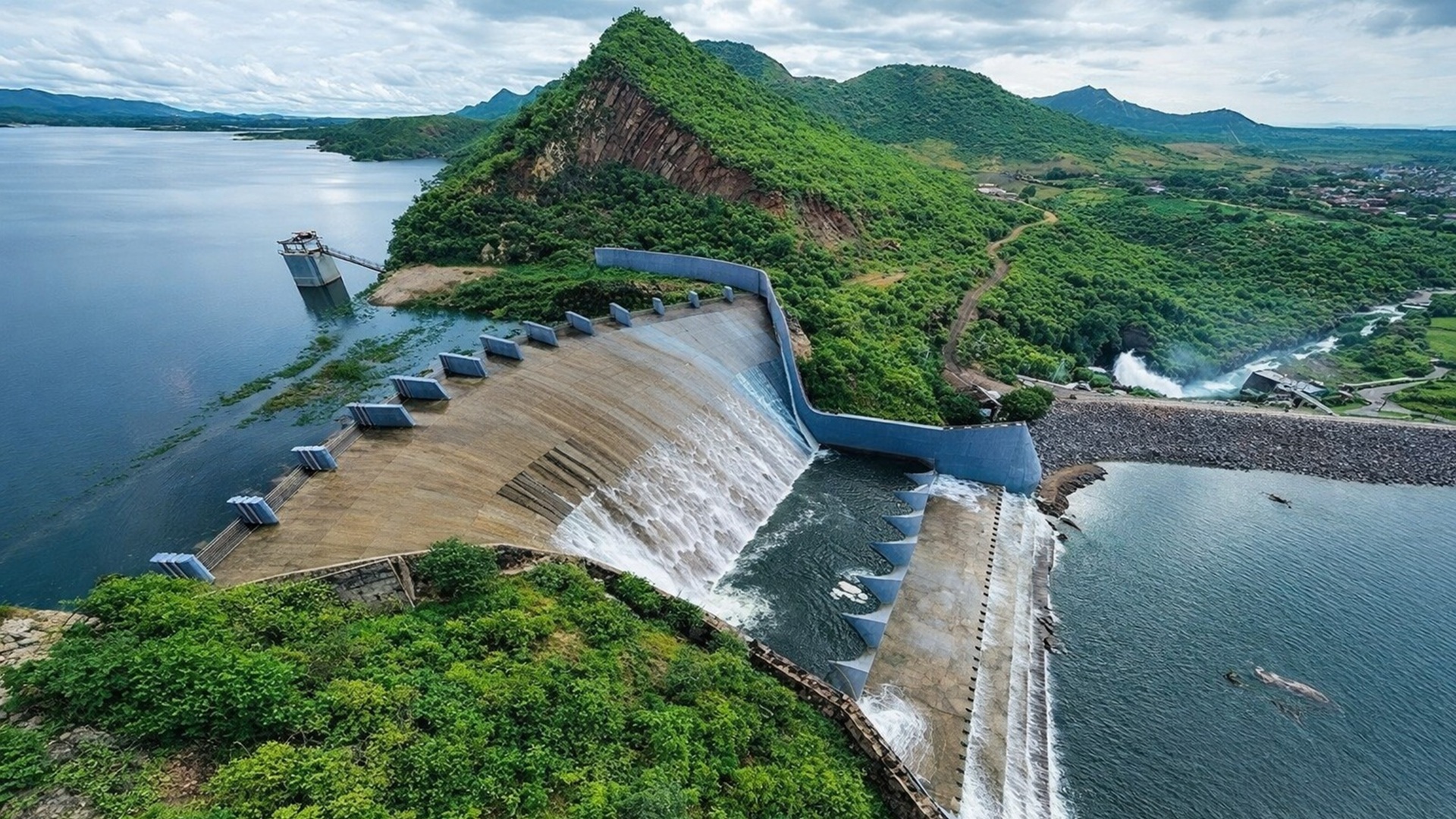
After More Than Eight Decades Of Studies, Interruptions, Collapses, And Resumptions, The Oros Dam Consolidated Itself As The Central Infrastructure For Water Security In Ceará, With A Dam Of 670 Meters, Capacity Of 2 Billion Cubic Meters And A Decisive Role In The Perennialization Of The Jaguaribe River, Agricultural Irrigation And Regional Supply, Culminating In The Overflow Registered In April 2025 After 14 Years
The Oros Dam, the second largest water reservoir in Ceará, overflowed again on April 26, 2025, after 14 years, ending a historic cycle that began in the Empire, marked by studies, interruptions, and works that resulted in a dam of 670 meters, 54 meters high, and a capacity of 2,000,000,000 m³.
The resumption of the overflow, recorded after rains that raised the volume to the maximum level, puts the reservoir back at the center of state water security, strengthening structural functions such as the perennialization of the Jaguaribe River, irrigation, human supply, and productive activities.
The history of the Oros Dam begins in the imperial period, when droughts in the Northeast were already a recurring concern for rulers, due to the social, economic, and demographic impacts caused by the prolonged lack of rain.
-
He started running at 66 years old, broke records at 82, and is now a subject of study for having a metabolic age comparable to that of a 20-year-old, in a case that is intriguing scientists and inspiring the world.

-
Oldest tree on the planet reappears after 130 years of searches: Wattieza, 385 million years old, was 10 meters tall and had no leaves or seeds; Gilboa fossils in New York solved the mystery in 2007.

-
A 48-square-meter house assembled in hours with 4,000 bricks made of recycled plastic that does not absorb moisture, has natural thermal insulation, and costs less than 90,000 reais in a complete kit.

-
Luciano Hang revealed that Havan’s air fleet has already accumulated more than 20,000 landings, 10,000 flight hours, and 6 million kilometers traveled, and he says that without the planes, the company would never have grown so quickly.


In 1878, Emperor Dom Pedro II gathered a committee of scholars to discuss the consequences of drought in Ceará, in a context of calamity that affected entire populations and compromised their permanence in the territory.
Among the members, Baron de Capanema advocated for structural solutions, such as the construction of dams in strategic channels, drilling wells, and planting trees in the state’s interior, focusing on creating permanent sources of water supply.
In this set of proposals, the Oros dam began to be mentioned among projects for channeling waters, still in an incipient way but already embedded in a technical vision focused on coexisting with the semi-arid region.

From Initial Omission To The Aggravation Of Droughts At The Beginning Of The 20th Century
Despite the discussions in the Empire, between that period and 1909, there were no records of concrete advances regarding the Oros Dam, as government priorities turned to works in other regions.
The focus shifted to the opening of roads, aimed at facilitating the movement of people and materials employed in different construction fronts across the Northeast, leaving water projects in the background.
As a result, droughts followed one another incessantly, provoking a growing and alarming rural exodus, as populations abandoned the countryside in search of survival.
Men fleeing drought, plague, and hunger that affected plants, herds, and entire communities contributed to a progressive depopulation process in Ceará, amplifying the social crisis.
Faced with the imminent prospect of total depopulation, the Government resumed planning actions aimed at facing the consequences of droughts, reorienting public policies toward emergency works.
Creation Of IFOCS And The First Technical Studies In Orós
In this context, the Federal Inspectorate for Drought Works, IFOCS, was created, the former name of the current National Department Of Drought Works, with the mission of planning emergency works.
Engineer Miguel Arrojado Lisboa organized geological observations in different watersheds, and starting in 1911, the region of Boqueirão do Orós began to be studied in more detail.
The first topographic survey was conducted by engineer José Gomes Parente, assisted by Louis Philipps, resulting in drawings of the region sent to IFOCS in Fortaleza.
These surveys allowed the agency’s management to understand the reality of the location where the dam was intended to be built, providing unprecedented data on the feasibility of the project.
In preliminary soundings, technicians discovered a well over forty meters deep in the center of the channel, exactly where the dam was to be built.
The complete report with this data was destroyed in a fire that occurred in December 1912, leaving only a sketch of Boqueirão do Orós and a topographic reduction of the hydraulic basin of the Jaguaribe River.
Legal Resumption And Successive Interruptions Over The Decades
Only in 1919 did President Epitácio Pessoa sign Law No. 3925, which set plans for the construction of large dams in the Northeast.
With the new legislation, the Oros project once again became the subject of studies, now included in a broader plan for regional water infrastructure.
In 1921, the American firm Dwight Robinson & C° Incorporated arrived in the Sítio Orós area, conducting detailed topographic surveys and outlining the first complete designs of the dam.
These projects included the installation of houses, access roads, electrification, and other works deemed urgent, representing the first precise set of technical documents for the dam.
In 1924, heavy rains hit the region, causing work to be suspended, once again interrupting the progress of the project.
The following year, in 1925, a law decreed by the Government suspended all public works, causing Orós to be sidelined and practically forgotten once again.
New Projects, Technical Limits And Definitive Studies
In 1930, by ordinance of engineer Palhano de Jesus, new studies and projects were carried out under the direction of engineer Luís Augusto Vieira.
Two projects were authored by him for the Oros dam, but reports indicated that both did not adapt to local reality nor provide guarantees against the impetuosity of the Jaguaribe River.
The lack of adequate technical solutions prolonged the delay of the work, keeping the project on hold for over two decades.
Only in 1957 did the National Department Of Drought Works complete the definitive studies for the construction of the dam, consolidating viable technical parameters.
The execution of the work was entrusted to a team led by engineer Anastácio Honório Maia, marking the beginning of the final phase of implementation.
Construction, Partial Collapse And Completion In 1961
Excavations for the dam wall foundation began in 1958, advancing according to the schedule established by the definitive studies.
In 1960, heavy rains came early and hit the construction, generating days of panic throughout Ceará, given the imminent risk associated with the volume of the Jaguaribe River.
On March 26 of that year, an alarm announced that the waters of the Jaguaribe were overflowing the still unfinished wall, taking with it the hopes of the population.
Despite the impact, the work was not abandoned. On July 15, 1960, construction resumed with the mobilization of 1,600 men.
In just 80 working days, the team managed to recover the dam’s position prior to the overflow, restoring the conditions for the completion of the project, even after the critical episode.
On January 5, 1961, the construction of the Oros Dam was officially completed, with a dam 670 meters long, 54 meters high, and a capacity to store 2,000,000,000 m³ of water.
Presidential Inauguration And Strategic Functions Of The Reservoir
The then-president Juscelino Kubitschek inaugurated the Oros Dam as he bid farewell to Ceará as head of the federal Executive.
In his speech, he highlighted that the vast lake formed was not only meant to reflect the light of the stars, but to regularize the flow of the largest dry river in the world.
Located 450 km from Fortaleza, the Oros Dam began to play strategic roles, such as the perennialization of the Jaguaribe River and the irrigation of the Médio and Baixo Jaguaribe.
The reservoir was also designated for fish farming, agricultural crops in upstream areas, tourism, and hydropower utilization, expanding its economic role.
Until 2002, Oros held the title of the largest reservoir in Ceará, a position lost with the construction of Castanhão, but without reducing its structural relevance.
Historical Overflow In 2025 And Current Impacts
In 2022, the reservoir more than doubled in volume and reached a level not recorded since 2014, exceeding 49% of accumulated water volume, according to data from Diário do Nordeste and Cogerh.
On April 26, 2025, after 14 years, the Oros Dam overflowed again, reaching its maximum level, with the last occurrence recorded on April 27, 2011.
The Secretary of Water Resources, Fernando Santana, visited the dam on April 27 and highlighted the moment as historic for the State, agriculture, and water security.
According to the Operations Director of Cogerh, Tércio Tavares, the Oros represents the water security of more than 70,000 residents of Ceará, in addition to serving producers and fish farmers in the Médio and Baixo Jaguaribe.
The overflow reinforces the role of the dam as a central structure in human supply and the strengthening of the regional economy, consolidating a trajectory that began in the Empire and is marked by decades of challenges, delays, and achievements.









Seja o primeiro a reagir!