





 Portuguese
  English
  Spanish
  3 min of reading


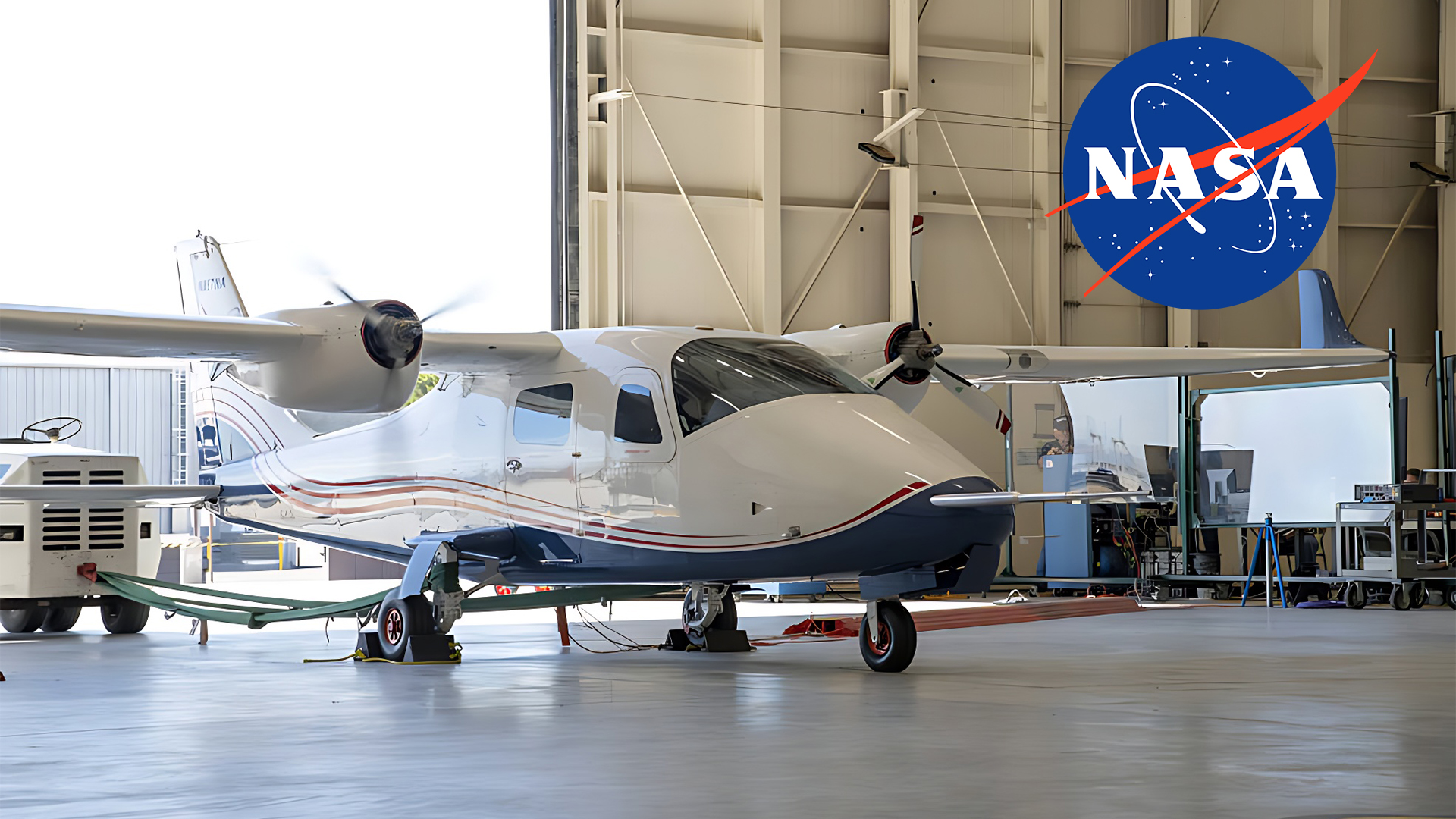
NASA’s Electric Aircraft Will Have a Propulsion System That Will Be Equipped With Lithium-Ion Batteries, Along With 14 Electric Motors and Propellers.
After successfully completing the thermal testing of its cruise motor controllers, the NASA announced that its fully electric experimental aircraft is closer to making its first flight. This development was made public by the space agency in a post on its official blog last Tuesday.
Since 2016, the United States Space Agency has been working hard on the development of the fully electric X-57 Maxwell aircraft with the intention of producing a more environmentally friendly, cost-effective, and quieter flying vehicle. In a recent blog entry, NASA detailed how the thermal testing of cruise motor controllers is essential to the overall system design.
The reason for this is that the temperature test confirms the design, functionality, and manufacturing quality of the controllers, which are described as essential components to power the experimental electric motor of the X-57.
-
A startup backed by OpenAI has started selling a $20,000 robot for household tasks, but when the robot doesn’t know what to do, an employee puts on a virtual reality headset, sees the inside of the house through a camera, and operates each movement. The CEO said that without this, he cannot improve the product.

-
Scientists create a semiconductor that mimics the human brain using hydrogen and boost a new generation of smart chips with learning capabilities and the potential to revolutionize artificial intelligence applications.

-
The radio has been in more than half of Brazilian households for decades, and in 2024, for the first time in history, the number of households without a device surpassed those with a device, with a decrease of 2.3 million in just one year.

-
A “silent skill” is allowing Brazilians to earn up to R$ 22,000 per month without a degree and become indispensable for companies that rely on millions of data to survive.


According to NASA’s revelation, complex systems like those in the electric aircraft include temperature-sensitive components, and as a result, it is imperative to establish whether these components can withstand adverse conditions during flight.
Recent tests were completed on the controllers in a testing chamber at the John H. Glenn Research Center in Cleveland, Ohio, which is operated by NASA. To simulate the conditions that the X-57 may encounter during flight, the temperatures inside the chamber were maintained at a constant level, ranging from -23.9 degrees Celsius to -99.3 degrees Celsius.
The plane will have an electric propulsion system that will be equipped with lithium-ion batteries, along with 14 electric motors and propellers.
An Italian Tecnam P2006T Aircraft Is Being Modified to Be Used in the Construction of NASA’s Electric Aircraft
The team designing NASA’s X-57 electric aircraft has now begun to integrate all systems to ensure they operate as one. This is a process that NASA describes as one of the biggest challenges for an aircraft. Once the capability of the controllers to handle challenging temperatures is confirmed, the team will proceed to integrate all systems of the plane.
The first flight of the X-57 Maxwell has not yet been scheduled, and the aircraft is currently undergoing a flight readiness evaluation at the Armstrong Flight Research Center in California, operated by NASA.
On Tuesday (7th), NASA announced that instead of looking through traditional cockpit windows, pilots of the X-57 electric aircraft will look at a 4K augmented reality screen. According to them, some rescue helicopters are already employing this technology to help navigate busy airspaces. This technology assists rescue helicopters in navigating crowded aerial spaces.
The aviation industry is increasingly looking at electric technology as a potential power source for aircraft. For example, United Airlines made an undisclosed investment in the Swedish company Heart Aerospace two years ago. The company is working on building an electric jet with a range of 250 miles for United Airlines.









Seja o primeiro a reagir!