





 Portuguese
  English
  Spanish
  11 min of reading
  0 comments


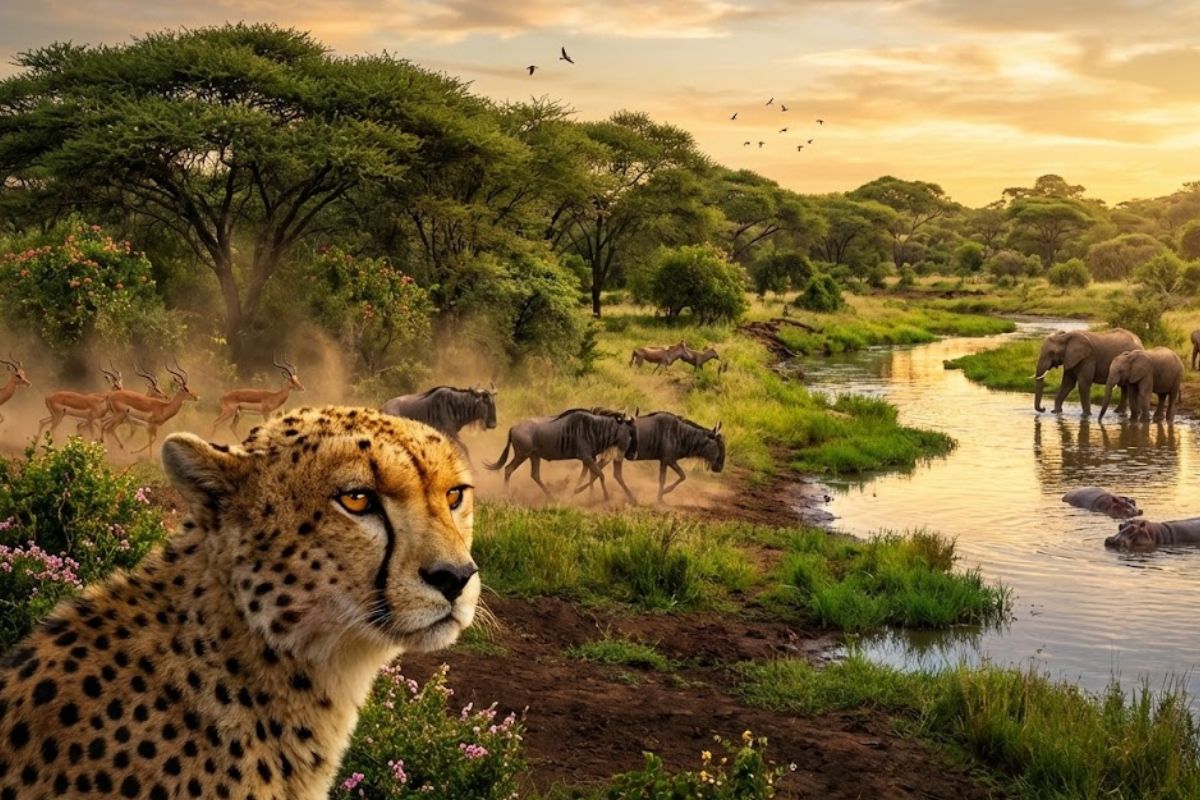
When Bringing Cheetahs Back To Degraded Savanahs Of Limpopo, KwaZulu-Natal And North West Province, South Africa Halted Desert Encroachment, Increased Vegetation Cover, Recovered Water And Soil, And Reduced Overgrazing Without Artificial Works.
South Africa witnessed regions that once appeared as a green carpet of grasses turn into cracked soil, constant dust, and dry streams in just a few decades. Grasslands that supported antelopes, zebras, and gazelles began to collapse, and desertification accelerated as if it were inevitable.
The turnaround happened when the country decided to reintroduce cheetahs to the savanahs. The return of the predator changed herbivore behavior, reduced overgrazing, and triggered a rapid and measurable recovery of vegetation, soil, and water, surprising scientists and farmers.
Savanahs That Were Green And Became Land On The Brink Of Death

Before the collapse, South Africa had some of the most productive savanahs on the continent.
-
In a flooded well, archaeologists found a 1,700-year-old Roman egg that still contains clear and yolk intact inside the very thin shell.

-
Something is happening around the Earth: Inside the huge explosion of fireballs in 2026

-
A hot air bubble coming from Argentina expands over Brazil, causing thermometers to exceed 38 degrees with a thermal sensation of 40 degrees in late March, affecting 6 states at once.

-
The radish leaf that almost everyone throws away has more polyphenols, flavonoids, and fiber than the consumed root, and a 2025 study showed that the leaf contains compounds that protect the intestine, combat inflammation, and may inhibit the growth of cancer cells.


The landscape was marked by herds spread as far as the eye could see and by perennial grasses capable of retaining moisture, protecting the soil, and supporting an entire ecological chain.

The Themeda triandra, mentioned as one of the dominant grasses, appeared as a velvety green carpet, with heights reaching the knee in many areas and covering hundreds of square kilometers in regions like Limpopo, KwaZulu-Natal, and the Northwest.
The problem is that in just a few decades, this scenario began to crumble. Since the late 20th century, the grass has been disappearing, and the soil has been left exposed.
The result was a classic degradation process: the land lost its protection, the wind began to carry away the fertile layer, and red dust storms became part of the routine.
In critical areas, patches were formed described as dead soil, dry and hard as rock, the kind of surface that does not absorb water and does not support roots easily.
The degradation was not limited to what was visible. Streams like Mcuzé and Laticulu began to dry up during the dry season and, in some spots, dried completely, leaving only the exposed bed.
At the same time, the groundwater level fell to the lowest point in many decades, intensifying the feeling that the savanahs were heading down a path of no return.
Desertification Accelerated And Vegetation Lost Space To Invaders

As perennial grasses decreased, invasive shrubs, which previously occupied a smaller part of the ecosystem, advanced en masse.
Records cite increases of over 200% and reaching 300% in some locations.
This created an ecological suffocation effect: the invaders swallowed the living space of native grasses, while the increasingly exposed soil became warmer, harder, and drier.
From this point on, degradation began to function as a feedback loop. The less grass there was, the less infiltration occurred.
The less infiltration, the more surface runoff. The more runoff, the more erosion. And the more erosion, the harder it becomes for natural regeneration.
The consequence was directly felt in the field. Herds became leaner, the soil became dustier, and rains began to fall without fulfilling their recovery role, as the water did not penetrate. Instead, it ran off the land and took away what remained of the fertile layer.
The Economic Impact Hit Farmers And Communities Hard
In 1998, the South African Ministry of Agriculture published a report described as shocking, attributing the degradation of pastures to losses exceeding $1.2 billion in just a decade.
For farmers, this meant loss of productivity, increased vulnerability to drought, and reduced capacity to sustain livestock and other animals in areas that were once considered among the best in the country.
This data is important because it shows that desertification was not just a distant environmental issue. It became a real, measurable economic problem capable of changing the financial stability of entire regions.
The Surprising Diagnosis: It Was Not Just Climate Or Direct Human Action
When specialists were sent to investigate at the end of the 1990s, the central conclusion was unexpected: climate was not the main culprit, and humans, though relevant in other areas, were also not the dominant factor in that specific mechanism.
The real problem was linked to the disappearance of a predator.
An entire ecosystem collapsed because a single fundamental link disappeared. And that link was the cheetah.
This conclusion completely transforms the understanding of what was happening. Instead of being just a case of drought or improper land use, the collapse is understood as a breakdown of ecological balance, the kind that generates domino effects.
Why The Absence Of Cheetahs Disorganized Everything

Cheetahs, when present, do not only function as hunters that reduce populations. Their role also involves altering herbivores’ behavior.
Without predators, antelopes can remain too long in sensitive areas, consuming young shoots and low grass close to the root.
And that is exactly what happened. Populations of antelopes, especially impalas and springboks, grew out of control.
In areas where cheetahs disappeared, impala density increased from about four individuals per square kilometer to something between 10 and 12. In the case of springboks, the density rose from two to something between six and eight.
This increase was critical because these herbivores are selective. They focus on young shoots and low grass, precisely the most important parts for retaining moisture, protecting soil, and initiating regeneration cycles.
By repeatedly consuming what the vegetation has of most vital, they prevent grasses from recovering.
The attack also directly targeted watercourses. They consumed vegetation along the streams and eliminated the layer of protection that helps retain water in the soil.
With less riverside vegetation, streams dried up faster.
Soil Compaction: The Invisible Enemy That Turned Rain Into Erosion
In addition to the removal of vegetation cover, the excess of herbivores compacted the soil. A cited study conducted in 2003 in KwaZulu-Natal recorded an increase in compaction between 15% and 30%.
The effect of this is devastating: compaction reduces the water infiltration capacity by 40% to 60%.
In other words, even when it rained, the water did not enter the ground as it should. It ran off, carrying away particles and taking away the thin layer of fertile soil, which is the basis of all grassland vegetation.
From this moment on, rain stops being recovery and becomes an erosion event.
The soil becomes harder, warmer, drier, and natural regeneration becomes even more difficult.
Attempts To Fix The Savanna Without Cheetahs Failed In Chain Reaction
When the problem became evident, the reaction was to attempt direct interventions. The most common was replanting grass. Tons of seeds were spread over degraded areas, but the soil had already lost its biological structure.
The bacteria were exhausted, the humus layer had disappeared, and the surface was hard and cracked. The failure rate reached 70%. And even where it sprouted, it disappeared after weeks of intense sun.
Then came artificial irrigation. The logic was simple: provide moisture and keep vegetation alive. But the compacted soil did not absorb it.
The water ran off and took away the little fertile soil that remained. The cost was high, between $1,000 and $3,000 per hectare, and the effect was minimal, with the added risk of accelerating erosion.
Next came windbreaks, with rows of wood and screens.
But the strong winds of the high-altitude savanahs rendered these structures ineffective. Dust continued to be lifted, and the soil kept disappearing.
Finally, the most controversial measure: reducing antelope populations through controlled hunting. Some reserves eliminated between 300 and 500 impalas per year.
Even so, recovery did not consolidate.
The central point is that all these attempts operated against symptoms, not against the underlying ecological cause.
The Turnaround In 2003: Reintroducing Cheetahs As A Scientific Strategy

In 2003, South Africa made what was considered an almost unthinkable decision: to reintroduce cheetahs to the savanahs.
The initiative was treated as an experiment based on science, centered on a key mechanism: the ecology of fear.
The logic was as follows: when the predator is present, antelopes cannot stay too long in the same pasture, consuming the vegetation down to the root.
They move more, disperse, and avoid vulnerable areas, creating breathing spaces for vegetation to regenerate.
To facilitate this, the country mobilized a broad network. The Cheetah Meta Population Project, SANParks, and over 60 private reserves, including Finda, Pilanesberg, and Belgevonden, were mentioned.
The goal was not just to release cheetahs, but to rebuild a connected metapopulation, strong enough to avoid isolation, diverse enough to reduce inbreeding, and stable enough to restore the ecological role of the predator.
What Changed With The Cheetahs: Behavior, Not Just Predation
The transformation did not depend solely on direct hunting. The most powerful effect was the behavioral effect.
Data collected by GPS collars between 2004 and 2008 showed that the time impalas spent in a single spot decreased by 50% to 80%.
This means they could no longer completely graze areas that were on the brink of degradation. In other words, the cheetahs redistributed the grazing impact across the entire territory.
This detail is crucial because it debunks the simplistic idea that the predator “solves” things solely by killing. It solves by reorganizing the rhythm of the ecosystem.
The Recovery Appeared Above And Below The Soil
Between 2018 and 2022, researchers recorded that vegetation cover in areas such as Limpopo, Finda, and Pilanesberg increased between 20% and 40%, precisely in places that were previously expected to become desert in less than a decade.
The most impressive data came in terms of speed. The Belgevonden report published in 2021 recorded that the process should take 10 to 15 years, but results appeared in less than four years.
Satellite images showed that semiarid areas ceased to expand. In some places, the boundary of dry land receded, and new shades of green emerged.
The ecological response spread.
Insectivorous birds increased by 30% to 50%. Small antelopes that had been absent for almost a decade returned to camera traps.
Small predators, such as serval and caracal, returned drawn by the increased availability of prey.
In Finda, recovery was so intense that the area was reclassified from degraded savannah to recovering savannah in just four years.
Below the surface, soil analyses indicated an increase in organic matter content of between 12% and 19%. The water retention capacity grew by nearly 25%. Soil bacteria returned faster than expected.
And even without an increase in rainfall, water began to infiltrate more deeply, reducing surface runoff and stabilizing streams that had dried for years.
Why Cheetahs Generate Less Social Impact Than Imagined
The cheetah has a particular ecological and behavioral profile. It is described as the fastest land animal on the planet, with speeds between 93 and 112 km/h and acceleration from 0 to 80 km/h in just three seconds. However, this characteristic does not make it a predator of extensive impact.
It is a sprinter, not a stayer. It only maintains high speeds for a few hundred meters and tends to abandon the hunt if its body temperature exceeds a critical limit.
It hunts alone, is active during the day, completely consumes its prey, and does not hide carcasses, reducing the attraction of scavengers.
For farmers, this was described as a differential: zero human fatalities recorded in South Africa and an attack rate on domestic animals of less than 2%.
Furthermore, its diet centers on species such as impalas and springboks, which exert the most pressure on pastures.
An adult cheetah needs, on average, one impala every two or three days. But its impact goes beyond this number because the continuous presence alters herbivore movement patterns.
How Cheetahs Almost Disappeared And Why This Aggravated Everything
The story of the cheetahs’ disappearance goes through human interference.
Since the 1950s, there has been large-scale expansion of livestock farming, fragmenting previously continuous pastures into private farms. Between 20% and 30% of natural habitat was converted for cattle, sheep, and goat farming.
The fragmentation was accompanied by a dense network of fences. The cited density is 1.7 to 2.1 km of fence per square kilometer, considered extremely high.
For humans, this controls herds. For cheetahs, this became a prison: they could not run sufficient distances, did not migrate when prey became scarce, and did not find other individuals for reproduction.
To make matters worse, the cheetah’s spotted coat is similar to that of the leopard, known for attacking livestock. A 1991 survey cited that 70% of rural landowners admitted to having shot cheetahs “just to be safe.”
Wire traps set to capture hyenas also caught cheetahs. At high speeds, just getting a paw caught in the wire can be fatal.
Many died, and survivors became isolated, unable to reproduce. In some regions, populations fell to 10 to 15 individuals, increasing inbreeding, weakening cubs, and reducing genetic diversity.
The Economic Effect: Tourism And Model Shift For Farmers
With the return of cheetahs and the recovery of the ecosystem, the local economy also changed. In a few years, the number of tourists in areas with cheetahs increased between 40% and 60%.
The interest expanded beyond just the “classic big predator” and began to include the regeneration process itself.
For landowners, this opened a new model. Some stopped relying solely on livestock farming, vulnerable to drought and market fluctuations, and began profiting from safaris and conservation.
It has been reported that many began to earn two to three times more than with traditional livestock farming, with long-term contracts with international operators.
The conflict with farmers also diminished. In regions where attacks on livestock were feared, conflicts fell between 70% and 90%, using GPS collars, rapid compensation systems, and community education. Many producers realized, by viewing routes on a map, that the cheetahs avoided inhabited areas.
What Still Threatens Recovery: Traps, Inbreeding, And Soil Limits
Even with progress, challenges remain. Illegal hunting continues to be a problem. In one cited region, in 2019, more than 230 wire traps were removed in just one month.
These traps are not always made for cheetahs, but they frequently affect them.
Another challenge is inbreeding. Small reserves, with restricted populations, cannot sustain healthy genetic flow on their own.
There were periods when a cited reserve recorded up to 15% of malformations in cubs due to breeding among relatives.
To confront this, a planned transfer network for cheetahs between protected areas emerged, with relocations to renew the genetic pool.
Between 2011 and 2021, more than 100 individuals were relocated.
The climate also weighs in. Prolonged droughts delay recovery. In areas where there are few natural prey, reintroductions may fail and require animal transfers.
Moreover, not every place responds the same.
There are cases where recovery was limited because the soil had been severely compacted by decades of intensive grazing. This reinforces the point: cheetahs change the system, but there are limits when the biological foundation has already been deeply destroyed.
What South Africa Showed About Desertification: The Lost Link Decides The Destiny Of The Land
The South African experience left a clear message: ecosystems do not function without essential links. When a predator disappears, the imbalance spreads like dominoes, from antelope populations to pastures, then to soil, and finally to people’s livelihoods.
When the cheetahs returned, correction began to happen by itself, without concrete, without pumps, and without expensive works.
Nature regained its rhythm.
And now, the final provocation remains: if a predator managed to halt desertification and make savanahs green again, how many other ecosystems around the world are collapsing just because the right link has yet to be restored?
Do you think reintroducing cheetahs and other predators could be the fastest solution to recover degraded lands?







-

-

-

-

13 pessoas reagiram a isso.