





A ballast water failure almost capsized the Cougar Ace in Alaska. Specialists saved the ship, but Mazda destroyed 4,703 new cars because they could not guarantee the future safety of each unit. Even cars with few visible damages did not reach dealerships.
In July 2006, a ballast failure left the cargo ship Cougar Ace tilted at about 60 degrees near the Aleutian Islands in Alaska. The ship was carrying 4,703 new Mazda cars destined for the United States and Canada.
Specialists managed to recover the 199-meter-long vessel, but saving the ship did not mean saving its cargo. The final decision was announced by Mazda Newsroom, the automaker’s institutional news channel.
Many cars appeared intact. Even so, none were sold as new or used. Mazda concluded that it could not guarantee the safety and future operation of each unit after the long period of tilting.
-
The lunchbox that conquered the office became the target of Seara: JBS giant enters the R$ 12 billion market and bets on the new way Brazilians eat.
-
SpaceX sends “mechanic” robot with 3-meter arms to repair and extend the lifespan of satellites by up to eight years.
-
SpaceX sends “mechanic” robot with 3-meter arms to repair and extend the lifespan of satellites by up to eight years.
-
Who said that Bolsa Família keeps workers away from employment? Data from the MTE shows that beneficiaries and those registered in CadÚnico occupied 91% of the new formal jobs, with a strong presence of women, young people, and Black or mixed-race workers.
The ballast error left the cargo ship almost lying in the sea
Ballast water is stored in tanks at the bottom of the ship. It functions as a controlled weight, helping to keep the vessel balanced during the journey.
During an exchange of this water, the weight was no longer distributed correctly. The report published by Car and Driver, a U.S. automotive magazine, detailed how the operation compromised the stability of the Cougar Ace.
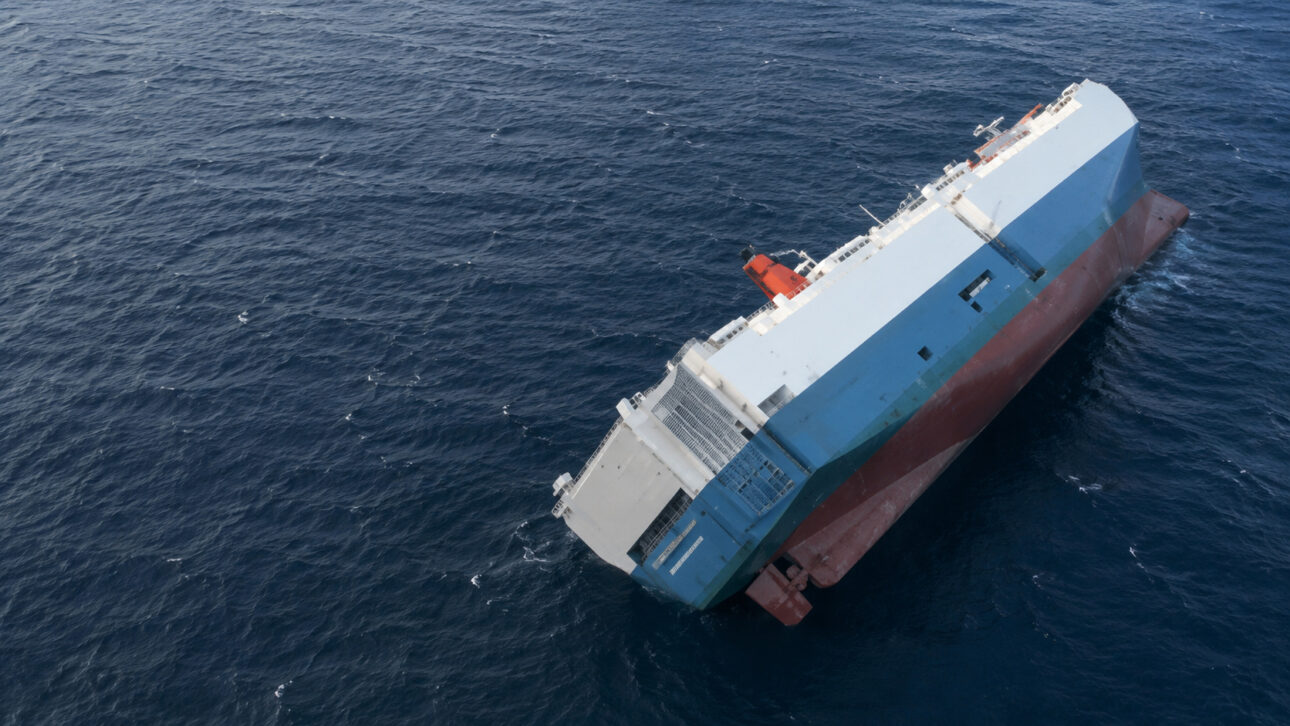
The cargo ship began to tilt to the left until it reached about 60 degrees. In a vessel with several internal decks, such a change shifts the point where the weight is concentrated and increases the risk of capsizing.
The accident did not start with a collision or a large hole in the hull. An operation intended to balance the ship caused exactly the opposite effect.
Specialists needed to balance a 199-meter ship
The 23 crew members were rescued alive. After the rescue, the Cougar Ace remained at sea in a position that made any internal work extremely dangerous.
The vessel was towed to protected waters in Dutch Harbor, Alaska. Specialists needed to remove accumulated water in some areas and adjust the ballast tanks on the opposite side.
Each change needed to be made slowly. If the weight was transferred abruptly, the freighter could pass the balance point and tip over to the other side.

The ship remained tilted for almost a month. After regaining a position close to normal, it was taken to the Port of Portland, where it would undergo repairs and have the cargo removed.
The 4,703 cars would occupy several entire parking lots
If each car were placed in a single spot, 4,703 parking spaces would be needed. In Brazil, this would be equivalent to gathering several large parking lots to accommodate all of Mazda’s cargo.
The cars were distributed across the internal decks and secured by fastening systems. Some units suffered visible damage, while others remained tied and seemed to have gone through the accident without major damage.
The appearance, however, did not show everything that might have occurred. The cars remained for a long period in an extreme tilt, a situation that could alter the position of fluids and cause unusual stress on internal parts.

An external evaluation would not be enough to ensure that each vehicle would function normally in the following years. This risk turned thousands of seemingly usable cars into cargo without a safe commercial destination.
Why Mazda decided to destroy all the cars
The first possibility was to discard the clearly damaged vehicles and offer the approved units as used cars. The automaker abandoned this idea after evaluations by engineers from the research and development centers in the United States and Japan.
The Mazda Newsroom, the automaker’s institutional news channel, announced on December 15, 2006 that all 4,703 cars would be destroyed.
Jim O’Sullivan, president and CEO of Mazda North American Operations, acknowledged that some vehicles showed little or no visible damage. Even so, the possibility of future problems led the company to prevent the sale of any unit.
Mazda could not know if a hidden defect would appear months or years later. Therefore, it preferred to lose the entire load rather than put cars on the streets whose safety and durability could not be guaranteed.
Not even the cars with minor damage reached the dealerships
The automaker released the identification numbers of the vehicles involved in the accident. This record allowed differentiation of the cars transported by the Cougar Ace from other identical models sold normally.
The decision also prevented apparently intact units from being repaired and offered later without the buyer knowing their origin. None of the 4,703 Mazdas was sold as new or used cars.
Car and Driver, a U.S. automotive magazine, reported that components were not released for commercial reuse. The cars underwent fluid removal, parts disabling, and crushing.
The remaining material was sent for recycling as scrap. Thus, the vehicles could not be rebuilt nor supply the common market for used parts.
The freighter was saved and returned to transporting automobiles
After regaining stability, the Cougar Ace was towed to Portland, inspected, and repaired. The vessel managed to return to service and resumed transporting cars across the Pacific Ocean.
The fate of the ship created the greatest contradiction of the accident. The 199-meter structure was recovered, but the thousands of cars carried on its decks were condemned to destruction.
The episode showed how a failure during ballast water exchange can put a gigantic vessel at risk. It also revealed why the lack of visible damage does not mean a vehicle is safe after going through an extreme situation.
Mazda preferred to destroy all 4,703 new cars because it could not guarantee the future behavior of each unit. The ship returned to sail, but none of those cars reached the dealerships.
Do you consider that destruction was the safest decision, or do you believe the cars could have been given another destination? Leave your opinion in the comments and share the post.


