





 Portuguese
  English
  Spanish
  5 min of reading
  0 comments



Laser Leveling Technology Corrects Nearly Imperceptible Soil Unevenness and Improves Water Distribution in Irrigated Crops. With a More Uniform Surface, Producers Reduce Water Waste, Shorten Irrigation Time, and Can Save Up to 30% of Water, a Strategy Increasingly Relevant in Areas Under Pressure on Water Resources.
Rural producers in irrigated areas have turned to laser leveling to correct discreet unevenness in the terrain and make water distribution more uniform.
In surface systems, the technique reduces pooling, shortens the time for water to advance, and can cut water consumption by 20% to 30%, according to the ISSCA platform from ICRISAT, dedicated to disseminating agricultural solutions for areas under greater pressure on water and productivity.
In practice, the method acts less on the plant and more on the physical base of the crop.
-
Scientists have finally discovered where the plastic that disappeared from the oceans went, and the answer is frightening: it fragmented into such tiny particles that they became invisible and now there are 27 million tons of nanoplastic just in the North Atlantic.

-
The Artemis II mission will take the Orion capsule back to the vicinity of the Moon with four astronauts, a private bathroom with a curtain, a system adapted for men and women, and a level of comfort that highlights how the Apollo era operated at the rawest limits of space exploration.

-
Giant structures on the seabed precisely control oil and reveal how high-tech underwater valves work.

-
China has just tested a giant drone the size of a fighter jet with a wingspan of 25 meters that carries 6 tons, flies for 12 hours, and the most frightening part: it can launch entire swarms of smaller drones directly from the air.

The objective is simple: to prevent a few centimeters of elevation difference from causing water to accumulate on one end and run short on the other.
When the terrain gains uniformity, surface irrigation operates with fewer losses due to runoff, excessive infiltration in depressions, and prolonged standing water in specific areas.
How Laser Leveling Works in Irrigated Agriculture
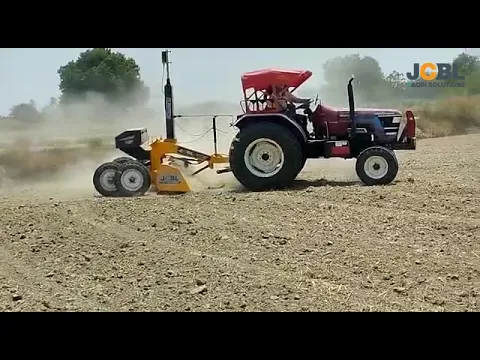
The system works with a laser emitter that projects a reference plane and with sensors attached to the implement pulled by the tractor.
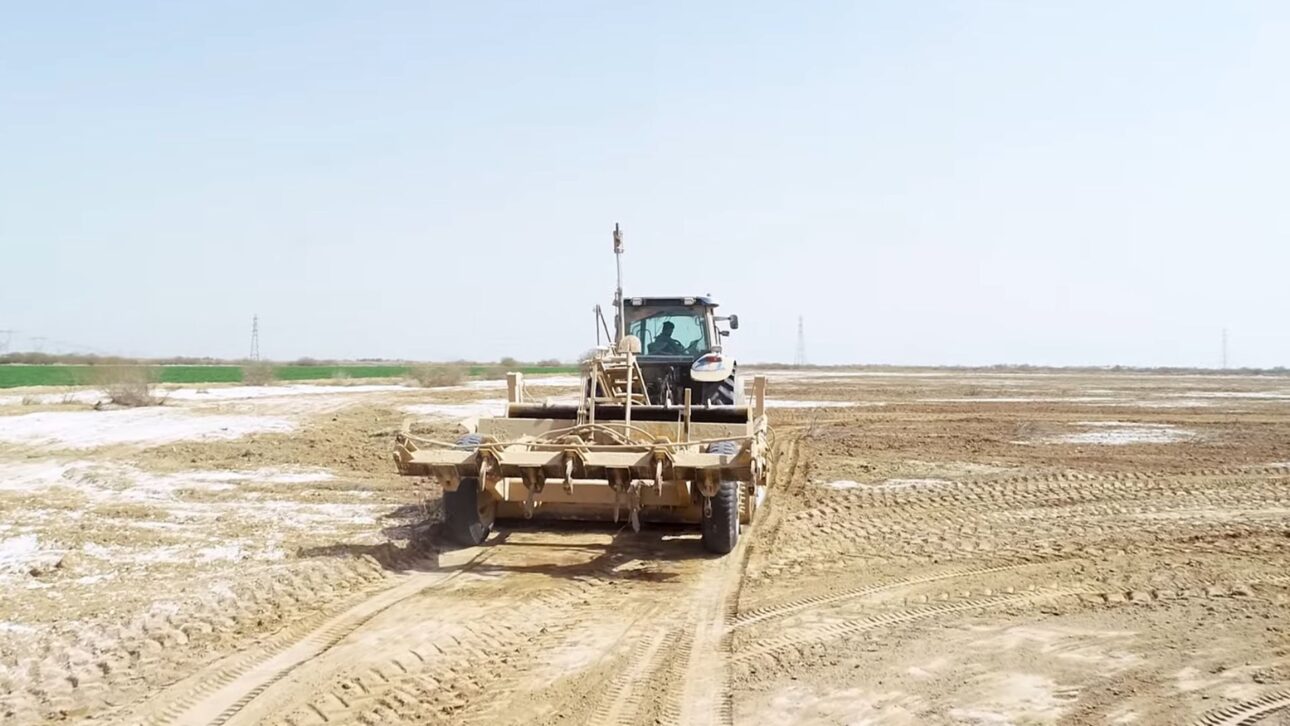
As the machine advances, the equipment identifies areas with excess or insufficient soil and adjusts the hydraulic system to cut or fill the surface until it reaches the planned elevation, with a level of precision superior to conventional leveling.
FAO highlights that land preparation is decisive for the efficiency of surface irrigation and states that laser-leveled fields show better irrigation and production performance compared to less precise techniques.
The same document notes that the advancement of laser control has made the final finishing of the terrain more exact, especially in areas where the regularity of the plane defines the efficiency of the applied water.
This adjustment is especially relevant in basins, furrows, and controlled flooding systems.
In these arrangements, water is not distributed by sprinklers or drippers, but by the very design of the terrain.
Therefore, small irregularities can force the producer to irrigate for longer, increasing costs with pumping, energy, and management, even when the crop has already received sufficient water in part of the area.
Water Savings and Impacts on Agricultural Productivity
The most cited gains appear precisely where waste tends to be less visible.
ICRISAT reports that laser leveling improves surface uniformity, decreases runoff, and reduces the time and energy required for irrigation.
The organization also reports positive effects on plant establishment, nutrient use, and the regularity of production in semi-arid and irrigated regions of South Asia.
In project documents supported by the World Bank in Punjab, Pakistan, the technology is associated with savings of up to 30% in irrigation water, more uniform germination, and greater efficiency in fertilizer use, with potential to increase productivity by up to 20%.
The strategy adopted in these programs included strengthening private service providers, who operate the equipment and service farmers by charging for the leveling performed.
This model has gained traction because the initial investment remains a barrier for some producers.

FAO itself emphasizes that the cost of laser leveling tends to limit direct adoption when the equipment is not shared, subsidized, or operated by cooperatives and contractors.
Instead of requiring each property to purchase its own unit, service provision dilutes the expense and broadens access during short windows between one harvest and another.
Field Studies Show Reduction in Water Waste
The results observed in irrigated properties in Pakistan reinforce that the effect is not limited to the theoretical plane.
A study by the Pakistan Council of Research in Water Resources, with leveled and non-leveled areas monitored in the same agricultural cycle, recorded an average annual savings of 51% in water on laser-leveled plots.
In the same work, rice, wheat, and forage corn showed productivity gains between 6% and 10%, while water use efficiency was 33% to 38% higher than that observed in areas without precision adjustment.
The researchers also reported that the operating cost was recouped in one harvest, a result attributed to the combination between lower volume applied and better productive performance.
The study also noted that over time, part of the initial regularity of the field is lost with continuous use, indicating the need for re-leveling after some years to maintain the standard of water application.
In addition to agronomic trials, surveys with farmers indicate an increase in adoption when a service network is available.
An article published in the journal Food Policy, based on primary data from 350 producers in four districts of Punjab, Pakistan, showed that 57% had access to laser leveling.
The study concluded that the technology had a positive impact on water savings, rice and wheat yields, and household income, as well as highlighting the central role of service providers to expand the dissemination of the practice.
Technical Limits and Ideal Conditions for Using the Technology

Although the advancement of technology is consistent, laser leveling is not treated as a universal solution.
ICRISAT reports that the method is indicated for areas with a slope of less than 1%, a condition that favors the formation of a uniform surface without excessive soil movement.
In terrain with steeper slopes, the very logic of preparation may require another field design, such as terraces or benches, according to FAO’s technical recommendations for surface irrigation.
There are also agronomic and operational limits.
Levelling the terrain precisely does not replace the irrigation schedule, moisture monitoring, the choice of the appropriate system, or fertility management.
The technique corrects the base on which water moves across the field, but still depends on field planning, defining the desired slope, a compatible tractor, and a skilled operator to execute cuts and fills without compromising the most fertile surface layer.
Still, the growing interest in this type of preparation signals a significant shift in irrigated agriculture.
Instead of focusing the entire search for efficiency solely on new water capture sources or more sophisticated application equipment, some producers have begun to tackle losses that occur even before the water reaches the root zone with regularity.
When centimeters of elevation difference mean more hours of irrigation and greater pressure on springs and aquifers, precisely leveled terrain becomes strategically significant in the cost and result of the harvest.







-

-

3 pessoas reagiram a isso.