





 Portuguese
  English
  Spanish
  4 min of reading
  1 comment


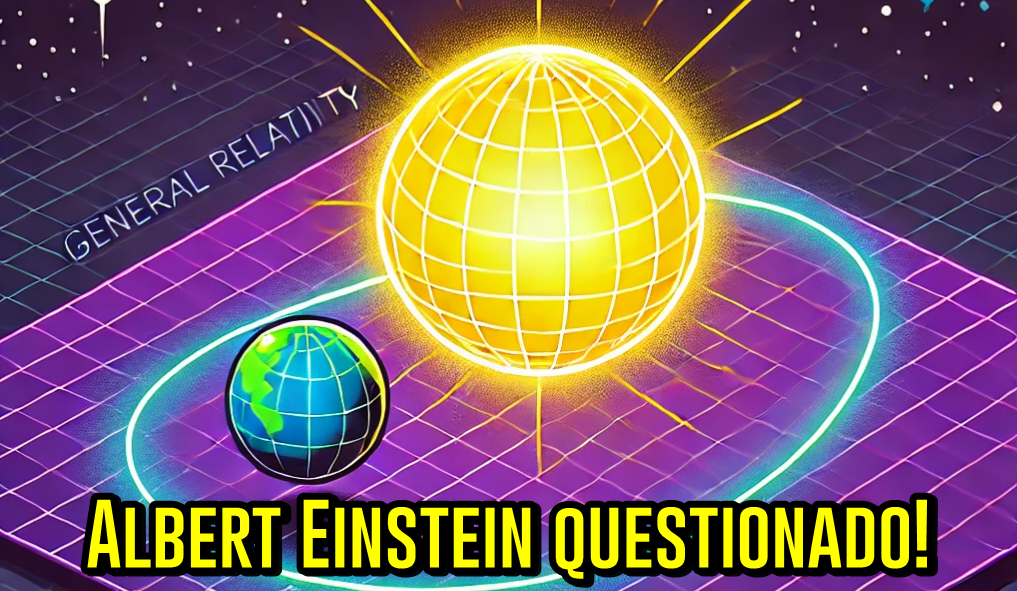

Scientists Analyze 100 Million Galaxies and Reveal Evidence That May Challenge Albert Einstein’s Theory of Gravity
For generations, Albert Einstein’s general theory of relativity has been a foundation for our understanding of the universe. This theory, which describes how massive objects warp space-time, has helped us understand specifically black holes and the expansion of the universe. However, a recent study may change everything we think we know about gravity.
Researchers, comparing Albert Einstein’s theory with data from the Dark Energy Survey (DES), found a “small discrepancy” in the way gravity behaves over cosmic time.
This means that, at different times in the universe, gravity appears to act differently than the previous theory of Einstein. But before we dive deeper, let’s understand a bit about how Einstein envisioned the universe and his famous theory.
-
Something is happening around the Earth: Inside the huge explosion of fireballs in 2026

-
A hot air bubble coming from Argentina expands over Brazil, causing thermometers to exceed 38 degrees with a thermal sensation of 40 degrees in late March, affecting 6 states at once.

-
The radish leaf that almost everyone throws away has more polyphenols, flavonoids, and fiber than the consumed root, and a 2025 study showed that the leaf contains compounds that protect the intestine, combat inflammation, and may inhibit the growth of cancer cells.

-
A planet that seemed to defy the laws of physics has intrigued scientists for decades, until the James Webb revealed what is really affecting Saturn’s rotation.
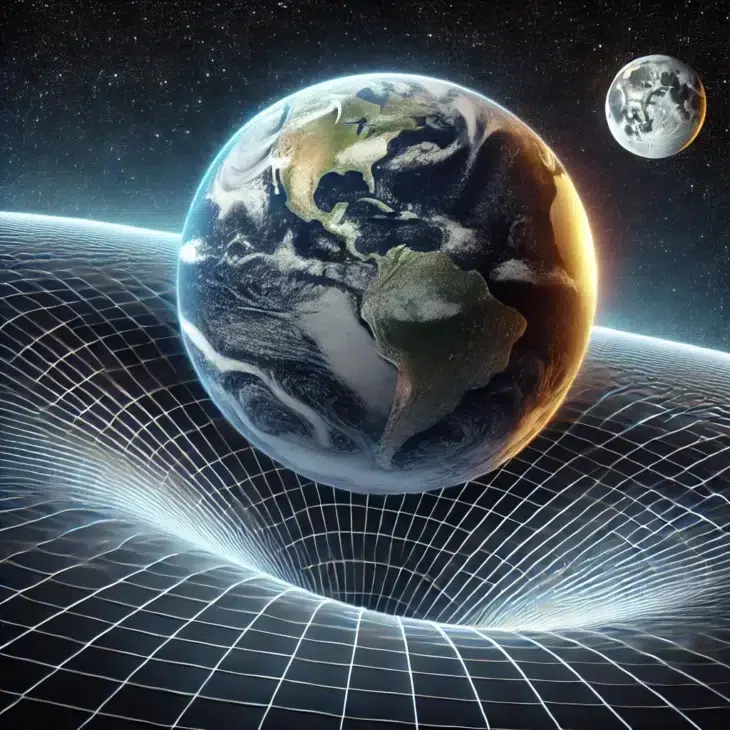
The Warping of Space-Time: The Ball on the Elastic Mat
To simplify Einstein’s theory, imagine a heavy ball placed on a metalworking mat. It creates a depression around it, bending the fabric. Similarly, Albert Einstein suggested that massive objects like stars and galaxies warp the “fabric” of space-time.
This distortion affects everything that follows, including light, an effect known as gravitational lensing. This phenomenon was first observed in 1919, when a solar eclipse confirmed that light bent as it passed near the Sun, exactly as Albert Einstein had predicted.
Since then, gravitational lensing has become a valuable tool in astronomy, allowing scientists to study distant objects and gain insights about the expansion of the universe. The Dark Energy Survey, a mission focused on understanding dark energy and the accelerated expansion of the universe, is one of the projects that utilizes this tool extensively.
The Dark Energy Survey and the Cosmic Enigma
The team of scientists from the DES mapped hundreds of millions of galaxies, and upon analyzing the data, noticed something interesting. When studying galaxies at different epochs of the universe – specifically at points like 3.5, 5, 6, and 7 billion years ago – they found that the depths of the “wells” of gravity, or the depressions created by massive objects in space-time, did not always correspond to what Einstein’s previous theory predicted.
Isaac Tutusaus, an astronomer involved in the study, explained that in earlier epochs, such as 6 and 7 billion years ago, the gravitational wells aligned perfectly with Einstein’s theory. However, in more recent times, like 3.5 billion years ago, these obvious wells are slightly shallower than expected. This deviation is subtle but significant.
What Does This Mean for Albert Einstein’s Theory?
According to Nastassia Grimm, a researcher at the University of Geneva, the deviation is “3 sigma,” a measure that indicates an intriguing incompatibility, but still not strong enough to invalidate the theory. In scientific terms, this means there is something that merits further investigation, but not necessarily a total “break” from Einstein’s theory.
Think of the theory of relativity as a big cake recipe. So far, this recipe has always given us a delicious cake. However, when baking the cake in different ovens (or, in this case, studying gravity at different moments in the universe), we notice a slight difference in the outcome. This doesn’t mean the recipe is wrong, but perhaps it needs minor adjustments when applied to different contexts.
The Future of Research: The Euclid Space Telescope
With this discovery, scientists are now looking to the Euclid space telescope, which is expected to provide better precision in gravitational lensing. It will be able to observe about 1.5 billion galaxies, providing detailed data on how gravity operates on large scales. This will be useful for scientists to re-test Einstein’s theory on an even larger scale.
However, the work is challenging. Gravity is one of the most fundamental forces in the universe, and to this day, we understand little about how it actually works. New data might either confirm Einstein’s theory or indicate that gravity behaves in ways we are still far from fully understanding.
The discovery of small discrepancies in the general theory of relativity is a reminder of how much we still have to learn about the cosmos.
Albert Einstein’s theory may be one of the pillars of modern physics, but the universe, in its infinite complexity, continues to surprise us. And, as many scientists say, every new question leads to more discoveries. Ultimately, this constant quest for answers is what makes the exploration of the universe so fascinating.
So, if you look up at the night sky and wonder about what lies beyond, know that science is doing the same – seeking not only to understand the stars, but the invisible forces that shape and distort them. Albert Einstein may have been right, but perhaps there is an expanded version of his theory waiting to be discovered. After all, the universe never stops teaching us.







Eu amai muito é muito eteresate