





 Portuguese
  English
  Spanish
  5 min of reading
  1 comment


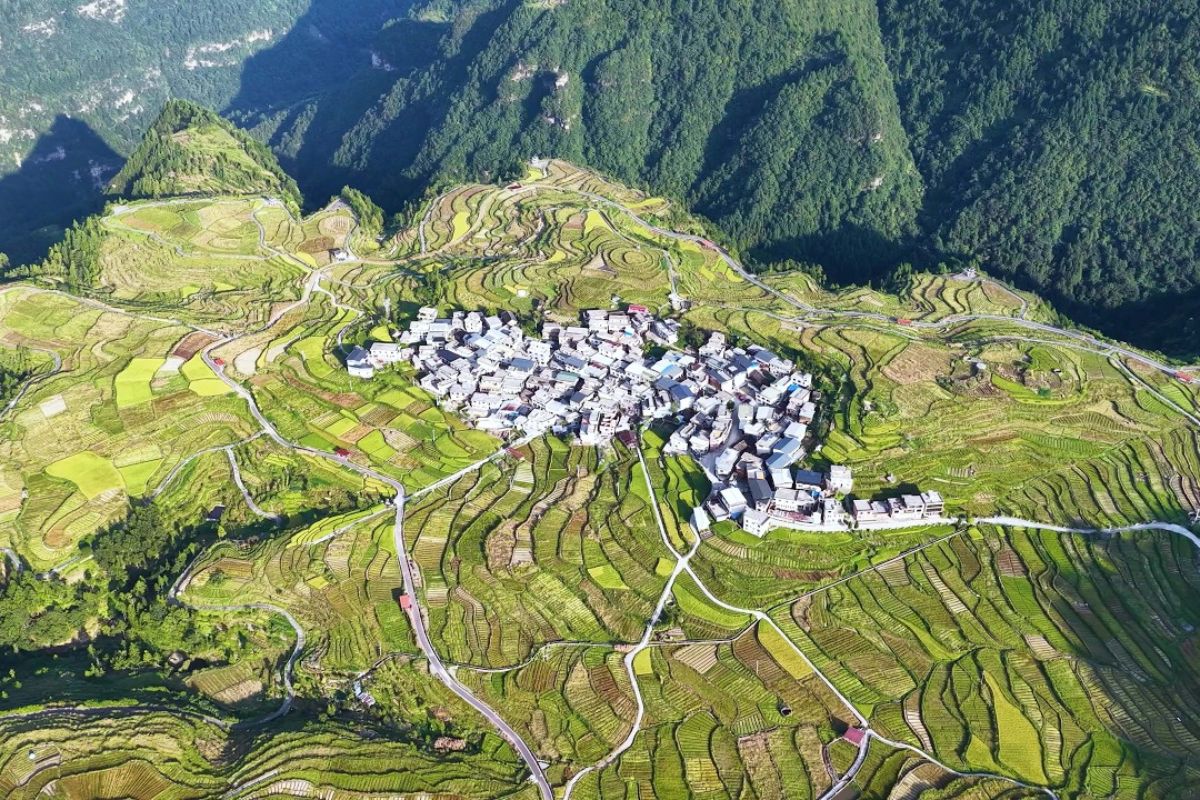


Isolated On The Cliffs Of Guizhou Province, The Chinese Village Of Jiading Houses About 200 Families Of The Shui People, Lives Off Agriculture On Terraced Fields, And Maintains Century-Old Houses Suspended Over A Sea Of Clouds Year-Round, Almost Untouched By The Accelerated Modernization Of Cities
As Chinese megacities continue to grow at a frenetic pace, an isolated Chinese village in the mountains of Guizhou Province remains almost untouched. The Village of Jiading, perched about 1,200 meters above sea level, is home to approximately 200 residents of the Shui people on cliffs surrounded by clouds and steep slopes on all sides.
For centuries, these families have lived off cultivation on small plots and in terraced fields carved into the hillside, combining agriculture and animal husbandry in a limited space. Despite the arrival of a paved road and a timid flow of visitors, the Chinese village maintains a slow routine, marked by mild weather, near-permanent fog, and houses that appear to be suspended over the void.
Chinese Village Suspended Over Cliffs At 1,200 Meters

Viewed from above, the Village of Jiading appears as a flat platform carved on the mountaintop, surrounded by cliffs on three sides.
-
YouTuber creates an excavator equipped with a giant 4.5-meter sword to challenge his brother to a rematch, and the invention quickly goes viral on social media.
-
The U.S. Army surprises the world by presenting the UH-60MX Black Hawk helicopter capable of flying without pilots, controlled by a tablet, featuring the MATRIX system, smart sensors, and full autonomy in real combat and rescue missions.

-
Heineken’s factory in Brazil produces 300 million beer cans in just 4 months, reaches 1 million hectoliters, received R$ 2.5 billion, and is already projecting an annual capacity of 5 million with sustainable technology.

-
Inside an active volcano in Africa, residents use volcanic rocks to build houses in an impressive setting.

The hills around form a kind of natural amphitheater, while the terraced fields fit into the curves of the terrain like green steps, giving the impression that the entire Chinese village is floating over a sea of clouds.
On colder mornings, the fog covers the valley, and only the top of the plateau where the Village of Jiading is located remains visible.
For those observing from the tourist trail built along the cliff’s edge, the landscape resembles a “fairyland”: vertical cliffs, agricultural terraces hanging on the slope, and absolute silence broken only by the mountain wind.
The extreme location explains the historical isolation.
For a long time, access was only possible via narrow, steep paths carved into the rock.
The paved road that now connects the Chinese village to nearby centers has made the transport of people and goods easier, but it has not changed the fact that the community remains physically and symbolically separated from the urban world.
Almost Isolated Life And Agricultural Routine Of The Shui People

Almost all families in the Village of Jiading belong to the Shui people, an ethnic minority that has occupied this region of Guizhou Province for generations.
Older residents report that their ancestors climbed the mountain to flee conflicts and found, on this plateau, a rare combination of arable land, spring water, and natural protection from the cliffs.
The economy remains based on small-scale agriculture and livestock raising.
Around the Chinese village, residents plant rice, corn, vegetables, and a medicinal plant locally known as “sea flower grass.”
The corn cobs dry hanging on bamboo racks and mats, while the higher terraces receive rows of this herb which, after being dried, is sold at a good price for pharmaceutical use.
Still, many terraced fields are abandoned.
The younger members of the Shui people leave the Village of Jiading in search of work in cities, and the burden of cultivation increasingly falls on the elderly.
In conversations along the roadside, they report that the number of hands has decreased, but the rhythm of the land remains the same, forcing them to concentrate planting in smaller, more productive areas.
Century-Old Houses, Repeated Surnames, And Memory In Wood

With improved transport conditions and income, much of the old wooden houses of the Shui people have been replaced by simple brick homes, lined along the cement streets of the Chinese village.
Still, two wooden buildings remain standing, described by residents as houses with at least two hundred years of family history.
One of these houses, surrounded by cornfields and gardens, serves as a living point of memory for the Village of Jiading.
There, successive generations of the same clan have been born and raised, in a region where practically only two surnames exist: Wei and Wu. This repetition of names reveals how closed the community has been over the centuries and how kinship ties structure life on the mountain.
Residents acknowledge that without constant repairs, the old wooden structures tend to collapse.
Still, the preservation of these houses is seen as a symbol of the ongoing presence of the Shui people on the mountain, a physical testament that the Chinese village has endured wars, poverty, and migration, maintaining the community core atop the cliff.
Fantian Seal Stone, Tourist Trails, And Gazing Into The Valley
In recent years, local authorities have opened a tourist trail around the Village of Jiading, paving sections with asphalt and building small rest pavilions.
The goal is to allow visitors to safely contemplate the dramatic view of the cliffs and the terraced fields that descend towards the valley.
One of the most sought-after spots is an isolated rock at the edge of the abyss, known as the Fantian Seal Stone.
The shape resembles a stone mushroom, with a narrow base and a bulky upper block, as if it were about to slide.
According to legend told by the residents of the Chinese village, the “seal” is said to have fallen from the sky in ancient times, reinforcing the mystical character of the place.
From the top of the Fantian Seal Stone, one can hear the sound of a stream at the bottom of the canyon and see another community, also hanging on the ridges of Guizhou Province.
The comparison between the two villages reveals a pattern: isolated plateaus, occupied by small agricultural villages of the Shui people, surrounded by steep slopes and connected by long paths, despite the apparent visual proximity.
Between The Past And The Future Of The Village Of Jiading
The Village of Jiading synthesizes various tensions of contemporary rural China.
On one side, the persistence of a way of life based on agriculture, livestock raising, and community cohesion of the Shui people; on the other, the outmigration of youth, the abandonment of part of the terraced fields, and the gradual arrival of tourism and development policies in Guizhou Province.
For older residents, the priority is to keep the Chinese village livable and safe, securing spring water, small incomes from the sale of sea flower grass, and some basic infrastructure.
For the youth who return only on festive occasions, Jiading tends to increasingly occupy the role of affective and identity reference, and less of a space for daily work and sustenance.
As regional governments discuss how to transform mountain villages into tourist destinations without destroying their authenticity, the Chinese village remains suspended on the cliff, balancing tradition and uncertainty.
What seems today like a “paradise above the clouds” depends, in practice, on the ability to maintain residents, minimal income, and a physical environment that remains habitable in the coming decades.
Would you trade life in big cities for an isolated routine in the mountains, in a place like the Village of Jiading, in exchange for silence, starry skies, and direct contact with nature every day?







Sim . É uma benção morar em um lugar sem barulho, com ar puro,clima agradável. Todos os moradores amigos é saudáveis.