





 Portuguese
  English
  Spanish
  4 min of reading
  0 comments


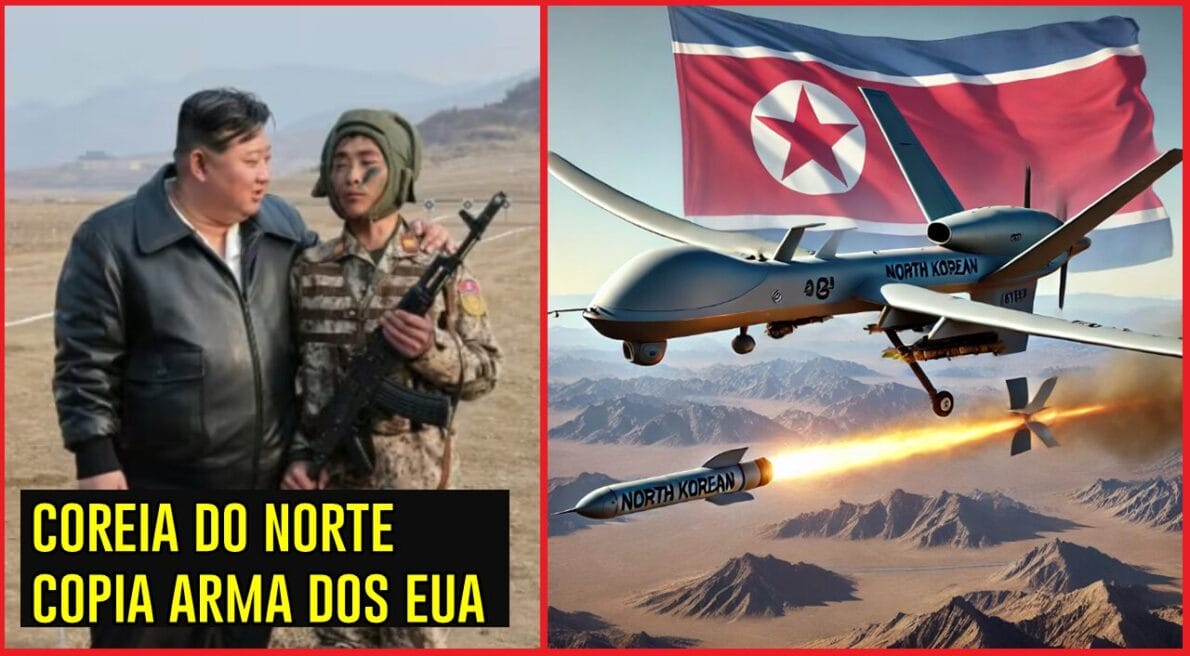
The Reverse Engineering of American Hellfire Missiles Resulted in Armed Drones Developed by North Korea. See How This Military Innovation Is Heightening International Tensions and Representing a New Global Threat!
The North Korea surprised the international community by unveiling military drones equipped with reverse-engineered missiles from the United States. During a conference of the United States Army Association in 2024, Brigadier General Patrick Costello highlighted the growing threat these new North Korean drones pose, especially in the Indo-Pacific region.
The similarities to American MQ-9 Reaper and RQ-4 Global Hawk drones and the copy of Hellfire missiles caught attention, raising concerns among U.S. authorities.
North Korean Drones and Reverse Engineering Technology
The drones developed by North Korea, such as the Saetbyol-4 and Saetbyol-9, bear a remarkable resemblance to American models, both in design and armament. Experts believe that North Korea utilized reverse engineering techniques to replicate U.S. drone and missile technology.
-
If the USA were to go to war with Brazil, Washington’s greatest fear would not be the attack itself, but facing a vast territory, prolonged resistance, and a costly, chaotic, and unpredictable occupation.

-
In 2013, Nicaragua sold the concession for a canal to rival Panama to a Chinese billionaire who lost 85% of his fortune, disappeared, and was declared bankrupt. Now the project resurfaces with a new route, a new Chinese partner, and a cost of $64.5 billion.

-
The USA announces a mysterious billion-dollar vault project to store critical minerals, but what intrigues experts is not just the plan itself, but why Latin America, including Brazil, has entered the center of this global dispute against China.

-
Trump Announces Bombing of U.S. Military Targets on Iranian Island Responsible for About 90% of Iran’s Oil Exports, Warns of Further Attacks if Navigation in Strategic Strait of Hormuz Is Threatened


The Hellfire missile, in particular, is widely used in American drones in various conflict zones, and its copy represents a significant advancement for the Pyongyang regime.

In July 2023, North Korea showcased these drones for the first time during a military parade, where one of the models was filmed firing missiles that closely resemble the AGM-114 Hellfire.
While the technical details of these weapons are still not fully known, the American intelligence community believes that espionage or recovery of parts in conflict zones may have contributed to the development of this technology.
This situation highlights North Korea’s capability to develop modern weaponry, which may not be as advanced as their Western counterparts, but are sufficiently dangerous to destabilize regional security.
The Growing Threat in the Indo-Pacific
The presence of North Korean drones with long-range missiles represents a new challenge for countries in the Indo-Pacific region. The United States and its allies are increasingly concerned about the impact of this technology on potential conflicts, especially in already tense areas like the Korean Peninsula.

General David Stewart, Director of the Joint Counter-UAS Office, emphasized that drones have become a fundamental part of modern conflicts, and the U.S. armed forces are aware of the importance of developing counter-drone technologies to protect against these new threats.
In response to this scenario, the U.S. Department of Defense requested a budget of US$ 2.4 billion for unmanned aerial systems in fiscal year 2025. Additionally, there was an additional request for US$ 741 million to fund counter-drone technologies, which have yet to receive the necessary funding.
Companies like Anduril, one of the leaders in defense technology production, are at the forefront of developing systems that can neutralize enemy drones. Recently, the company signed billion-dollar contracts with U.S. Special Operations Command, reinforcing the importance of having drone defense technologies that are seen as crucial in future combat scenarios.
Geopolitical Impacts and Possible Alliances with Russia
The advancement of North Korea in armed drones also raises concerns about its cooperation with Russia. In recent months, rumors have emerged that Pyongyang could share its new military technologies with Moscow, strengthening Russian capabilities in the war against Ukraine.
This would not only represent an increase in Russia’s military capabilities but also consolidate a strategic alliance between the two countries.
In addition to drones, North Korea has shown progress in the development of ballistic missiles. On January 14, 2024, the country successfully tested a solid-fueled ballistic missile equipped with a hypersonic warhead.
This type of missile, in addition to being faster and harder to intercept, is capable of targeting important strategic locations, such as the U.S. base in Guam. This significantly raises tensions in the Pacific and puts U.S. defense capabilities to the test.
Growing Tension on the Korean Peninsula
The Korean Peninsula, in turn, is facing a period of rising political tensions. Recently, North Korea proposed a constitutional amendment that challenges South Korea’s status as a separate state, which could further complicate relations between the two nations.
While Pyongyang insists it is not seeking military confrontation, its actions indicate a readiness for future conflicts, should the situation require.
These developments serve as a clear reminder that North Korea’s military capabilities are evolving rapidly, and the world must be prepared to address the geopolitical implications of this new reality.
The combination of armed drones, hypersonic missiles, and strategic alliances could alter the balance of power in an already unstable region, and the coming years will be crucial in determining the impact of these technological advancements on the global stage.









Seja o primeiro a reagir!