





 English
  Francês
  Alemão
  Italiano
  Japonês
  Norueguês
  Portuguese
  Spanish
  2 min of reading
  0 comments


NASA Alerts A Massive Asteroid, Classified As ‘Potentially Hazardous’, Will Pass Close To Earth On Tuesday. Understand The Risk And How It Will Be Monitored By Scientists
On Tuesday, September 17, a “potentially hazardous” asteroid the size of a skyscraper will pass close to Earth. This asteroid, designated 2024 ON by NASA, has an estimated diameter between 220 and 480 meters and moves at an impressive speed of 31,933 km/h, which is about 26 times the speed of sound.
Despite the proximity, NASA has assured that the minimum distance the asteroid will reach from Earth will be approximately 1 million kilometers, about 2.6 times the distance between Earth and the Moon. Even though this is a narrow margin by cosmic standards, there is no reason for concern for the planet’s inhabitants.
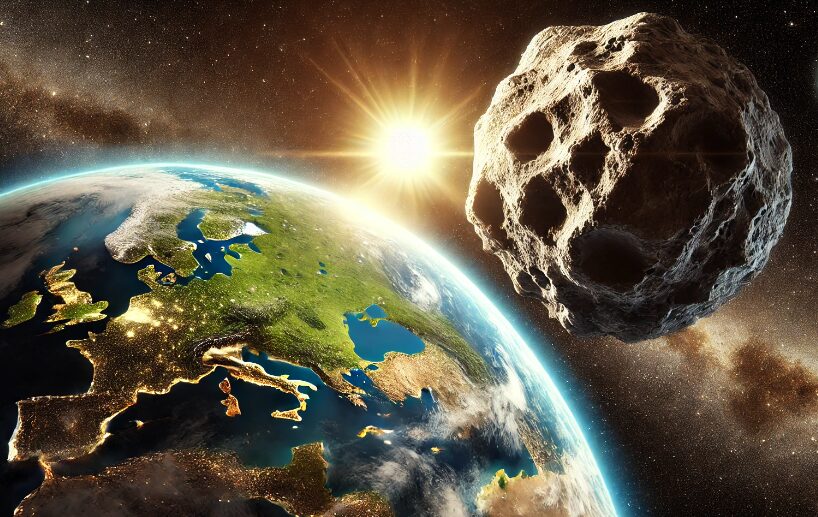
According to NASA, any object that comes within 193 million kilometers of Earth is considered a “near-Earth object.” Those that approach within 7.5 million kilometers are classified as “potentially hazardous.” The asteroid 2024 ON, for example, falls into this category due to its relative proximity, even though it does not pose an immediate threat of collision.
-
The climate in 2026 may surprise with extremes even more intense than in 2025, with heatwaves, out-of-season cold, and irregular rainfall in Brazil.

-
Astronomers identify 45 rocky planets that could harbor life, and one of them is just 4.2 light-years from Earth, making it the closest neighbor with the potential to have liquid water on its surface.

-
Archaeologists discover 43,000 ostraca in Egypt with tax lists, drawings, religious texts, and everyday notes that reveal what life was like in ancient Athribis before Cleopatra.

-
China showcases laser defense systems that target drones flying very low and attempts to address a flaw that has been concerning armies worldwide.
NASA continuously monitors the orbits of approximately 28,000 asteroids with its Asteroid Terrestrial-impact Last Alert System (ATLAS), which consists of four telescopes that scan the night sky every 24 hours.
This surveillance is essential to ensure that any potential threat is detected in advance. However, NASA has estimated that Earth does not face the risk of an apocalyptic collision for at least the next 100 years.
What Would Be The Impact On Earth?
If the asteroid 2024 ON were to collide with Earth, the damage would be significant but not catastrophic like the event that wiped out the dinosaurs 66 million years ago.
The impact of this asteroid would be devastating locally but would not have global reach. One example of similar events was the explosion of an 18-meter meteor over Chelyabinsk, Russia, in 2013. This explosion, caused by a much smaller celestial body, released energy equivalent to 400-500 kilotons of TNT, injuring around 1,500 people.
For this reason, NASA continues to monitor these celestial bodies, such as asteroid 2024 ON, to ensure the safety of Earth. Even if these potentially hazardous asteroids pass close to our planet, the agency assures that, for now, the risk of a major impact collision is extremely low.










Seja o primeiro a reagir!