





 Portuguese
  English
  Spanish
  4 min of reading
  0 comments


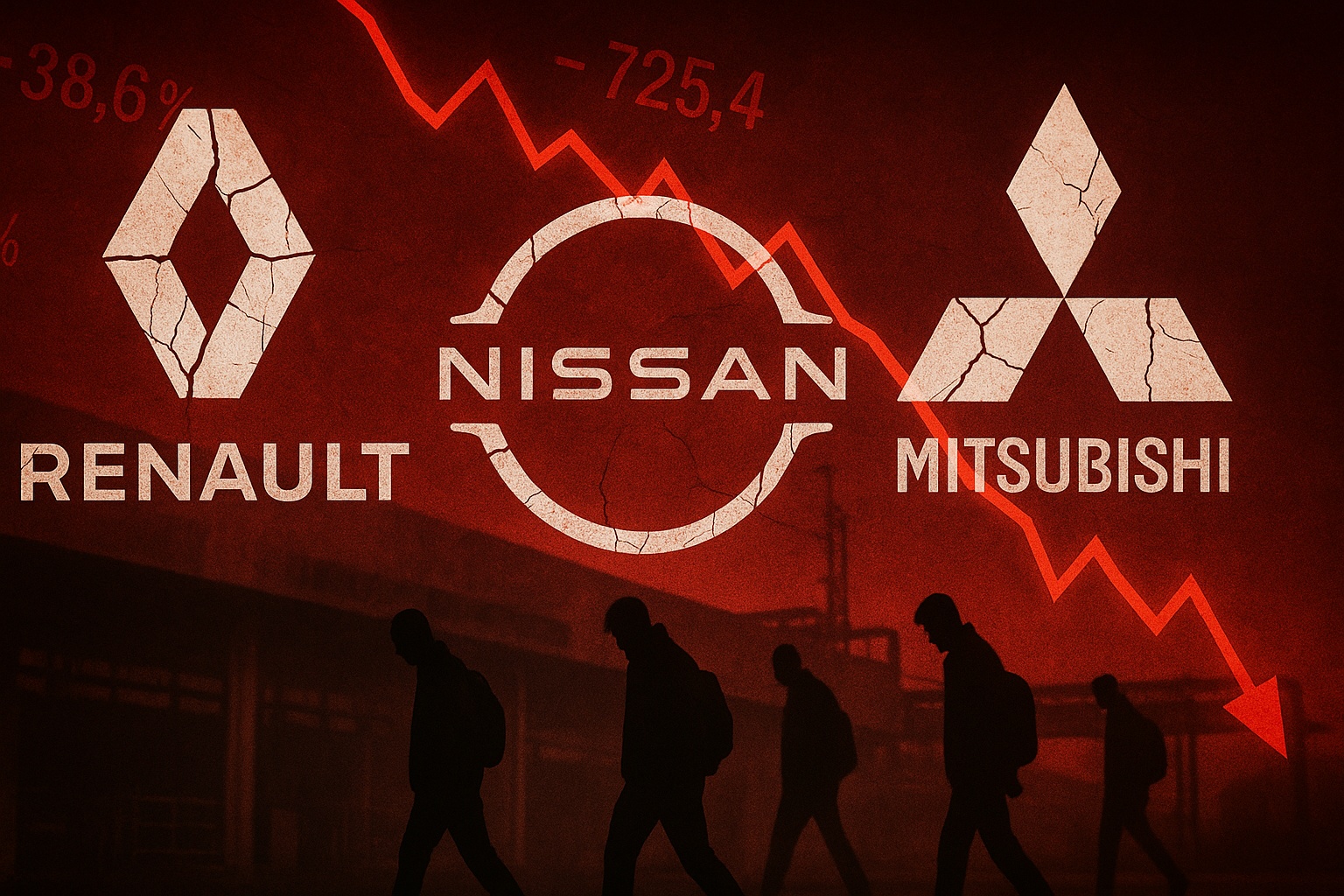
Renault-Nissan-Mitsubishi Alliance Faces Billion-Dollar Losses, Job Cuts, and Restructuring to Try to Survive the New Automotive Era.
When it was created in 1999, the Renault-Nissan alliance was seen as one of the boldest and most innovative partnerships in the automotive industry. The union, strengthened in 2016 with Mitsubishi’s entry, transformed the group into one of the largest global forces in the sector, even competing for leadership with Toyota and Volkswagen in worldwide sales. But in 2025, the same alliance that was once a symbol of integration and efficiency faces one of its most delicate moments in history: billion-dollar losses, massive job cuts, and the need to restructure agreements to try to survive in an increasingly competitive market.
The Weight of the Losses
The most recent blow came with Renault’s announcement, which registered an accounting loss of approximately € 9.5 billion solely due to the depreciation of its stake in Nissan.
The Japanese automaker, for its part, also reported billion-dollar losses in 2025, affected by trade tariffs, high electrification costs, and falling sales in key markets.
-
The car stored for 38 years: when opening the barn door, what appears is breathtaking and looks like a scene from a movie!

-
Fiat works miracles in the Brazilian market, lowers the price of its 0 km hatch to R$ 69,990, reestablishes the model as the cheapest car in the country, and reignites the battle against Kwid and C3.
-
Chevette with cooking gas: How the gas cylinder ends up being used in cars clandestinely and why this makeshift solution can result in leaks, explosions, damaged engines, and seized vehicles.

-
Fiat launches the new 2027 Toro hybrid with 48V, 176 hp, an electric motor of 15.5 hp, a 0.85 kWh battery, up to 7% fuel savings, 8% fewer emissions, and possible exemption from IPVA.

This scenario exposed a problem that had been dragging on: the difficulty of aligning strategies and leveraging synergies. While Renault seeks to accelerate its transformation into an electric mobility company, Nissan faces structural production and sales issues.
Mitsubishi, smaller and more dependent on niches like compact SUVs and vehicles for Asia, suffers from reduced margins and limited scale.
Job Cuts and Factories at Risk
Nissan announced a plan to cut 20,000 global jobs by 2027, along with the closure of seven factories during the same period.
The goal is to reduce production capacity and adjust the cost structure to lower demand. Countries such as Japan, the United Kingdom, and Spain are among the most impacted by these measures.
These decisions have strong political repercussions, as local governments and unions pressure to preserve jobs. In France, where Renault has historical roots, there is a fear that the alliance’s crisis will have severe collateral effects on the national industry.
Restructuring Agreements
In light of this situation, the alliance decided to review its internal agreements. The cross-shareholding relationship, in which Renault held a significant stake in Nissan and vice-versa, has been simplified. The intention is to give more autonomy to each company, allowing each to pursue regional and strategic agreements independently.
In practice, this means that cooperation will be less integrated than in the past. Joint projects will be maintained only where there is a real gain in scale, such as in the development of electric and hybrid platforms. However, in specific markets such as China and Latin America, each brand will have more freedom to define its operations.
The Challenge of Electrification
One of the main tension points within the alliance is the electrification strategy. Renault has been heavily investing in its Ampere division, dedicated to electric vehicles, with new compact and affordable models.
Nissan, a pioneer with the Leaf, has lost relevance by not updating the model quickly and is now trying to catch up with rivals like Tesla, BYD, and even Hyundai.
Mitsubishi focuses on plug-in hybrids, such as the Outlander PHEV, but struggles to compete globally in pure electric vehicles. The lack of strategic alignment hinders scale gains, which would be the greatest benefit of such a large alliance.
Overwhelming Competition
While the Renault-Nissan-Mitsubishi alliance tries to reorganize, global rivals are advancing. Toyota maintains a solid lead, with stable sales and domination of hybrids.
The Volkswagen Group is heavily investing in electrics and still holds the European leadership. And BYD, the largest EV manufacturer in the world, has already surpassed Tesla in volume and is pushing with low prices and aggressive expansion in Europe and Latin America.
In this scenario, the alliance loses relevance. In global rankings, it no longer appears among the three largest groups and risks being relegated to the second tier if it does not find a clear strategy.
The Role of Governments
Governments in France and Japan are closely monitoring the developments of the crisis. Renault, partially state-owned, relies on political support to advance strategic projects.
In Japan, Nissan is seen as a national symbol, and any more drastic restructuring measures generate strong resistance. This political complexity makes it even more difficult to find quick solutions.
The alliance that was once a reference for integration now struggles to prove that it still has global relevance. Job cuts, billion-dollar losses, and the revision of agreements show that survival is at stake.
If it can adapt, Renault-Nissan-Mitsubishi may be reborn as a leaner and more flexible group, focusing on strategic regions and segments. But if it fails, it could become an example of how traditional giants lost ground in the transition to electrics, suffocated by the speed of more agile rivals.
The crisis of the Renault-Nissan-Mitsubishi alliance is a warning for the entire automotive industry. Even established groups, with global presence and iconic brands, are not immune to the profound changes in the sector. The future will require not only electrification but also efficiency, innovation, and the courage to make tough decisions.
The challenge for the alliance now is to prove that it can still be a protagonist — or accept a secondary role in a market that waits for no one.









Seja o primeiro a reagir!