





 Portuguese
  English
  Spanish
  3 min of reading
  0 comments


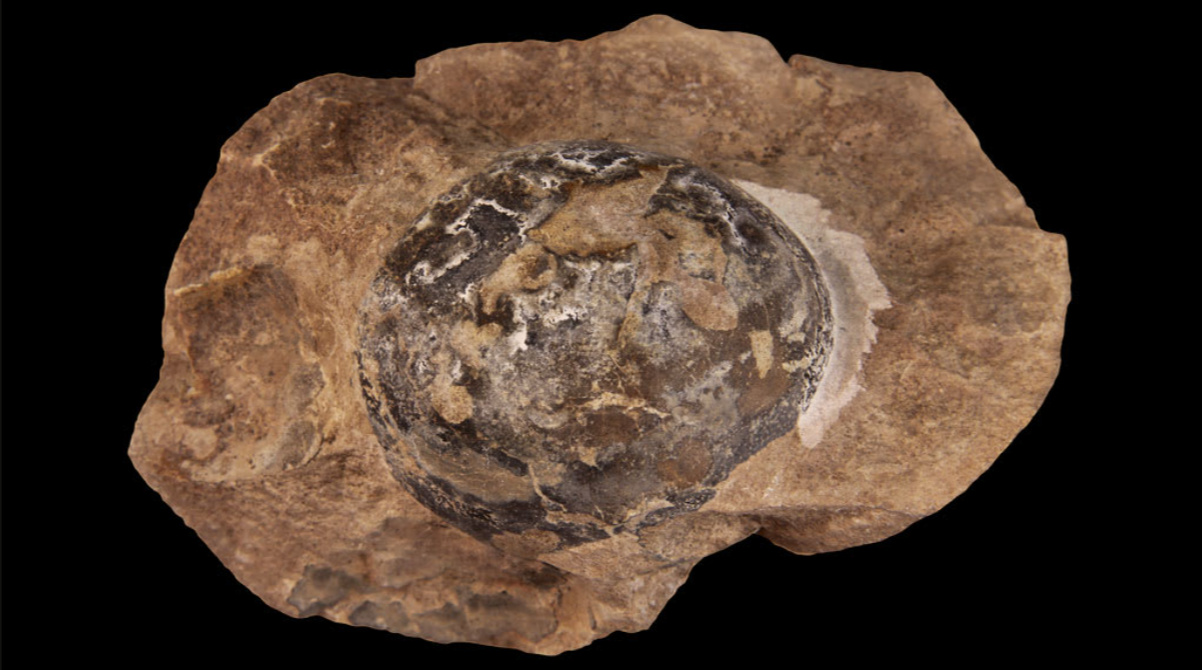
Study published in the journal PLOS ONE reveals the first fossil egg of a non-mammalian synapsid, found inside a skull just 34.5 mm preserved in a rock in South Africa, changing what was known about the reproduction of the ancestors of mammals that lived 250 million years ago in the Triassic period.
Scientists have found the first fossil egg of a mammal ancestor ever discovered. Therefore, the discovery changes what was known about how the ancestors of all mammals on the planet reproduced 250 million years ago.
The study was published on April 9, 2026, in the journal PLOS ONE, one of the largest peer-reviewed scientific journals in the world.
The fossil was hidden inside a skull smaller than a coin — only 34.5 mm — preserved in a rock in South Africa.
-
Created in silence in the middle of the ocean, a Brazilian startup developed technology that predicts failures in oil platforms before they occur, and now ExxonMobil and Equinor are competing for its contracts.

-
Big techs plan US$ 635 billion in AI data centers by 2026, but the crisis in the Middle East threatens investments, and Brazil is betting on natural gas to attract megacomplexes of up to 1,500 MW in Rio de Janeiro, Rio Grande do Sul, and Paraná.

-
FPSO P-78 begins operations in the pre-salt of Búzios with 180,000 barrels/day, ROTA 3 pipeline, 13 smart wells, and CO₂ reinjection, while the field already produces 1 million barrels per day and generated R$ 81 billion in royalties in 2025.

-
The Moon has essential rare earth minerals for 99% of the electronics you use in your daily life and a future fuel that is almost nonexistent on Earth: now the race to explore the satellite has turned into a global competition among more than 70 countries.


Scientists found the first fossil egg of a mammal ancestor, preserved in a 73 mm rock nodule in South Africa, with a skull of only 34.5 mm.
Fossil preparator found the stone in 2008 without knowing what was inside
The specimen was discovered by John Nyaphuli, a fossil preparator, in 2008 on the Rheeboksfontein farm, Free State Province, South Africa. However, what was inside the rock was only revealed now.
Thus, the 73 mm long and 55 mm wide rock nodule was kept at the National Museum in Bloemfontein for nearly two decades. Only with advanced technology was it possible to see its contents.
The animal inside the egg belongs to the species Lystrosaurus, a robust herbivore that lived during the Early Triassic, about 250 million years ago.

First fossil egg of a mammal ancestor revealed by X-rays from the European Synchrotron
The team led by Prof. Julien Benoit, from the University of the Witwatersrand (Johannesburg), used synchrotron tomography at the ESRF — European Synchrotron Radiation Facility in Grenoble, France.
Thus, the world’s most powerful X-rays revealed details invisible to the naked eye. Dr. Vincent Fernandez, from the ESRF, conducted the analysis that identified the embryo inside the rock.
The estimated volume of the egg is extremely small, compatible with the smallest Lystrosaurus skull ever found — 34.5 mm.
Furthermore, Prof. Jennifer Botha, co-author of the study, confirmed that the histological analysis reinforces that it is an embryo, not a newborn pup.

Lystrosaurus survived the largest mass extinction in history
Lystrosaurus is one of the most important animals in paleontology. Therefore, understanding how it reproduced is fundamental to science.
This herbivore was one of the few survivors of the Permian-Triassic extinction — the largest mass extinction event in Earth’s history, which eliminated about 90% of all marine species and 70% of terrestrial species.
After the catastrophe, Lystrosaurus dominated terrestrial ecosystems. Thus, its fossils are found abundantly in South Africa, Antarctica, and India.
The discovery of the egg suggests that egg-laying was the ancestral condition of synapsids — the group that eventually gave rise to all modern mammals, including humans.

How mammals transitioned from laying eggs to giving birth to live young
Today, the overwhelming majority of mammals are viviparous — giving birth to live young. However, this has not always been the case.
Monotremes — such as the
Thus, the first fossil egg of a mammal ancestor confirms this hypothesis with direct evidence. Until now, there were only indirect inferences based on the pelvic anatomy of fossils.
The transition from eggs to internal gestation occurred gradually over millions of years. Still, the exact timing of this change remains one of the great mysteries of evolutionary biology.
Benoit stated that the discovery “fills a crucial gap in understanding the reproductive evolution of synapsids and, by extension, all mammals.”

Discovery changes understanding of the origin of mammals
The study was funded by the South African government through the Department of Science, Technology and Innovation and the National Research Foundation. Additionally, it received support from the Center of Excellence in Paleosciences.
The editor responsible for reviewing the paper was Jörg Fröbisch, from the Museum für Naturkunde in Berlin — one of the world’s leading authorities on synapsids.
Therefore, the discovery is not just an isolated find. It represents a milestone in paleontology that directly connects ancestral reptiles to the mammals that dominate the planet today.
From a skull smaller than a coin, preserved inside a rock for 250 million years on a farm in South Africa, came the first proof that all our oldest ancestors were born from eggs.




Seja o primeiro a reagir!