





 Portuguese
  English
  Spanish
  8 min of reading
  0 comments


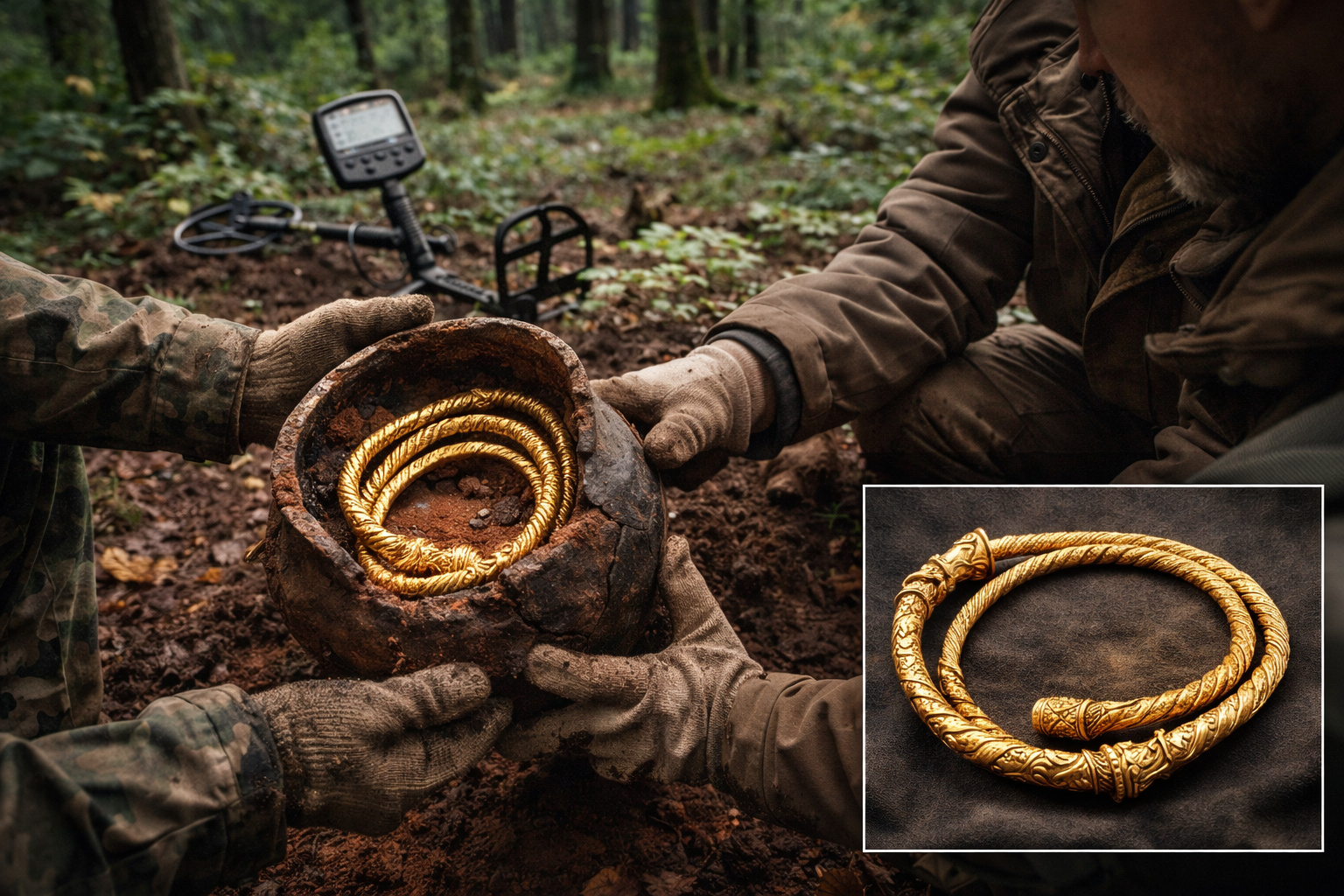
Detectorists find buried pot with a 222 g gold necklace in Poland; rare piece identified as the first Gothic torque ever recorded in the country.
In the summer of 2025, a group of amateur archaeologists called DENAR Kalisz was exploring the Grodziec Forest, near the city of Kalisz in central Poland, in cooperation with the Provincial Office for Environmental Protection. In five weeks, they found not one, but three buried treasures in ceramic pots — each from a different period, each with different contents. The third pot held something no one expected: a glimmer of yellow gold around the neck of the pot, partially visible in the compacted soil. According to Ancient Origins, Heritage Daily, and Arkeonews, what appeared to be a piece of bracelet was actually a complete necklace of nearly pure gold, weighing 222 grams, carefully folded and curved to fit inside the pot — a piece from the 5th century linked to the Goths, the Germanic people who shook Europe during the Migration Period.
The first treasure: the warrior’s tomb
The story begins in early June 2025, when the DENAR Kalisz group started its exploration in the Grodziec Forest, in the Zbiersk district. The first finds came from a Roman-period cemetery linked to the Przeworsk culture — a group that inhabited the region of present-day Poland between the 2nd century BC and the 5th century AD. Among the graves, one stood out: the tomb of a warrior, buried with the tip of his spear and the umbo of his shield.

The Przeworsk culture is known for its burials with weapons — a tradition that reflects the importance of military status in society. The presence of a warrior’s tomb at the site indicated to researchers that the area had significant historical relevance. But what came next made this first discovery seem like a warm-up.
-
Millions of people have been eating pomegranates for centuries without knowing that this ancient fruit contains punicalagins, which scientists are studying for their possible effects on memory and vascular health.

-
Argentina patrols the South Atlantic with ships built in France and monitors over 1.1 million km² with 87 m OPVs, a range of 7,500 miles, 360° radar, and a 30 mm cannon against illegal fishing in the 200-mile zone.

-
U.S. gardeners are starting to replace a historic item with a lighter, quieter battery model that doesn’t require fuel mixing.

-
Researchers from UFJF analyzed an audio tape from 1955 and concluded that Chico Xavier got 88% of the information about 18 deceased people in Portugal whom he had never met, and the international scientific journal Explore has just published the study that is reigniting the debate between science and spirituality 71 years later.

The second treasure: 631 coins in a sealed pot
Days after the warrior’s tomb, the group found an 11th-century coin and, next to it, a small ceramic pot decorated with grooves. The pot was sealed with earth, making its contents a mystery until it could be opened under controlled conditions at the Kalisz University of Sciences.

Inside: 631 coins and fragments. The loose coin found next to the pot had been, in fact, a sign that there was hidden wealth nearby. Two weeks later, another ceramic pot was unearthed with another collection of coins. In five weeks, the group had found three distinct treasures — from three different historical periods — in the same stretch of forest. And the third pot had yet to be opened.
The glimmer of gold around the neck of the pot
The third pot appeared at the end of July. Mateusz Lachowicz, a member of DENAR Kalisz, found it on August 7, 2025. In the compacted soil inside the pot, something was shining: a curved piece of yellow metal, partially visible. The first assumption was that it was a fragment of a bracelet.

But when the pot was taken for analysis, an X-ray revealed something much more impressive: it was not a bracelet. It was a complete necklace — a torque, a type of rigid necklace used in antiquity — with a hook and loop fastening mechanism, entirely made of gold, weighing 222 grams.
It had been deliberately folded and curved — “like a pretzel,” described the blog The History Blog — to fit inside the small ceramic pot. Someone, over 1,500 years ago, had hidden a treasure of pure gold in a clay pot and buried it in a forest.
The nearly pure gold of the Goths
The bright yellow color of the torque indicated to experts that it was made of high-purity gold — possibly nearly pure gold, with no significant alloys of silver or copper. The weight of 222 grams is extraordinary: for comparison, a modern wedding ring typically weighs between 3 and 7 grams. The torque weighs the equivalent of 30 to 70 gold rings.
Experts believe the piece is linked to the Goths — a Germanic people who inhabited parts of present-day Poland during the Migration Period, the tumultuous era between the 4th and 6th centuries when various peoples crossed Europe, establishing new kingdoms and toppling others. The Goths had already settled in the Lower Vistula region, including the Tuchola Forest and the Krajna region, and had interactions with local Slavic cultures.

The first Gothic torque in Poland
The find is unprecedented in Polish territory. Similar torques — rigid gold necklaces with hook and loop fastenings — have been found in Scandinavia, some engraved with runic inscriptions. But this is the first example of a Gothic torque discovered in Poland. Researcher Marzena Przybyła, in an article published in 2021 in the journal Wiadomości Archeologiczne, noted that gold ornaments of this type were among the most frequently referenced prestige items in medieval Scandinavian literature.
The Kalisz torque has no inscriptions — which may indicate a different origin within the Gothic tradition or simply reflect regional preferences. But the quality of craftsmanship, the purity of the gold, and the fact that it was carefully hidden in a pot suggest that it belonged to someone of high status — possibly a leader, a noble, or a figure of ritual importance.
The act of hiding
One detail that fascinates archaeologists is the way the torque was stored. Someone in the 5th century took a gold necklace of enormous value, carefully folded it to fit into a small ceramic pot, and buried the pot in the forest. Why?
The practice of hiding valuable objects in times of uncertainty is well documented in archaeology. During the Migration Period, when invasions, wars, and forced displacements were constant, hiding wealth in the ground was a form of protection.

The intention was to return later to recover the treasure. Whoever buried this torque never returned. The reason — death, flight, forgetfulness — has been lost to the centuries. The gold waited 1,500 years until a metal detector beeped in the hand of an amateur archaeologist in a Polish forest.
The gift of the king that no one refused
In the Germanic society of the Migration Period, gold torques were not simply jewelry. They were political instruments. Leaders and kings distributed gold pieces as a demonstration of generosity, reward for loyalty, or sealing of alliances. Receiving a gold torque from a chief meant being under his protection and indebted to him. Refusing was an offense.
TVP World reported that archaeologists believe the torque may have been such a gift — an object that carried both material and symbolic value. If it was given by a Gothic leader to a local ally, the piece connects the Kalisz forest to a network of political relations that extended from Scandinavia to the Black Sea in the 5th century.
Poland that still holds treasures
The leader of DENAR Kalisz, Kurowiak, called the discovery an “archaeological sensation in Poland.” Fox News Digital and Men’s Journal reported that the find attracted attention from national institutions and amateur enthusiasts abroad, including Americans. The torque has been transferred to the Regional Museum of Kalisz, where it will be preserved and eventually displayed to the public.
Poland has a rich tradition of amateur archaeology, and the country’s laws encourage cooperation between seekers and authorities — finds must be reported and handed over to museums, ensuring preservation and documentation. DENAR Kalisz followed the protocol strictly, which ensured that the torque reached specialists in ideal conditions for analysis.
Trade routes written in gold
The significance of the torque goes beyond its material value. Pieces like this — high-purity gold, sophisticated manufacturing technique, design consistent with Scandinavian traditions — map trade routes and cultural exchanges that connected the Baltic to the heart of Europe in the first millennium.
The Goths, who had migrated from southern Scandinavia to the Vistula region before spreading throughout the Mediterranean, brought with them metallurgical techniques, artistic traditions, and trade networks that left material marks along the way.

The Kalisz torque is one of those marks — a physical data point in a network of connections that historians reconstruct from fragments. Each piece found adds a node to the network and changes the map of who was connected to whom, where, and when.
The Goths who changed Europe
For the reader who associates “Goths” only with cathedrals or an urban subculture, it is worth taking a step back: the Goths were one of the most consequential peoples in European history. Originating from Scandinavia, they migrated to present-day southern Poland and Ukraine in the early centuries of the Christian era. They split into Ostrogoths and Visigoths — the former conquered Italy and the latter sacked Rome in 410 AD and later founded a kingdom in Spain that lasted three centuries.
The Kalisz torque belongs to the earlier phase of this dispersion — when Gothic communities still inhabited the Vistula region and interacted with local populations. The piece is material evidence of this coexistence: an object of Scandinavian tradition found in Slavic culture territory, buried during a time when all of Europe was in motion. The torque is not just a piece of jewelry — it is a testament to a world in transition.
The X-ray that changed everything
The decisive moment of the discovery was not the find in the ground — it was the X-ray in the laboratory. When Lachowicz unearthed the pot and saw the curve of yellow metal, the team assumed it was a fragmented bracelet. If they had tried to unfold the piece manually in the field, they could have damaged it. Instead, they took the intact pot for controlled analysis at the Kalisz University of Sciences.
The X-ray revealed the complete shape of the torque — folded in tight curves inside the pot, with the hook and loop fastening mechanism visible in the image. The decision not to touch the piece before analysis was what preserved the integrity of the find. It is a reminder that, in archaeology, the discipline of doing nothing — resisting the temptation to pull, open, unfold — is often the most important act.
The forest that has not finished telling
The Grodziec Forest yielded three treasures in five weeks — a Roman-period warrior’s tomb, 631 medieval coins, and a pure gold Gothic torque. The periods covered range from the 2nd century to the 11th century — almost a thousand years of history buried in the same stretch of forest. The likelihood that there is more is high. Forests in Central Europe are known for preserving artifacts because the forest soil — acidic, covered with leaves, and little disturbed by agriculture — acts as a natural time capsule.
DENAR Kalisz plans to continue exploring. And somewhere in the Grodziec Forest, under leaves, roots, and centuries of silence, there may be another ceramic pot with something shining inside — waiting for the right hands and the right beep from a metal detector to return to the world after 1,500 years in the dark.







Seja o primeiro a reagir!