





 Portuguese
  English
  Spanish
  3 min of reading


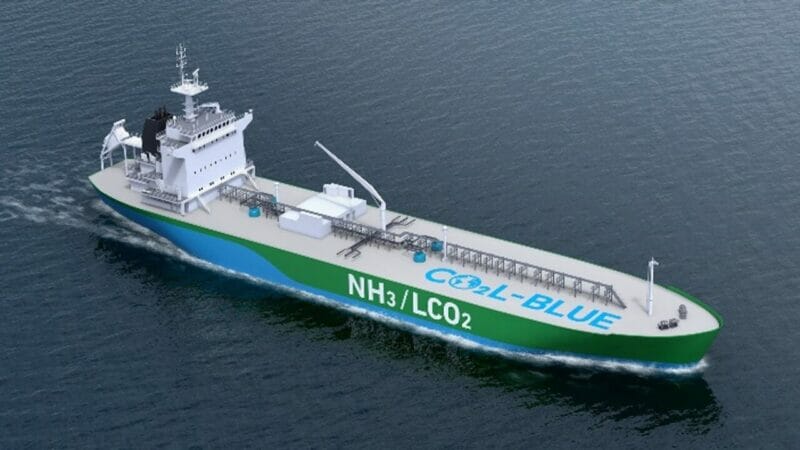
Policies And Incentives From Various Countries Highlight The Growth Perspective In The Use Of This Sustainable Fuel. The Production Of Blue Ammonia Is Expected To Grow Strongly In The Maritime Industry In The Race For Decarbonization.
Blue ammonia emerges as a promising fuel for the maritime industry, as highlighted by the Maersk Mc-Kinney Moller Center for Zero Carbon Shipping this Monday, (08/28). The company’s report forecasts significant availability by 2027 and a potential increase in fuel production. Its rapid expansion utilizing existing technologies and favorable production costs makes it attractive, especially amid the industry’s decarbonization efforts until 2050. Existing and developing technological capacity promises to overcome challenges presented by other alternative fuels in the sector.
Blue Ammonia Gains Spotlight In The Race For Decarbonization In The Global Maritime Industry
The search for more sustainable fuels drives the growing attention to blue ammonia in the maritime industry.
An optimistic forecast suggests that by 2027, this promising fuel alternative could be available in considerable quantities, potentially triggering a significant increase in production in the subsequent years.
-
OceanPact Announces Acquisition of CBO and Creates One of Brazil’s Largest Maritime Support Structures with 73 Vessels, Annual Revenue Above R$ 4 Billion and R$ 14 Billion Backlog
-
With Extreme Winds, Giant Waves, and Unrestricted Currents, Drake Passage Is Considered the Most Violent Stretch of the Oceans

-
15th Century Merchant Ship Surprises Archaeologists

-
Odfjell Inaugurates First Operational Green Corridor Between Brazil and Europe Using Sustainable B24 on Maritime Routes and Reinforces Decarbonization Strategy

These prospects align with the findings of a recent report from the Maersk Mc-Kinney Moller Center for Zero Carbon Shipping.
The attraction to blue ammonia, according to the study, is justified by its rapid expansion capacity, utilizing existing technologies, as well as lower production costs compared to other low-emission fuels.
As the maritime industry approaches the crucial milestone of 2030 in its decarbonization journey towards 2050, it becomes essential for the sector to prepare for adopting low-emission fuels in its operations.
According to the company’s report, the use of blue ammonia has the potential to overcome the limitations faced by alternative fuels, reducing risks associated with investments in onboard technology.
Technological maturity in the production of this fuel is evident, with conventional ammonia and high-capacity blue ammonia plants already in operation or in development.
The expectation is for significant expansion in blue ammonia production capacity over the next 5 to 10 years.
Tax incentives and investments in projects in major maritime industry countries reinforce the expectations of the report.
Production Growth Still Faces Challenges In The Maritime Industry
The viability of blue ammonia as a lower cost and rapidly scalable fuel is clear, especially if ships are built with the capacity to utilize it as a propellant, as indicated by the report from the Maersk Mc-Kinney Moller Center for Zero Carbon Shipping.
This fuel is derived from natural gas and incorporates carbon capture and storage (CCS) steps, highlighting its sustainable and environmentally friendly nature.
However, the availability of carbon storage needs to increase substantially to make large-scale blue ammonia production feasible, essential for decarbonizing the maritime industry.
To achieve decarbonization goals, millions of tons of blue ammonia and CO2 storage will be needed.
The report emphasizes optimism regarding global growth in CO2 transport and storage capacity.
Now, various countries are emerging as key players in large-scale blue ammonia production, establishing policies and incentives to support this transition.
Regions such as North America, the Arabian Gulf, Norway, Australia, and Southeast Asia are at the forefront of this movement. Ongoing projects indicate a gradual increase in the availability of blue ammonia in the coming years.
“Therefore, the shipping industry will need to demonstrate concrete measures to adopt ammonia as fuel to encourage new investment decisions in blue fuel production,” the report emphasized.









Seja o primeiro a reagir!