





 Portuguese
  English
  Spanish
  5 min of reading
  0 comments


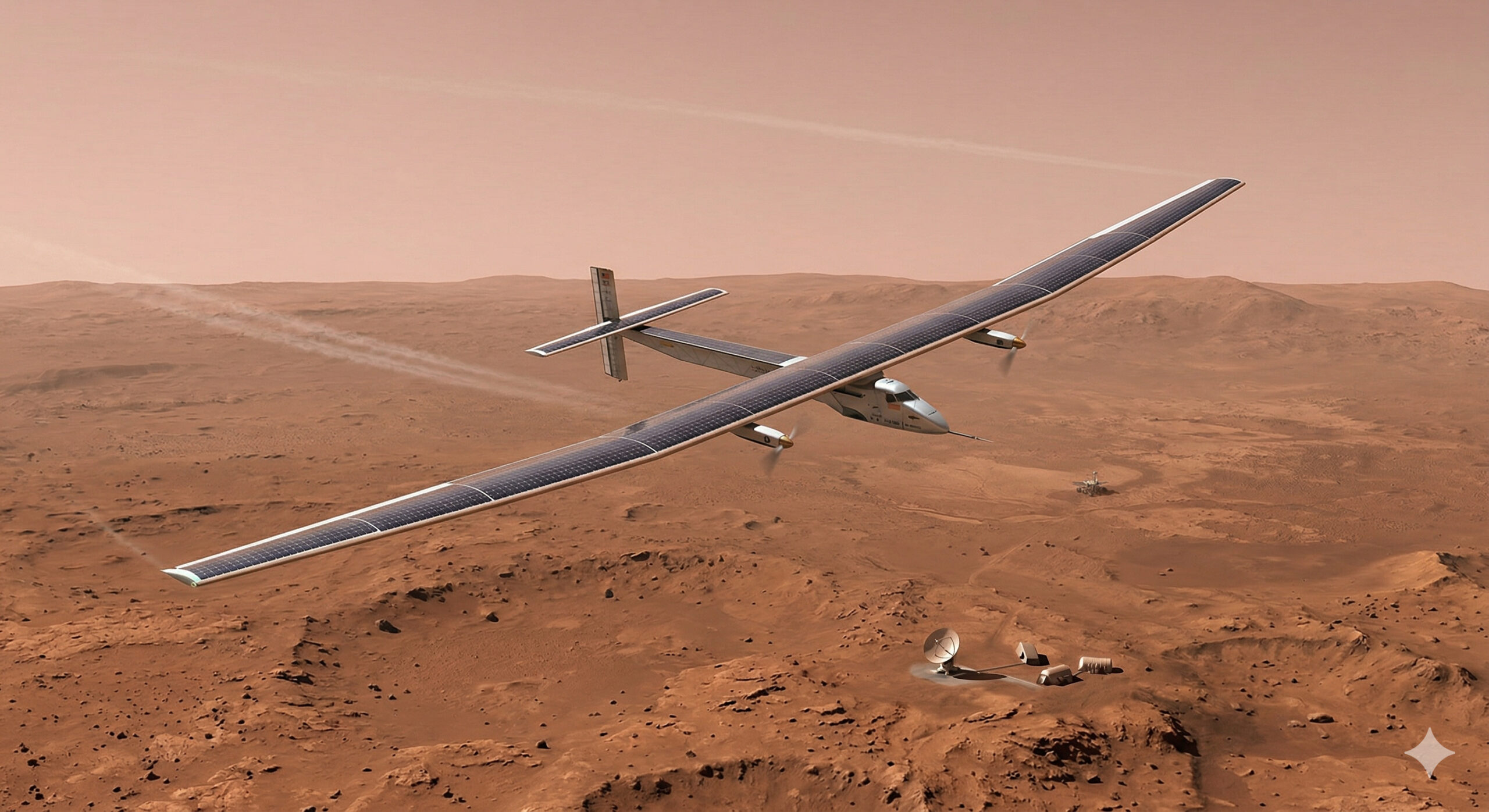
Solar plane MAGGIE can fly on Mars at 300 km/h and 1,000 m altitude, covering 16 thousand km and surpassing the Ingenuity helicopter
After nearly three decades of Mars exploration by NASA robots, a new concept could completely transform the way the planet is studied. According to a study from the University of Miami selected by the NIAC program in 2024, the solar plane MAGGIE promises to cover up to 16,048 kilometers in a Martian year, flying at 1,000 meters altitude and 300 km/h. The project arises after the limits observed in previous missions, such as the rovers Sojourner, Spirit, Opportunity, Curiosity, and Perseverance, in addition to the Ingenuity helicopter, which traveled only 18 kilometers in three years before suffering a rotor failure in 2024. MAGGIE represents a leap in scale, moving from point exploration to global coverage of the planet.
Limitations of rovers on Mars prevent global surface exploration
In nearly 30 years of sending robots to Mars, NASA’s rovers have explored only extremely limited areas of the surface. Curiosity has traveled about 32 kilometers since 2012, while Perseverance has advanced less than 30 kilometers since 2021.
This slow pace prevents large-scale investigations, such as global atmospheric analysis, methane tracking, and magnetic mapping. Orbital satellites can achieve broad coverage but with low resolution. Rovers provide local precision but lack sufficient mobility.
-
A new phenomenon of contactless magnetic friction intrigues scientists and questions a theory that has been valid since the 17th century.

-
An impressive phenomenon in Northern Brazil causes rivers of different colors to flow side by side, revealing secrets about sediments, currents, and biodiversity.

-
While many schools are still struggling with the basics, a teacher in China went viral for having elementary school students build a two-stage rocket using plastic bottles, water, and pressurized air in a science class that caught the attention of the entire world.

-
10 million robots per year in unprecedented industrial scale place China at the forefront of automated production and raise the question of how far machines can manufacture other machines.


MAGGIE emerges precisely to fill this gap between global scale and detailed analysis, combining aerial mobility with advanced scientific capability.
Ingenuity helicopter proved that flight on Mars is possible, but with limitations
The Ingenuity helicopter was the first vehicle to fly on another planet, operating in an atmosphere with only 1% of Earth’s density. Over 72 flights, it traveled about 18 kilometers before suffering rotor damage in January 2024.
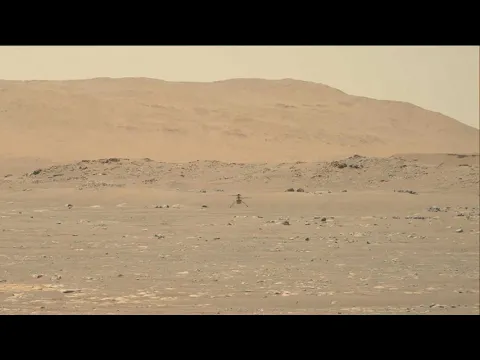

The experiment proved that flight on Mars is viable, but also highlighted critical limitations in range, payload, and autonomy. These factors restrict the use of helicopters for large-scale scientific exploration.
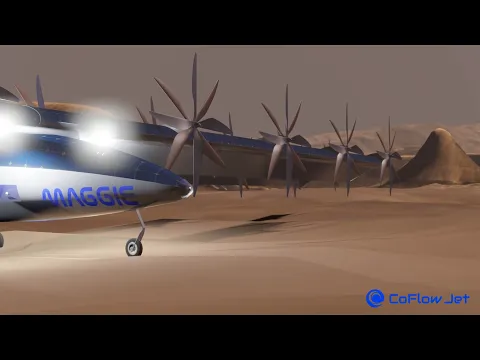
Flying on Mars is an extreme challenge due to the low atmospheric density. To overcome this obstacle, MAGGIE utilizes CoFlow Jet technology, based on micro-compressors embedded in the wings.
These devices suck in, pressurize, and expel air at high speed, significantly increasing lift. The system allows for a lift coefficient of 3.5, nearly ten times greater than conventional aircraft on Earth.
This innovation makes it possible to maintain stable flight in an environment where traditional aircraft would not even be able to take off.
MAGGIE’s vertical takeoff allows operation without runways in any region of Mars
One of the most relevant features of MAGGIE is its ability to take off and land vertically. The system combines micro-compressors with 14 rotors to generate enough thrust to leave the ground without a runway.

After takeoff, the aircraft transitions to fixed-wing flight, optimizing energy efficiency. Landing occurs in reverse, allowing for landing on any type of terrain, including craters, slopes, and plains.
This capability drastically expands scientific reach, allowing access to regions inaccessible to rovers.
Solar plane with 8 meters wingspan can fly for days using solar energy
MAGGIE has a wingspan of 8 meters and uses solar panels across the upper surface of the wings. The energy generated powers electric motors, micro-compressors, and onboard systems.
With a charged battery, the aircraft can operate for up to 7.6 consecutive Martian days, covering about 179 kilometers per charge. Over a Martian year, the projected total distance is 16,048 kilometers. This range is hundreds of times greater than any vehicle ever operated on Mars.
The mission plan includes three main investigations. The first is measuring methane in the atmosphere, the origin of which is still unknown. On Earth, this gas is strongly associated with biological activity.
The second investigation involves mapping Mars’ residual magnetic field, which exhibits fragmented characteristics. The third seeks to identify subsurface water ice at mid-latitudes. All these analyses require global coverage, something impossible with current surface technologies.
Methane on Mars may indicate geological or biological activity
The methane detected by the Curiosity rover shows variations throughout the day and seasons. Hypotheses include geological processes or possible forms of subsurface microbial life.
The challenge is to locate the source of these emissions. MAGGIE, with high-resolution sensors and aerial mobility, can trace methane plumes back to their source. If the origin is biological, the discovery would have historic implications for science.
The project has been selected for Phase 1 of the NIAC program, receiving funding of up to $175,000 for initial feasibility studies.
If it advances, it could proceed to additional development phases, including prototypes and testing in simulated environments. The path to a real mission is still long, but the NIAC program has already enabled technologies used in previous missions. The funding indicates that the concept is considered technically promising by NASA.
Fixed-wing airplane on Mars can surpass helicopters in efficiency and range
Unlike helicopters, fixed-wing aircraft use aerodynamic lift during flight, reducing energy consumption. This allows for much greater distances to be covered with the same amount of energy.
This efficiency explains why MAGGIE can reach 16 thousand kilometers while Ingenuity traveled only 18 kilometers. The paradigm shift transforms Mars exploration from local to global.
MAGGIE can land, collect data, and take off again on Mars
The project combines aerial and terrestrial capabilities. MAGGIE can identify regions of interest during flight, land, collect data, and take off again.
This versatility allows for detailed analyses without the mobility limitations of rovers. The system acts as a hybrid explorer, integrating aerial observation and ground data collection. This operational duality significantly enhances the scientific potential of the mission.
The CoFlow Jet technology also has applications on Earth, especially in the development of electric vertical takeoff aircraft, known as eVTOL.
These aircraft are considered key for urban air mobility. The aerodynamic efficiency developed for Mars could make these systems more viable and efficient. This is a classic example of space technology having a direct impact on terrestrial applications.






Seja o primeiro a reagir!