





 Portuguese
  English
  Spanish
 4 min of reading


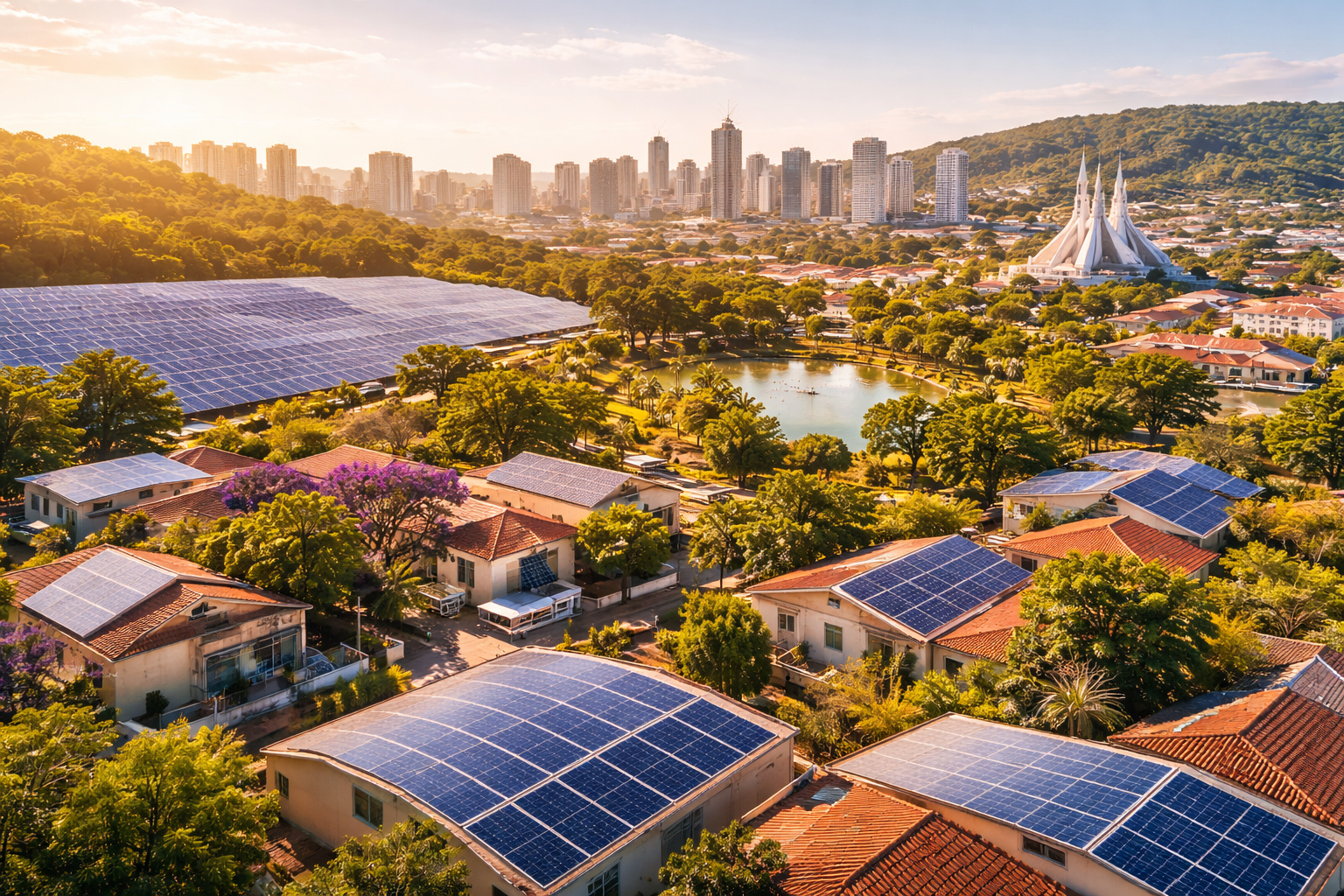
The expansion of sustainable energy has gained momentum in Brazil, and in this scenario, Anápolis, in Goiás, has stood out based on innovation, planning, and clean technology. The city now ranks among the urban municipalities that are growing the fastest in the use of solar energy, according to data from ABSOLAR, which places it as a national reference in the transition to renewable sources.
This advancement does not happen by chance. The city invested in infrastructure and training, allowing residents, businesses, and public institutions to adopt solar generation at an accelerated pace. Thus, Anápolis reduced costs, increased local autonomy, and favored a more modern model of development.
How Sustainable Energy Is Already Changing the Municipality’s Routine
As new photovoltaic systems come online, the city observes immediate economic gains. First, families and businesses pay less for electricity, freeing up resources that can be allocated to consumption or new investments. Moreover, schools, shops, and clinics have begun to produce part of their own energy, which strengthens their budgets.
-
ANEEL confirms green flag in April and Brazilians save up to R$ 23.61 per month on their electricity bill, but the second half of the year is already concerning with reservoirs below 28% in the southern part of the country.

-
Big techs plan US$ 635 billion in AI data centers by 2026, but the crisis in the Middle East threatens investments, and Brazil is betting on natural gas to attract megacomplexes of up to 1,500 MW in Rio de Janeiro, Rio Grande do Sul, and Paraná.

-
Sustainable progress in the Southeast: ARSESP opens public consultation for biomethane and accelerates decarbonization projects of the energy matrix in São Paulo.
-
The end of an era? Brazil and global powers accelerate investments in technology and infrastructure to solidify the transition away from fossil fuels.

As a direct result, Anápolis shows a decline in dependence on energy coming exclusively from the grid. This makes the municipality more resilient to water crises, tariff flags, and cost fluctuations. Therefore, the sustainable energy model ceases to be merely an environmental choice and becomes an efficient economic strategy.
The Data That Proves Growth
The numbers released by ABSOLAR show why Anápolis reached a leadership position in the Midwest. As the state of Goiás hit new records in urban solar generation, the city contributed significantly to this growth. Homes, businesses, and industries increased their adoption of photovoltaic systems, while the public sector invested in its own projects.
Additionally, local installers, manufacturers, and suppliers found opportunities to operate. As a result, new businesses emerged, and the municipal economy gained dynamism in areas related to sustainable energy.
Environmental, Economic, and Social Benefits
The sustainable impact is broad. While each solar system installed reduces carbon emissions and decreases the need to activate thermoelectric plants, the municipality also preserves water resources and reduces pressures on the transmission grid. Consequently, air quality improves, and fossil fuel consumption declines.
On the other hand, the job market gains strength. As the city grows in solar generation, the demand for skilled professionals increases, attracting students, technicians, and engineers seeking opportunities more aligned with the country’s energy future.
Furthermore, sustainable energy encourages conscious consumption. Communities and businesses start to monitor their own production and adopt more efficient practices, which amplifies the positive effects for the city as a whole.
Innovation and Science Drive Anápolis
Another differentiator lies in investment in training. Educational institutions, training centers, and specialized companies are already training professionals for the sector. As a result, Anápolis becomes an expanding technological hub within the state.
This structure, in turn, attracts more enterprises, generating a continuous cycle of innovation. Thus, sustainable energy not only powers rooftops and solar plants but also energizes laboratories, startups, and new productive arrangements.
Sustainable Energy as a Direction for the Future
The case of Anápolis shows that the energy transition is feasible when there is planning. As technology becomes more accessible and financing expands, the trend is that solar energy will grow even more, especially among consumers seeking predictability in their bills.
Experts point out that shared systems, solar cooperatives, and micro plants are expected to gain strength in the coming years. In this way, the city can occupy an even more central role in the national energy map.
What started as an alternative to reduce expenses is now consolidating as a permanent model of urban development. Therefore, the advancement of sustainable energy in Anápolis highlights how local policies and private decisions help to transform the Brazilian energy matrix.
The data that highlight Anápolis as a regional leader originate from analyses by ABSOLAR, which monitors the evolution of distributed solar energy in the country. Information from municipal public sector also confirms the increase in installed capacity and the positive effects for consumers and businesses.
Therefore, Anápolis’ example proves that the consistent adoption of sustainable energy builds more prosperous, more efficient cities, and prepares them for the climatic and economic challenges of the future.









Seja o primeiro a reagir!