





 Portuguese
  English
  Spanish
  5 min of reading
  0 comments


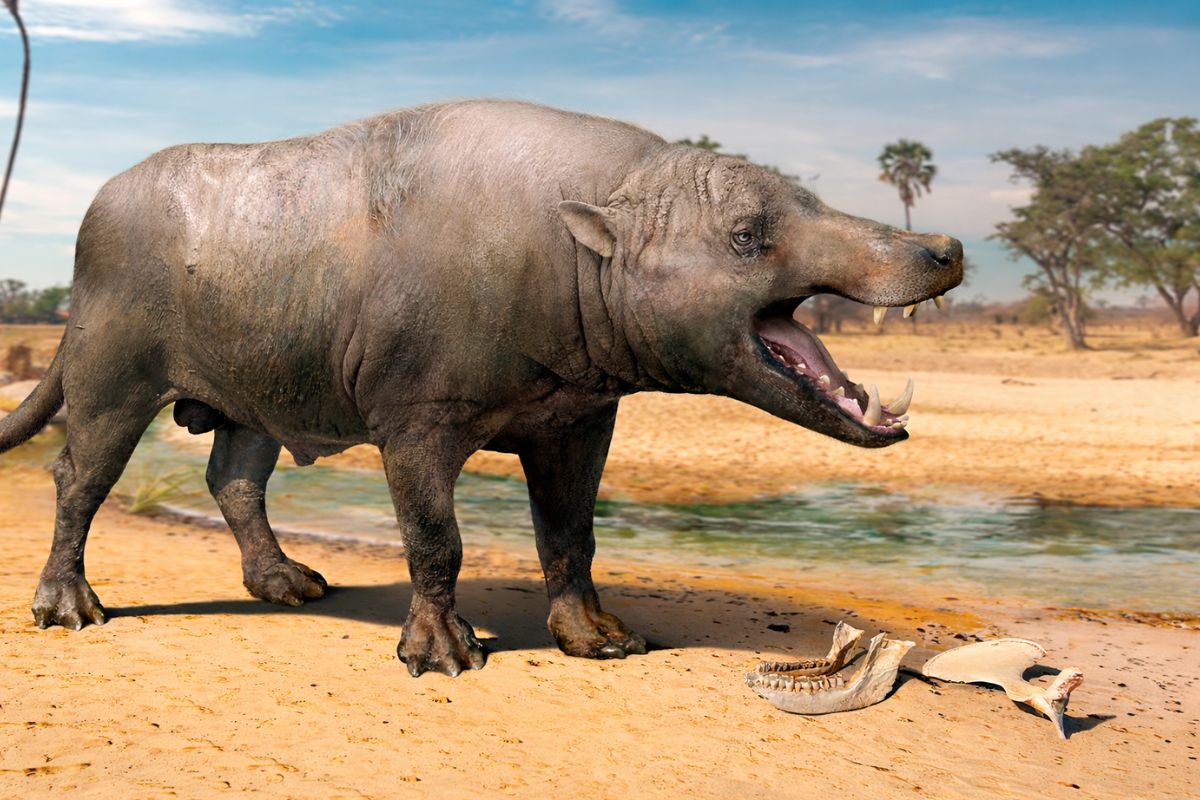
One-Meter Skull, Giant Teeth, and a Single Fossil Make Andrewsarchus the Beast of the Eocene, a Carnivorous Artiodactyl Linked to the Lineage of Modern Whales.
For a century, Andrewsarchus has been at the center of one of paleontology’s greatest puzzles. Known only from an incomplete skull found in Inner Mongolia, this Eocene carnivorous mammal was imagined as a monster between a wolf and an elongated pig, capable of being the largest terrestrial mammalian predator that ever existed.
Time and fossils love to debunk certainties. New analyses of the teeth and relationships with other groups revealed that Andrewsarchus was not a “giant wolf,” but likely an artiodactyl, belonging to the same large family that includes hippos and whales themselves. The “beast of the Eocene” may have more in common with cetaceans than with any prehistoric dog.
What Was Andrewsarchus and When Did It Live
Andrewsarchus mongoliensis was an extinct carnivorous mammal that lived in Inner Mongolia during the Eocene epoch, the intermediate period of the Paleogene, shortly after the extinction event that wiped out non-avian dinosaurs.
-
With a cost per shot close to zero, the DragonFire laser could change naval warfare in 2027 and provide British ships with nearly unlimited defense against drones.

-
A British startup creates tires that generate electricity in electric vehicles when passing over potholes, speed bumps, and cracks.

-
Scientists have created robots made with living cells that have their own nervous system, swim on their own, explore the environment, and self-organize without any genetic engineering, and now they want to do the same with human cells.

-
Students create a solar-powered ambulance that operates without a plug, without fuel, and still keeps medical equipment running in remote areas.


The name Eocene comes from the Greek eōs, “dawn.” It was literally the dawn of a new era, in which birds and mammals began to dominate terrestrial ecosystems, occupying niches left vacant by mass extinction.
Between the Paleocene and Oligocene, the first cats, bears, and weasels emerged, large ungulate mammals, and various lineages of modern birds.
At the same time, this era gave rise to mysterious mammals, whose appearance and way of life remain difficult to reconstruct accurately. Andrewsarchus is one of the most extreme cases of this category.
The Discovery of the One-Meter Skull in the Gobi Desert

Andrewsarchus was named in honor of Roy Chapman Andrews, an American explorer and naturalist who led Asian expeditions for the American Museum of Natural History in the 1920s.
These expeditions to the Gobi Desert became famous for discovering the first dinosaur eggs, but they also revealed something just as impressive: an enormous incomplete skull, attributed to Andrewsarchus, found in Inner Mongolia.
This skull measured nearly 1 meter long, had huge teeth in the front region, and exhibited a back arch with flatter molars.
The combination of extreme size and complex dentition fueled the idea that the “giant beast” could have been the largest terrestrial carnivorous mammal ever recorded, with initial estimates of more than 3.5 meters in length, nearly 2 meters in height, and around 1,000 kilograms.
These numbers, however, depend on comparisons with groups that are no longer considered the correct relatives of Andrewsarchus, leaving the actual size of the animal open to question.
The Enigma of the Teeth and Diet
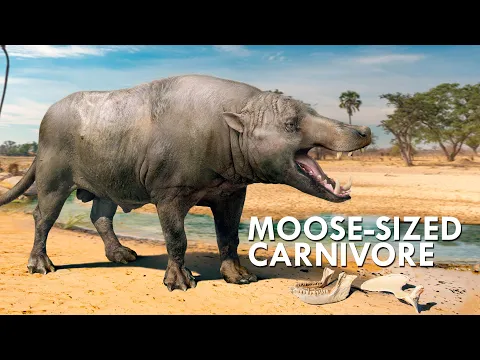

One of the reasons for the fascination with Andrewsarchus is precisely its dentition. The skull shows large canines that appear adapted for grasping, robust cheekbones suggesting a very strong bite, and relatively flat back molars.
This mix of “multi-purpose” teeth has created a 100-year enigma. Without a preserved lower jaw and no additional body bones found, it is difficult to say for certain whether Andrewsarchus was an active predator, a large scavenger specializing in carcasses, or had a more varied diet that mixed bones, meat, and other resources.
It could have attacked other Eocene mammals living in the same region, including small primates and primitive ungulates, and it may have also preyed on larger prey, such as equine ancestors like Hyracotherium that lived in Asia.
Without more fossils, the “beast of the Eocene” remains surrounded by simple but unanswered questions about what it ate, how it hunted, how fast it ran, and how it behaved in life.
From Giant Wolf to Distant Relative of Whales

For a long time, Andrewsarchus was classified as a mesonychid, a group of ancient carnivorous ungulates often described as “wolves with hooves.”
These animals were much smaller, but they served as the basis for extrapolating the size and shape of the “beast” with the giant skull.
Using the nearly one-meter skull and known mesonychid proportions, scientists imagined a long and tall animal, with a body resembling that of a robust giant wolf and possibly the largest terrestrial carnivorous mammal of all time.
Recent studies, however, turned this story upside down.
New evidence showed that mesonychids themselves were probably not the true ancestors of whales, as was believed for a time.
A key bone for this is the astragalus, the ankle bone. True artiodactyls, a group of even-toed ungulates, show a very characteristic double-pulley shaped astragalus, while mesonychids do not have this same anatomy.
Subsequent research connected whales to the lineage of aquatic artiodactyls, a group that today includes hippos, dolphins, and porpoises.
In the case of Andrewsarchus, an important clue came from the back teeth. The mysterious molars were found to be similar to those of entelodonts, an extinct group of artiodactyls that emerged in the late Eocene.
This dental similarity led to a reclassification. Andrewsarchus was removed from the mesonychid group and is now considered an artiodactyl, thus belonging to the same large order that includes modern whales.
Even without being a direct ancestor, Andrewsarchus is now seen as part of the broader lineage that whales are also part of, which completely changes its position in the mammal family tree.
What We Still Don’t Know About Andrewsarchus
Despite the advances, the truth is that we know very little about Andrewsarchus for how much it has been depicted in illustrations and imagined in reconstructions.
Today, the main limitations are clear. There is only one known incomplete skull, no limb or vertebrae bones have been found, we do not have the astragalus that would directly confirm the typical anatomy of artiodactyls, and any estimate of total size, mass, and body shape still depends on indirect comparisons with other groups.
This means that the title of “largest terrestrial carnivorous mammal” remains hypothetical, that much of the imagery circulating is highly speculative reconstructions, and that although the classification as an artiodactyl is currently the most robust hypothesis, it remains open to adjustments as new fossils appear.
It only takes a single more complete skeleton of Andrewsarchus to revise many current certainties, as has happened many times in paleontology in just one century.
A Beast Among Myths, Whales, and Science in Constant Revision
The story of Andrewsarchus is a good reminder of how science works in practice. With a single skull and many fragments of information, paleontologists had to build hypotheses, revise classifications, and abandon seductive ideas, such as that of the “giant wolf ancestor of whales.”
Today, what was once seen as a super predator mesonychid fits better as an enigmatic artiodactyl, distantly related in the same large order to modern whales.
The “beast of the Eocene” remains immense and mysterious, but now connected to a lineage that led to some of the most impressive animals that exist, the cetaceans.
And you, if a nearly complete skeleton of Andrewsarchus is ever discovered, do you think it will resemble more a “giant wolf” from older illustrations or a strange terrestrial relative of whales that we still cannot quite imagine?







-

-

-

-

-

-

53 pessoas reagiram a isso.