





 English
  Francês
  Alemão
  Italiano
  Japonês
  Norueguês
  Portuguese
  Spanish
  3 min of reading
  0 comments


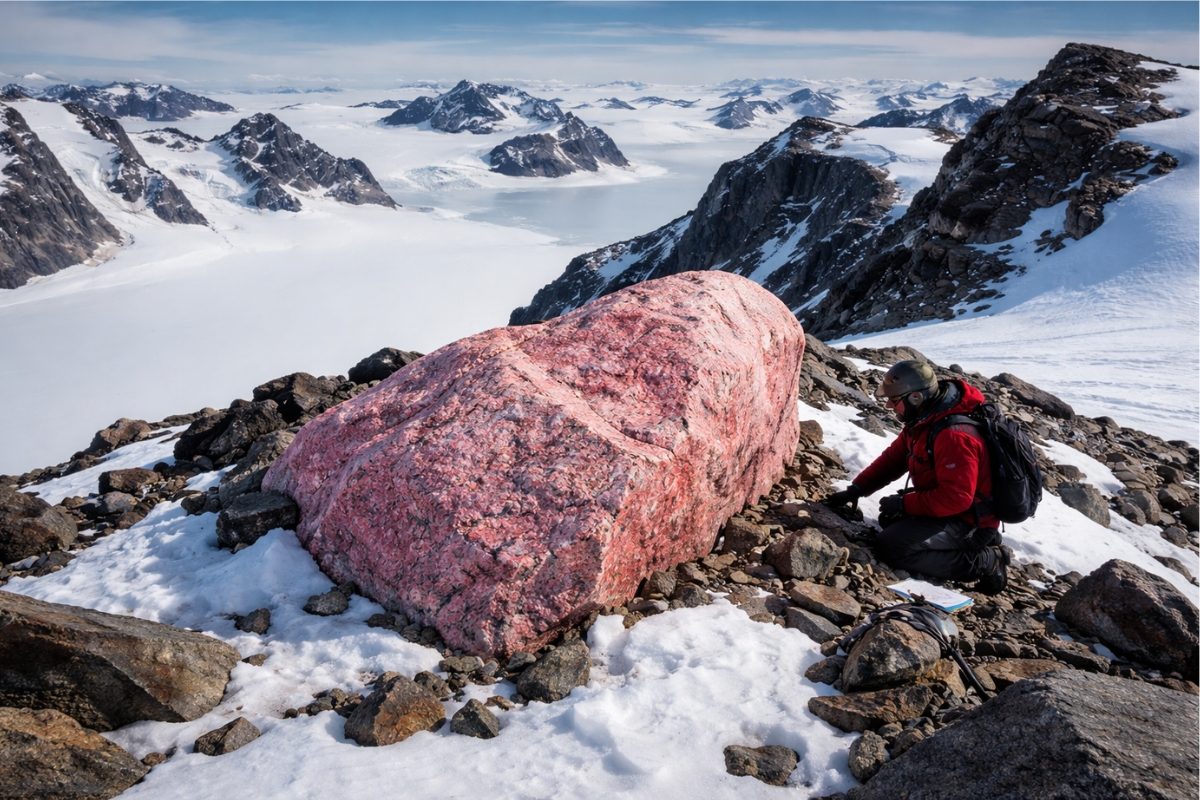
Granite emerges at the top of West Antarctica at 750 meters high, and what seemed impossible is linked to a subterranean mass 100 kilometers wide beneath the Pine Island Glacier
The appearance of large blocks of pink granite at the top of the Hudson Mountains drew attention for a simple reason. They were surrounded by snow, ice, and dark volcanic rocks, in a setting that did not match this type of material.
The discovery gained significance because the fragments were at a 750-meter altitude. This led scientists to investigate not only the origin of the stones but also what this path reveals about the ancient movement of ice in West Antarctica.
Pink blocks appeared in an area dominated by ice and volcanic rock
At first glance, the blocks seemed to have been placed there by chance. The contrast between the pink color of the stones and the surrounding terrain reinforced the idea that something was out of the ordinary in that landscape.
-
Salaries of up to R$ 25,000, a shortage of professionals, and exploding demand in 2026 make the no-code automation specialist one of the most sought-after careers in Brazil, even without requiring a degree or programming knowledge.

-
The first commercial-scale hydrogen-powered brick factory will be established.

-
Goodbye to the noisy exhaust fan: silent and smart technology transforms modern kitchens with more comfort, design, and efficiency in everyday life.

-
At just 14 years old, a boy creates a system without energy, using steel pipes buried in the ground, that irrigates seedlings with moisture from the air, to combat the water scarcity threatening reforestation in northern China.


As the analysis progressed, it became clear that the case did not involve an isolated event. The rocks began to be treated as clues to a much older and deeper geological story.

Dating indicated origin in the Jurassic period about 175 million years ago
The team analyzed minerals present in the fragments and used radioactive decay to estimate when this material formed. The result indicated an age of about 175 million years.
This data helped link the stones seen on the surface to a much older source, now hidden beneath the ice sheet. From this point, the focus shifted from what was exposed to the frozen underground.
Gravity anomaly indicated mass buried beneath the Pine Island Glacier
Scientific flights over the southern Hudson Mountains detected small variations in the region’s gravity. This type of difference usually indicates that there is a significant rocky mass hidden below the surface.
According to Nature Communications Earth & Environment, an international scientific journal on environmental and terrestrial research, the structure may be about 100 kilometers wide and seven kilometers thick beneath the Pine Island Glacier.
Ice movement brought the rocks to higher areas
The most accepted explanation is that the blocks were transported by the ice itself over time. In simple terms, the glacier acted as a force capable of tearing, carrying, and repositioning these rocks over great distances.
Although it is more common for material to descend slopes, changes in the shape of the ice and the direction of flow can also push blocks upward. This helps to understand why these stones appeared at such high points.
Rocks became valuable clues about the past of the ice sheet
Each block holds marks of erosion, transport, and deposition. In practice, this transforms these stones into a natural record of the behavior of ice over immense periods.
In a region where much of the terrain remains inaccessible, this type of evidence gains extra value. What is preserved on the surface helps reconstruct processes that occurred far below the ice.
Finding reinforces reading on future changes in West Antarctica
The identification of the origin of these rocks also has effects beyond the field of geology. Understanding how the ice sheet moved in the past improves the reading of how it may react to upcoming environmental changes.
This type of information is particularly significant when the topic involves rising sea levels. What today seems like a detail in isolated stones may influence how the risk to coastal areas is observed.
The finding connects a set of pink blocks to a giant hidden beneath the ice and enhances the scientific value of signals that previously seemed disconnected. More than geological curiosity, the discovery helps decipher the dynamics of one of the planet’s most sensitive areas.
By showing that ice was capable of moving ancient rocks to the tops of mountains, the study reinforces that Antarctica still holds little-known structures. This changes the strategic reading of the region.








Seja o primeiro a reagir!