





 Portuguese
  English
  Spanish
  4 min of reading
  1 comment


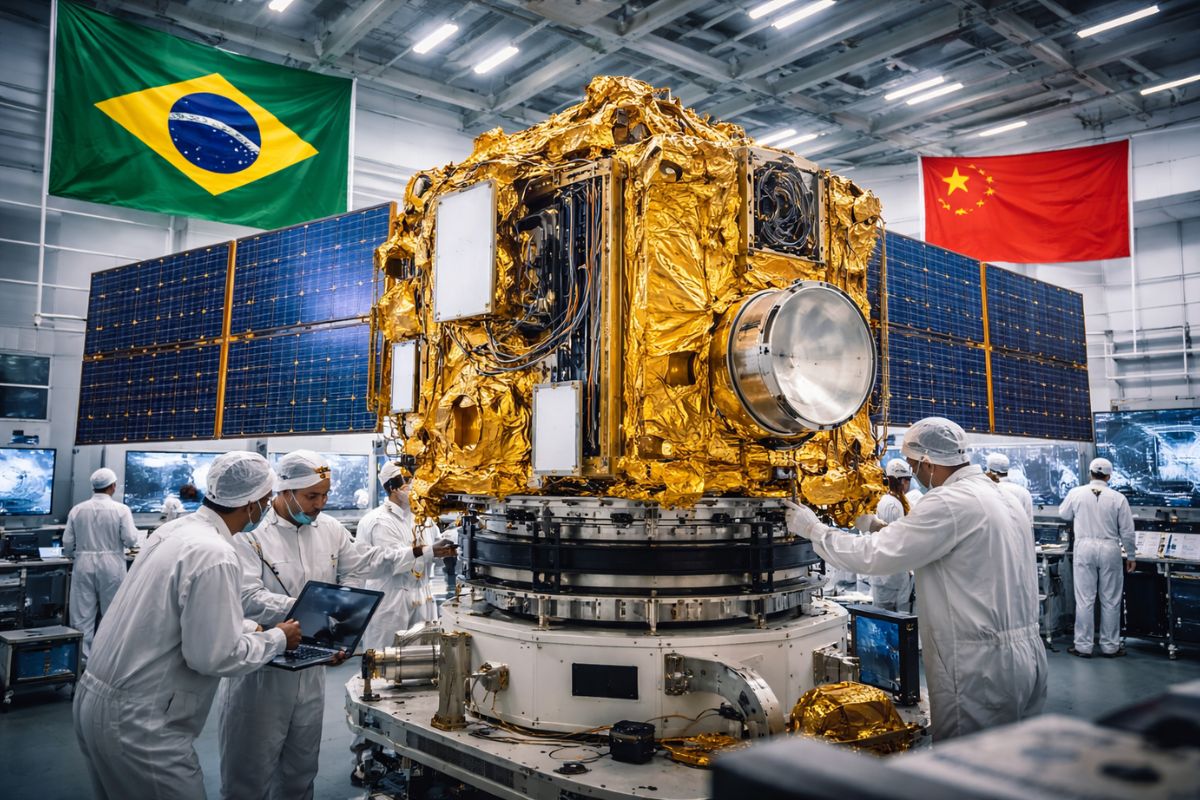


In The 1980s, China Sought Scientists Trained in Brazil With NASA Experience, Signed an Agreement in 1984, and Paved The Way for The CBERS Program. The First Satellite Was Launched in 1999. In 2025, The Partnership Reemerges, But Technological Power Has Already Shifted Sides in The Battle for Data and Orbit.
China is now a leading player in a new space race and competes directly with the United States on several fronts. What rarely enters the discussion is that, while still structuring its program, China came to Brazil to learn from researchers who had interned at NASA.
The initial link took institutional shape in 1984, with the signing of a Scientific and Technological Cooperation Agreement. From then on, Brazil and China created a technical exchange mechanism that would become a reference for South-South cooperation and put the satellite at the center of a data strategy.
The Starting Point in The 1980s

The movement began with visits from Chinese scientists to Brazil at a time when China was still consolidating the industrial and academic foundations of its program.
-
The heatwave in Brazil that hit in March is set to end as a cold front arrives between Good Friday and Easter Sunday, causing a temperature drop of up to 6 degrees and rain in the Central-South region, according to the Easter weather forecast.

-
The U.S. Army has introduced its first new lethal grenade since the Vietnam War: the M111 kills using pressure shock waves that bounce off walls and can explode the enemy’s lungs without producing a single shard.

-
Engineers are replacing pressure valves with hydraulic microturbines within drinking water networks and are generating up to 1,100 MWh per year with in-pipe hydropower technology that harnesses energy previously wasted in urban pipelines.

-
Elon Musk focused on Brazil and lowered the price of Starlink, his internet service, but the question remains: is it worth it? An expert provides a detailed analysis of the internet that promises to connect any part of Brazil.


The attraction was the knowledge accumulated by Brazilian researchers with experience at NASA, capable of translating engineering routines, testing protocols, and system integration logic.
This type of transfer is less about secrets and more about methodology.
When a program is still young, learning to organize the team, schedule, and validation cuts down years of trial and error.
In this case, the 1984 agreement served as a political milestone to unlock cooperations and prepare the groundwork for the CBERS program.
CBERS and The Satellite as Data Infrastructure

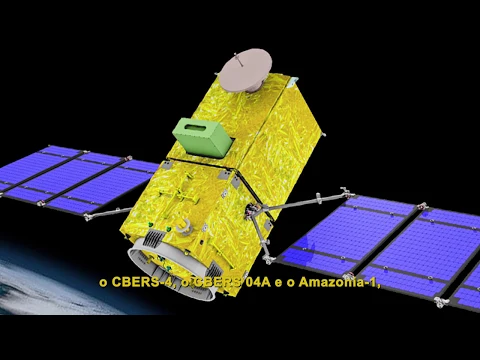
The best-known milestone of this cooperation is the CBERS program, which stands for China-Brazil Earth Resources Satellite.
After a little over a decade of joint work, the first satellite was successfully launched in 1999 from China, consolidating a minimal chain of design, construction, and testing within the program.
In practice, the CBERS satellite became infrastructure.
This type of satellite is used for monitoring deforestation in the Amazon, weather forecasting, and supporting agribusiness.
According to Marco Antonio Chamon, president of the Brazilian Space Agency, in an interview with CNN Brazil, CBERS continues to be a reference for technological cooperation among Global South countries.
Why China Advanced Faster Than Brazil
Since the 1980s, Brazil and China have gone through profound economic transformations, but at different paces.
China has established itself as the second-largest economy in the world, with a GDP of US$ 17.73 trillion in 2021, sustaining fiscal and political space to finance a long-term program.
In Brazil, there was expansion until 2011, followed by a contraction in 2015 and 2016 and another decline in 2020, with recovery in 2021.
In this scenario, experts point out that China prioritized its program and increased investments over the decades.
Budget continuity, rather than a one-time leap, often determines who reaches the finish line first.
The Factor of Domestic Politics and Program Continuity

According to Professor Maurício Santoro, an expert in China-Brazil relations, the Chinese space program gained resources and remained relevant to the government.
He also attributes part of the differential to the ability of Chinese scientists to politically organize within the Chinese Communist Party to ensure continuity and funding.
On the Brazilian side, the program remained relevant but did not reach the same level of technological sophistication.
This does not negate achievements like CBERS, but helps explain why the satellite is both a symbol of partnership and a reminder of growing asymmetry.
When the national strategy shifts priorities, cooperation becomes an exception, not the norm.
The 2025 Laboratory and What Is Still at Stake
Even with this difference in pace, cooperation remains active.
In 2025, Brazil and China announced the construction of a new joint laboratory aimed at developing space technologies, with participation from the Chinese state-owned CETC, and connection to broader scientific initiatives in South America.
The sensitive point is the real objective of this stage.
A laboratory can be a training bridge, but it can also be just a node within a chain already controlled by those who invest more.
The question for Brazil is whether the program becomes a platform for autonomy or if the satellite continues to operate as infrastructure while the decision-making center shifts.
This story suggests that “21st-century technology” is not a single piece, but rather a series of choices: agreement, program, satellite, data, budget, and continuity.
China and Brazil show that the beginning can be shared, but the destination depends on priority and governance.
In your view, what was the most decisive turning point for China to surge ahead and for Brazil to lose momentum in the program: financing, political coordination, focus on data, or the way the CBERS satellite was incorporated into the country’s routine?







Chinês é confiável igual nota de 3